Skip content
Dojo Tutor
Log inTry class

Writing Tutoring

Personalized support from experienced teachers, with the flexibility of learning online.

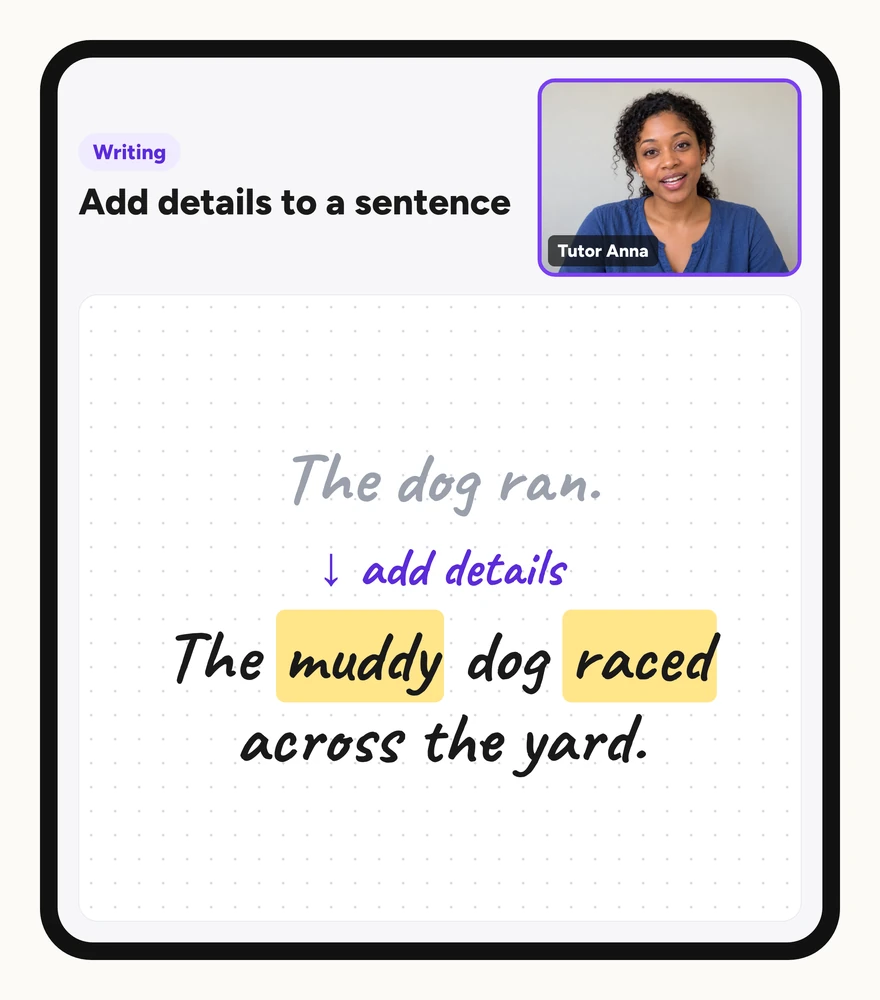
Illustration of an online writing lesson: a tutor on video and a whiteboard revising “The dog ran.” into a more detailed sentence.

She makes writing fun and encourages her to be creative — Kristen S, Writing Tutoring

Try a class

Top Writing Tutors

5 of 240 tutors shown · 5.0 avg rating from 1,274 reviews

Miss Kristin

Certified classroom teacher

Super tutor

5.0

136 ratings

1 years

Experience

Pre-K - 2nd

Available Mon, Tue, Wed, Thu, Sat

My name is Kristin Ritz and I have been teaching since 2011, after receiving my Bachelor's Degree in Early Childhood Education.

Pre-K - 3rd

Available Tue

Can support: ADHD, ESL, Speech

Hi! I’m Ms. Hannah, a proud mom to an energetic 2 year old boy who keeps me on my toes! I love spending time outdoors, going for walks, reading…

Pre-K - 3rd

7 days a week

Hi families! I'm Krystal, and I've worked in Head Start, kindergarten, and completed student teaching in 2nd grade. I love helping students build…

1st - 8th

Available Tue, Wed, Thu

I am a former public school teacher now hybrid school teacher. I homeschooled my 5 children who have gone into fields such as biochemistry, music…

1st - 5th

Available Sun, Mon, Tue, Wed, Thu, Fri

Hello! I am a 20-year veteran in education. In that time, I have worked with kids of all ages, but my preference is elementary-aged students. I've…

What parents are saying about Writing tutoring

We have been working with Hannah for 2 years and my son looks forward to their sessions. She has made great suggestions and has boost my son... ’s writing capabilities.

Jannella - 3rd grade, Writing

I loved her patience and willingness to help my daughter. She sees and understands where I’m coming from as a parent and my concerns for my ... child’s needs.

Martyne - 3rd grade, Writing

Very professional and Ms. Leone poured buckets of confidence into Joda and kept reassuring him he was there for great reasons and he would g... et it. Thank you Ms. Leone !!!!!!

William - 3rd grade, Writing

Writing help that turns ideas into clearer sentences and paragraphs

Writing asks students to make several decisions at once: what to say, how to organize it, which details matter, and how to make the sentences clear. Students may have plenty of ideas but struggle to start, or produce a draft that needs more explanation rather than more words.

Writing tutoring can focus on the next useful decision in the student's own work. That might mean completing a sentence, planning a paragraph, choosing evidence for an answer, or revising a confusing line. Tutors can separate work on ideas from a later pass for grammar, punctuation, and spelling, so students have a clearer purpose for each revision.

Sound familiar?

Why families look for Writing support

The ideas are there, but the page stays blank

Tutors can begin with a spoken explanation, a short list, or a simple organizer. Students can choose one point to develop rather than try to produce a finished paragraph immediately. The plan gives the first sentence a job to do.

The draft needs more than spelling corrections

A sentence can be correctly spelled and still leave the reader unsure what happened or why an idea matters. Tutors can help students add a relevant detail, explain a reason, or rearrange sentences before checking mechanics.

Where students can get stuck in Writing

Writing a phrase instead of a complete thought

Descriptive words alone do not necessarily make a sentence. Tutors can ask what the subject does or what is being said about it, then help students complete the thought. Reading the sentence aloud can reveal information that was clear in the writer's mind but missing on the page.

Adding words without adding useful information

A request for more detail can lead to a longer sentence that says little more. Tutors can ask what the reader needs to know: where an action happens, how something changes, or why a point matters. The purpose is clearer meaning, rather than a larger number of adjectives.

Losing the main point of a paragraph

Students may list facts or move between ideas without explaining their connection. A brief plan can give a paragraph one focus, identify supporting details, and make room for an explanation. Tutors can also ask whether a sentence belongs in that paragraph or needs a different place.

Including evidence without explaining it

A quotation or detail does not automatically show why an answer is convincing. Tutors can ask students to state their point, select relevant evidence, and explain the connection in their own words. The explanation should do more than repeat the evidence.

Applying a grammar rule without checking the sentence

A word's role depends on context. In The gardener plants seeds, plants is a verb; in The plants need water, plants is a noun. Tutors can compare sentences like these so students identify the subject and action before deciding how to edit.

How Writing tutors make the next step clearer

Give a sentence a specific revision goal

Tutors can ask students to improve one feature at a time: complete a thought, choose a more precise verb, or add a detail the reader needs. Students can compare the original and revised sentence and explain what changed. Longer is not automatically better; an unnecessary detail can be removed.

Plan the point, detail, and explanation

A simple organizer can separate the main point from its support. Students can decide what each paragraph should do before drafting full sentences. For a response about a text, the plan might include an answer, a relevant detail, and an explanation of how the detail supports the answer.

  1. State the point the paragraph needs to make.
  2. Choose a detail or piece of evidence that fits.
  3. Explain the connection for the reader.
  4. Reread to check whether every sentence contributes.

Separate revision from a focused editing pass

Revision can change the content or organization: add an explanation, cut repetition, or move a sentence. Editing can then focus on correctness. For example, The rain stopped we went outside can become The rain stopped. We went outside. Tutors can ask students to identify the two complete thoughts and choose a suitable way to separate or join them.

Putting Writing skills into practice

Original exercises that show a specific purpose for planning and revision.

From a general action to a precise description

Start with The gate closed. Try The metal gate clanged shut behind the cyclists. Compare what each sentence tells the reader about the action, sound, and setting. Then remove any detail that does not fit the purpose of the paragraph. Students can explain a revision choice rather than add description automatically.

From quoting a detail to explaining its relevance

Use this original practice text: The reading room has padded seats. A sign asks visitors to speak quietly. Explain why the room could be a comfortable place to read. A response can select padded seats as evidence, then explain how seating relates to comfort. A second detail about quiet can support a different part of the answer.

Inside a 25-minute session

What a Writing tutoring session can look like

This illustrative lesson develops one focused paragraph. The tutor can adapt the task for a short response, an informative paragraph, or part of a longer assignment.

  1. 0–3 min

    Talk through the main idea

    Explain the topic aloud and choose one point for the paragraph. The tutor can check what the reader should understand by the end.

  2. 3–8 min

    Plan the support

    List two relevant details or reasons. Decide which one needs an explanation, and set aside an interesting idea that does not serve this paragraph.

  3. 8–15 min

    Draft with a clear purpose

    Write a starting sentence and develop a supporting detail together. Check whether the explanation connects to the point instead of simply repeating it.

  4. 15–22 min

    Revise one part independently

    Add a missing explanation, replace a vague word, or move a sentence. Students compare the versions and explain how the change helps the reader.

  5. 22–25 min

    Edit and choose the next step

    Make a focused check for sentence endings, capitalization, or another current goal. Recap the revision choice and identify what to continue practicing.

Example timings only. Tutors can change the task, number of sentences, and pace to fit the writer's needs.

Frequently Asked Questions

Terms of servicePrivacy PolicyNotice at Collection

© 2026 ClassDojo. All Rights Reserved.