Skip content
Dojo Tutor
Log inTry class

Science Tutoring

Personalized support from experienced teachers, with the flexibility of learning online.

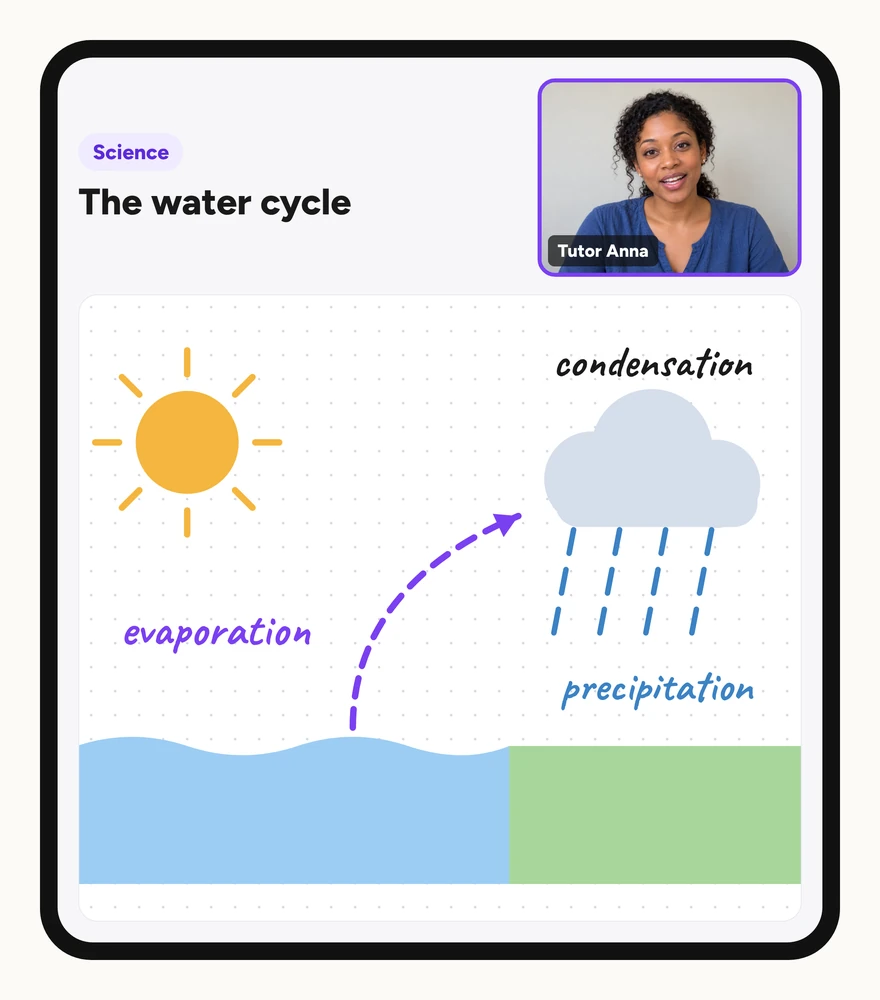
Illustration of an online science lesson: a tutor on video and a whiteboard diagram of the water cycle showing evaporation, condensation, and precipitation.

She used fun examples and made the lesson feel interactive — Lika Y, Science Tutoring

Try a class

Top Science Tutors

5 of 192 tutors shown · 5.0 avg rating from 277 reviews

Pre-K - 5th

Available Mon, Tue, Wed, Thu, Fri

Hi! I’m Miss Hamilton, and I’m passionate about helping students become confident, independent learners. I’m an elementary educator who enjoys…

Ms. Anna

Certified classroom teacher

Super tutor

5.0

82 ratings

24 years

Experience

2nd - 7th

Available Tue, Thu, Fri

Can support: Gifted & talented

Hi! My name is Anna and I am excited to start this learning journey with you! With 24 years of teaching experience under my belt, I have a passion…

2nd - 5th

Available Mon, Tue, Wed, Thu, Fri

Can support: ADHD, ESL, Behavioral

Hi families! My name is Andrea Edwards, and I am a certified teacher with 20 years of classroom and virtual teaching experience. I am passionate…

K - 4th

Available Wed, Fri

I am an early childhood educator who loves to teach young learners how to read. I have a passion for science and math. I want to make learning…

K - 5th

Available Mon, Tue, Wed, Thu, Fri, Sat

I have been teaching elementary school for five years now and absolutely love my job. I have been married for almost 20 years. I am also a mom of…

What parents are saying about Science tutoring

I love that Ms. Vanessa engaged Montrail by asking him what are some of the things that he liked. She allowed him to express his emotions an... d then gave him reassurance. By the end of class, his mood had changed! I like the idea that she asked questions that made him utilize his critical thinking skills! She also gave pointers on things that he can benefit from during the tutoring sessions.

Tyler - 3rd grade, Science

Mr. Elliott was awesome! He was patient with my son and showed so much encouragment. My son had so much fun and didn't feel pressured when h... e got answers wrong. I definitely recommend him.

Virginia - 8th grade, Science

Conducted a detailed and insightful assessment and was very good with my son. He is usually shy, and she was able to get him to come out of ... his shell within the first 10 minutes. Dr. Dee was highly knowledgeable and able to assess and tutor Jaylin while having fun. He really liked her and her teaching style; we will be booking more sessions with Dr. Dee.

Marchelle - 6th grade, Science

Science tutoring that connects observation to explanation

Science asks students to observe, predict, explain, and test ideas across many topics. A student may need help identifying parts of a cell, understanding how energy moves through a food web, distinguishing weathering from erosion, or explaining why a prediction was incorrect. Tutoring can start with the specific question or concept that has become unclear.

Tutors can use diagrams, models, and real-world examples to make abstract processes visible. Students might label a water cycle, trace energy from the sun through photosynthesis and respiration, compare rock types by their formation, or design a simple experiment. The goal is to help students explain the reasoning behind a scientific idea, not just recall a definition.

Sound familiar?

Why families look for Science support

Vocabulary is memorized but concepts remain unclear

Students may define photosynthesis or erosion without explaining how the process works or why it matters. Tutors can connect terms to diagrams, trace a cycle step by step, or ask students to describe what changes and what stays the same during a process.

Diagrams and models are hard to interpret

A food web, cell diagram, or rock cycle can contain many arrows and labels. Tutors can help students identify one relationship at a time, explain what an arrow represents, and connect the visual model to a written explanation or real-world example.

Where students can get stuck in Science

Confusing similar processes or structures

Students may mix up photosynthesis and cellular respiration, or weathering and erosion. Tutors can compare the inputs, changes, and results. Photosynthesis captures light energy to build sugars; cellular respiration transfers energy from glucose into ATP, a molecule cells use to power activities.

Identifying parts without understanding their function

Knowing a cell part's name does not automatically explain its role. Tutors can connect structure to function: the nucleus contains genetic instructions, the cell membrane regulates movement into and out of the cell, and mitochondria carry out key stages of aerobic respiration.

Treating a cycle as a list of separate steps

Evaporation, condensation, and precipitation describe connected changes, rather than a sequence that stops at rain. Tutors can trace water between locations and states. Sunlight supplies energy for evaporation; water vapor can condense as it cools. A diagram can also show collection and movement over or through the ground.

Applying a pattern without checking its scope

A rule learned in one context may not transfer everywhere. For example, not all animals that lay eggs are reptiles; birds and amphibians also lay eggs. Tutors can help students identify multiple characteristics and check whether an organism fits a group's full definition, rather than rely on one feature alone.

Predicting without connecting to evidence

Tutors can ask students to explain a prediction using an observation or a scientific idea. After an investigation, students can compare the result with the prediction, check how the test was carried out, and discuss what the evidence supports.

How Science tutors make concepts clearer

Trace matter or energy through a system

In a simple food chain, plants capture light energy and store chemical energy in sugars. Feeding transfers some of that energy to consumers, while organisms also release energy as heat. Tutors can distinguish that flow from matter cycling through organisms and the environment, then ask students to explain a diagram's arrows.

  1. Identify the starting point, such as sunlight or water.
  2. Describe each transformation or movement.
  3. Explain what drives the change, such as temperature or a chemical reaction.
  4. Connect the process back to the cycle or system.

Compare two related ideas with a clear distinction

Tutors can compare what changes in two related processes. Physical weathering breaks rock into smaller pieces; chemical weathering changes minerals through reactions. Erosion transports material, while deposition leaves it in a new location. Students can apply the distinction to a fresh example, such as water carrying loose sediment.

Use a model to make an invisible process visible

Many science concepts involve processes students cannot directly observe. Tutors can use diagrams, animations, or physical models to represent particle motion in states of matter, the path of light during refraction, or the arrangement of atoms in a molecule. Students can then explain what the model shows and how it connects to the scientific principle.

Putting Science understanding into practice

Original examples that connect observation to explanation.

From labeling a cell to explaining its parts

On a simple animal-cell diagram, identify the nucleus, mitochondria, cell membrane, and cytoplasm. Connect each label to a role: genetic information, key stages of aerobic respiration, movement across the cell boundary, or a setting for organelles and many reactions. Compare a leaf cell, which can also contain chloroplasts for photosynthesis, a cell wall, and a large central vacuole.

From observing a change to identifying the cause

Put the cut stem of a white flower in water tinted with food coloring. Record a prediction, then observe it over time; visible changes may take longer than one tutoring session. Color appearing in the petals provides evidence that the flower has taken up the tinted water. Tutors can connect the observation to water transport through xylem in the stem and discuss what the demonstration does and does not show.

Inside a 25-minute session

What a Science tutoring session can look like

This illustrative lesson focuses on distinguishing photosynthesis from cellular respiration and understanding how they connect. Tutors can choose a different topic or adjust the depth to match the student's current work.

  1. 0–3 min

    Identify what students already know

    Ask students to define photosynthesis and cellular respiration. Check whether they can name the organelles involved or describe the general purpose of each process.

  2. 3–10 min

    Clarify the inputs and outputs

    Compare the overall processes: photosynthesis uses light energy, carbon dioxide, and water to build sugars and release oxygen. Aerobic cellular respiration uses glucose and oxygen, transferring energy into ATP while producing carbon dioxide and water. In plant and animal cells, respiration begins in the cytoplasm and later stages take place in mitochondria.

  3. 10–17 min

    Connect the processes to plant and animal cells

    Use a photosynthetic leaf cell as an example: its chloroplasts capture light energy, while mitochondria support respiration. Compare an animal cell, which obtains food rather than making sugars by photosynthesis. Check that students understand plants also respire, instead of treating the two processes as exclusive to different organisms.

  4. 17–23 min

    Trace energy from the sun

    Trace light energy into chemical energy in sugars, then discuss how respiration transfers some of that energy into ATP for cell activities. Explain that energy changes form and some is released as heat; cells do not create energy.

  5. 23–25 min

    Check understanding and choose next practice

    Ask students to explain one key difference between the two processes and identify where each occurs. Choose a related topic, such as food webs or the carbon cycle, or revisit a step that remains unclear.

Example timings only. The topic, activities, and pace can change with the student's needs.

Frequently Asked Questions

Terms of servicePrivacy PolicyNotice at Collection

© 2026 ClassDojo. All Rights Reserved.