

Skip content
Dojo Tutor
Log inTry class

Spelling Tutoring

Personalized support from experienced teachers, with the flexibility of learning online.

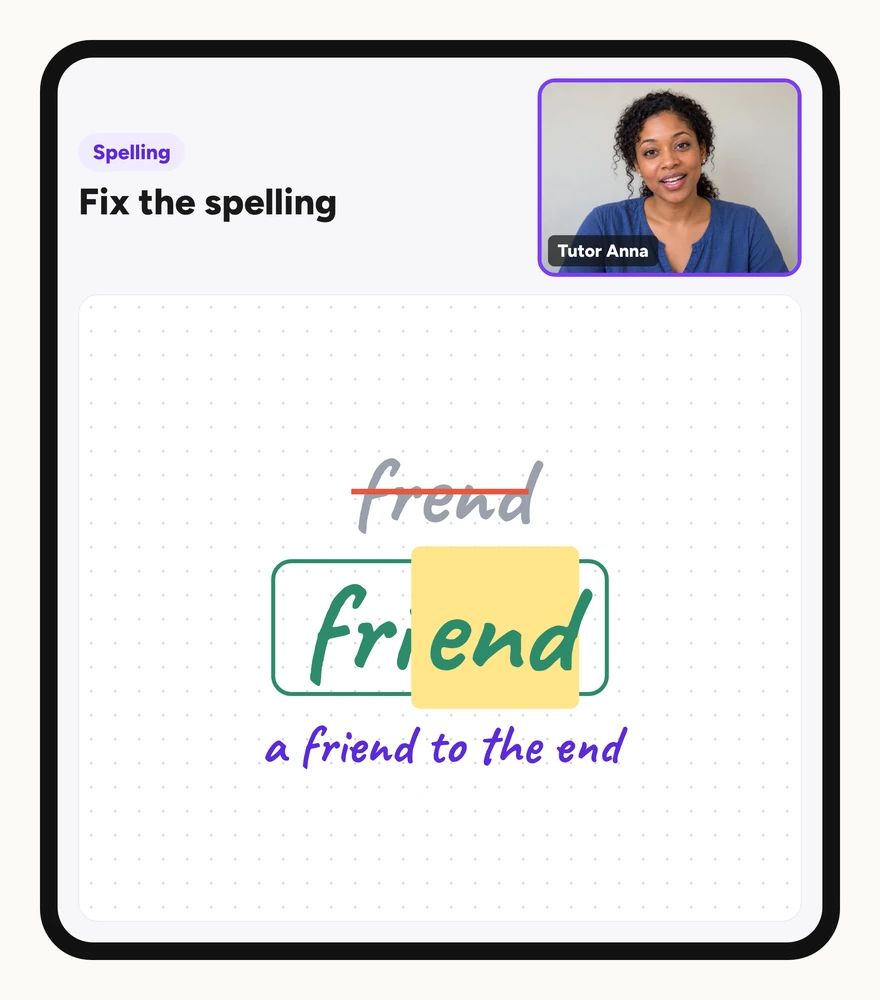
Illustration of an online spelling lesson: a tutor on video and a whiteboard correcting “frend” to “friend.”

My child learned a lot in a very short time — Ilen A, Spelling Tutoring

Try a class

Top Spelling Tutors

5 of 300+ tutors shown · 5.0 avg rating from 809 reviews

Miss Alison

Certified classroom teacher

4.9

40 ratings

15 years

Experience

k-3rd

Available Sun, Mon, Tue, Wed, Fri

Can support: ADHD, Dyslexia, Special ed ...

Hi! My name is Miss Alison. I’m a reading teacher for grades K-6 from NJ. I live with my husband , two kids, and three dogs. When I’m not tutoring, I…

K - 3rd

Available Mon, Tue, Wed, Thu, Fri

As an experienced tutor with 9 years of experience, I have taught Kindergarten through Second Grade in the sunny state of Florida. I hold a…

K-2nd grade

Available Mon, Tue, Wed, Thu

Can support: ADHD, Speech, Special ed ...

I have been a teacher for 16 years, teaching in both New Hampshire and Massachusetts. Throughout my career, I have taught a variety of grades and…

3rd - 6th

Available Mon, Tue, Wed, Thu, Fri

Can support: ESL, Special ed

Hi, my name is Caitlyn, and I am excited to begin this reading journey with you! I have been a teacher for four years, with a strong focus on helping…

K-6th grade

Available Tue, Wed, Sat

My name is Valencia Lyles. I have been teaching for 13 years and I love what I do. I am currently teaching first grade as well as tutoring at my…

What parents are saying about Spelling tutoring

Zion loves her Ms. Jackie and is always excited to go into another session. We started with one subject and progressed to two. Grateful tha... t we were able to have her for another school year.

Dr. Cicely M. - 3rd grade, Spelling

She is so awesome! Her teaching style really helps my child grasp the concept and she looks forward to each class!

Alicia - 2nd grade, Spelling

Ms. Cox is wonderful with my son. He’s completely engaged whenever he’s in class with her. She’s an awesome teacher and she makes learning f... un ✨

Tiffany - 3rd grade, Spelling

Spelling help that connects sounds, patterns, and meaning

Spelling difficulties can appear at different stages of learning. Students may know individual letter sounds but struggle to sequence them, remember which vowel team to use, or apply a suffix rule when the base word changes. Tutors can listen to how a student spells a word and identify whether the challenge involves sound-letter correspondence, a spelling pattern, or a rule for adding endings.

Spelling tutoring can connect phonics, visual patterns, syllable structure, and word meaning. Younger students might practice blending sounds in short words or distinguishing similar letters. Older students might work on vowel teams, silent letters, prefixes and suffixes, or commonly confused words. The goal is to give students a strategy they can apply to new words, alongside practicing the spelling itself.

Why families look for Spelling support

Sounds are known, but letters appear in the wrong order

Students may say the sounds in a word correctly but write the letters out of sequence or omit a middle vowel. Tutors can use sound boxes or syllable division to help students map each sound to its letter, then check the whole word.

Spelling patterns are inconsistent or confusing

English spelling includes patterns that change by position or context. The long a sound might be spelled with ai in the middle of a word and ay at the end. Tutors can introduce one pattern at a time, practice it in a focused set of words, and help students recognize when a pattern applies.

Adding a suffix changes the base word unpredictably

Rules for doubling consonants, dropping silent e, or changing y to i depend on the structure of the base word and the suffix being added. Tutors can show why a change happens, practice the pattern with related words, and help students check their spelling before moving on.

Where students can get stuck in Spelling

Confusing similar letters

Letters like b and d, or vowels like i and e, can be reversed or substituted. Tutors may use visual cues, such as describing b as having a belly in front, or ask students to say the sound aloud while writing the letter. Multisensory practice can reinforce the correct formation and sound association.

Omitting or misplacing vowels in short words

In a word like mat, students may write the consonants M and T but leave out the middle vowel or place it incorrectly. Sound boxes can help: each box holds one sound, so mat has three boxes for M, A, and T. Students can say each sound slowly and write the corresponding letter in its box.

Choosing between vowel teams that sound alike

The long e sound can be spelled with ee or ea, and the choice is not always predictable. Tutors can explain that ee often appears in words like seed and street, while ea appears in team and leaf but can also represent a short e sound in words like bread. Practice focuses on a small set of words with one pattern before introducing exceptions.

Forgetting silent letters

Words like knee, wrap, and gnat contain letters that are not pronounced. Students may spell these words phonetically and omit the silent k, w, or g. Tutors can highlight the silent letter, explain that it must be included, and provide repeated practice with words that share the same pattern.

Applying suffix rules without checking the base word

In one-syllable words such as hop, a single final consonant after a single short-vowel letter doubles before a vowel suffix: hopping. In hope, dropping the final silent e before -ing gives hoping. Tutors can compare those examples, note that final w, x, and y are not doubled under this pattern, and check unfamiliar words rather than assume one rule covers every ending.

Spelling homophones incorrectly in context

Words like to, too, and two sound the same but have different meanings and spellings. Students may write the wrong version in a sentence. Tutors can explain the meaning of each word, create example sentences, and ask students to choose the spelling that fits the context.

How Spelling tutors make the next step clearer

Map sounds to letters with sound boxes

Sound boxes give each phoneme a place. For the word ship, draw three boxes. Say each sound slowly: /sh/, /i/, /p/. Write sh in the first box (one sound, two letters), i in the second, and p in the third. Students can then read the word by blending the sounds. This approach works for short words and helps students attend to every sound, including vowels.

  1. Say the word slowly and count the sounds.
  2. Draw one box for each sound.
  3. Write the letter or letters for each sound in its box.
  4. Blend the sounds to read the whole word.

Teach vowel team patterns by position

Some vowel teams follow positional rules. For the long a sound, ai typically appears in the middle of a word, as in paint and train, while ay appears at the end, as in day and play. Tutors can present a small set of words with one pattern, ask students to notice where the vowel team appears, and then practice spelling new words that follow the same rule.

Show why a base word changes before adding a suffix

When adding -ed to hop, double the final consonant to keep the vowel short: hopped. When adding -ed to hope, drop the silent e: hoped. Tutors can explain that the spelling change preserves the pronunciation. Students can practice identifying the vowel sound and structure of the base word before applying the rule, then check the spelling by reading the new word aloud.

Putting Spelling skills into practice

From sound boxes to independent spelling

Use sound boxes to spell cat: three sounds, three boxes, C-A-T. Then try bat and sat, changing only the first letter. Students can explain which sound changed and spell each word independently. Next, remove the boxes and ask students to spell mat from memory, checking that all three letters appear in the correct order.

From one vowel pattern to a sentence

Practice the ai pattern in words like rain, train, and snail. Then write a short sentence: The snail left a trail in the rain. Students can identify the ai words, spell them correctly, and read the sentence aloud to check that the spelling matches the pronunciation and meaning.

Inside a 25-minute session

What a Spelling tutoring session can look like

This illustrative lesson focuses on the long a sound spelled with ai and ay, and the positional rule that guides the choice. Tutors can choose a different pattern, suffix rule, or set of words depending on the student's current needs.

  1. 0–3 min

    Review a known pattern

    Read a few words with the long a sound, such as make and day, to check whether students recognize the sound. Identify that the same sound can be spelled in different ways.

  2. 3–8 min

    Introduce the positional rule

    Explain that ai usually appears in the middle of a word, as in paint and train, while ay appears at the end, as in play and stay. Show the words and ask students to notice the position of the vowel team.

  3. 8–15 min

    Practice spelling with the pattern

    Dictate words like rain, stain, and day. Students write each word, checking whether the long a sound is in the middle or at the end, then choose ai or ay. Provide immediate feedback and correction.

  4. 15–22 min

    Apply the pattern in a sentence

    Write a sentence together: We will play in the rain. Students identify the ai and ay words, explain the spelling choice, and read the sentence aloud to confirm accuracy.

  5. 22–25 min

    Review and choose next practice

    Revisit one word from the lesson and ask students to explain how they knew which vowel team to use. Choose a short independent practice or return to the pattern if uncertainty remains.

Example timings only. The pattern, number of words, and pace can change with the student's spelling level and focus.

Frequently Asked Questions

Terms of servicePrivacy PolicyNotice at Collection

© 2026 ClassDojo. All Rights Reserved.