
Math was going well. Then Algebra arrived.
Tutors can start with the arithmetic students already know and connect it to variables and equations, one step at a time.
 Dojo Tutor
© 2026 ClassDojo. All Rights Reserved.
Algebra Tutoring
Personalized support from experienced teachers, with the flexibility of learning online.
I have seen such a boost in her grades and confidence — Jessica S
Personalized support from experienced teachers, with the flexibility of learning online.
I have seen such a boost in her grades and confidence — Jessica S
5 of 60 tutors shown · 4.7 avg rating from 1,298 reviews
6th - 12th
7 days a week
Hi! I became a Math teacher in 2017, and quickly learned how to reach individual students to bring out their best, even if they despise math.
Certified classroom teacher
6th - 12th
7 days a week
Hi! I became a Math teacher in 2017, and quickly learned how to reach individual students to bring out their best, even if they despise math.
5.0
153 ratings
11 years
Experience
3rd - 9th
Available Wed, Thu, Fri, Sat
Hi! I’m Lourdes Arroyo, and I earned my degree in Mathematics with a minor in Education from Concordia University Texas.
Certified classroom teacher
3rd - 9th
Available Wed, Thu, Fri, Sat
Hi! I’m Lourdes Arroyo, and I earned my degree in Mathematics with a minor in Education from Concordia University Texas.
2.0
1 ratings
5 years
Experience
9th - 12th
Available Wed, Thu
With 20 years of teaching experience, I have taught Math, Science, and Physical Education to learners in Arizona. My qualifications include an M.A.…
Certified classroom teacher
9th - 12th
Available Wed, Thu
With 20 years of teaching experience, I have taught Math, Science, and Physical Education to learners in Arizona. My qualifications include an M.A.…
5.0
85 ratings
31 years
Experience
6th grade
Available Sun, Mon, Wed, Fri
I’ve been teaching for six years and specialize in Math for students in grades 6 through 12. I hold a Bachelor of Education with a focus in…
Certified classroom teacher
6th grade
Available Sun, Mon, Wed, Fri
I’ve been teaching for six years and specialize in Math for students in grades 6 through 12. I hold a Bachelor of Education with a focus in…
5.0
240 ratings
6 years
Experience
7th grade and 1st year college
Available Tue, Wed, Thu, Fri, Sat
Can support: Behavioral, Gifted & talented
Hi! My name is Ms. Mondez, and I’m excited to support your child’s learning journey. I’ve worked with students of various ages and learning styles,…

Certified classroom teacher
7th grade and 1st year college
Available Tue, Wed, Thu, Fri, Sat
Can support: Behavioral, Gifted & talented
Hi! My name is Ms. Mondez, and I’m excited to support your child’s learning journey. I’ve worked with students of various ages and learning styles,…
5.0
99 ratings
19 years
Experience
Steven truly enjoys his tutoring sessions with Mrs. Irene. He mentioned that she has a wonderful way of explaining the material, making it e... asy to understand, and she patiently ensures he grasps the assignments. As a mother, I deeply appreciate this. Thank you, Mrs. Irene, for creating such a comfortable learning environment for my son.
Herrializ - 8th grade, Algebra
My daughter is so happy after her tutoring section and encouraged with the progress of learning!
Rebecca - 8th grade, Algebra
I felt listened to, and that I mattered and my problems academically is cared about and will soon be solved!
porshia - 9th grade, Algebra
Algebra asks students to move from calculating with numbers to reasoning about unknowns. A child who is comfortable with arithmetic may still find it difficult to work with variables, keep both sides of an equation balanced, or connect a formula to a graph. A lost negative sign or a missed term in distribution can change the answer even when the overall method makes sense.
In 1-to-1 Algebra tutoring, tutors can use your child’s homework or a practice problem to find the step that needs attention. That might mean revisiting fractions before solving equations, showing why an operation must apply to both sides, or linking slope to movement on a coordinate grid. Students can explain their reasoning, try a similar problem, and learn to check an answer by substituting it into the original equation.
Sound familiar?
Tutors can start with the arithmetic students already know and connect it to variables and equations, one step at a time.
Tutors can revisit building blocks, such as slope and two-step equations, and help students connect them to the topic they are learning now.
A familiar equation, such as x + 5 = 12, can give students a starting point before tackling variables on both sides. Tutors can build from what students can explain and add one new Algebra step at a time.
Tutors can help students name the unknown, separate the given information from the question, and translate one phrase at a time into an expression or equation.
Algebra test practice can include solving linear equations and inequalities, interpreting y = mx + b, and turning a word problem into an equation. Tutors can help students show their working, check a solution by substitution, and compare a calculated slope with the direction of its graph.
Inside a 25-minute session
A session on solving equations can connect familiar arithmetic to a new Algebra step. Here is one way tutors can move from checking sign rules to guided practice with distribution, then give students a related equation to solve independently.
0–3 min
Start with a quick check of negative-number multiplication and a familiar equation, such as 2x + 3 = 11. This helps tutors see whether sign rules or inverse operations need a refresher.
3–8 min
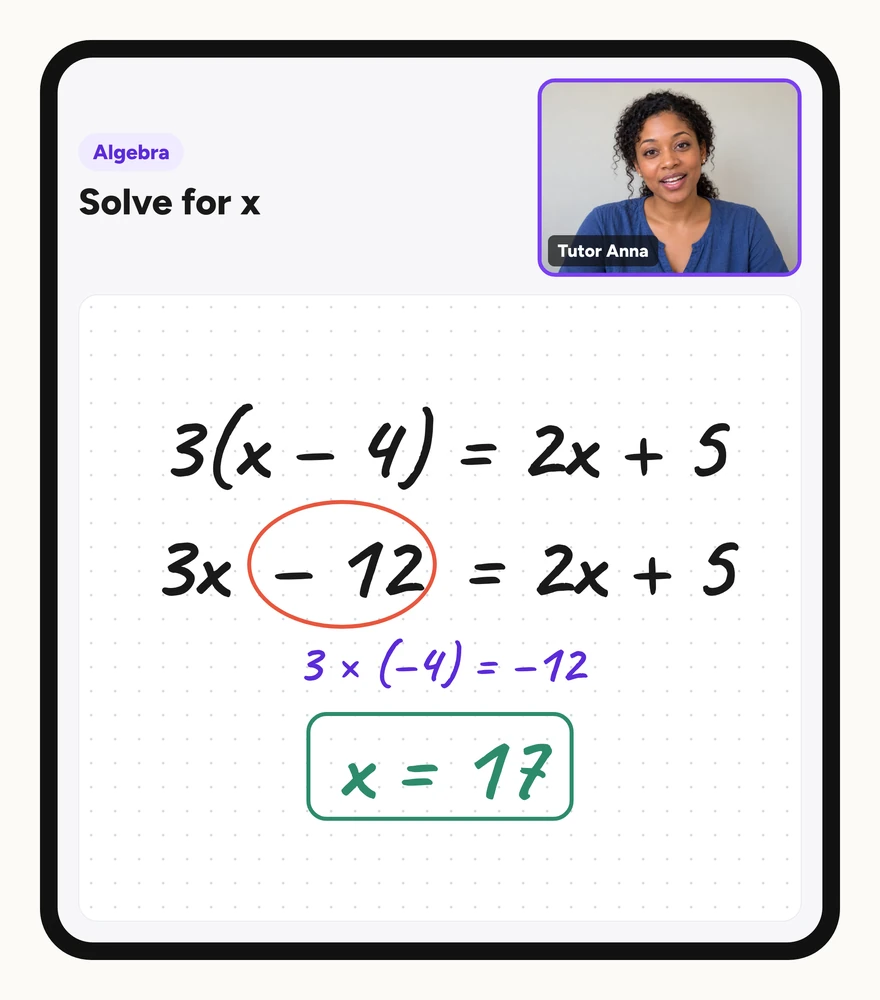
Look at a worked equation from homework or a quiz. In 2(3x − 4) = 22, for example, does the student multiply both terms inside the parentheses by 2, or leave the −4 unchanged?
8–15 min
Work through 2(3x − 4) = 22 to get 6x − 8 = 22, then x = 5. Tutors can ask students why the 2 multiplies both terms and why adding 8 to both sides preserves equality.
15–22 min
Try a related equation, such as 3(2x − 5) = 9. Students write each line themselves while tutors prompt them to track the negative sign and apply each operation to both sides.
22–25 min
Check the solution by substituting it into the original equation. Recap the idea that needed attention, then choose a next step, such as distributing a negative factor or solving an equation with variables on both sides.
Example timings. Tutors can adjust the pace to your child’s needs.
A negative sign can belong to a number, an operation, or an entire expression. Ask your child to show one line at a time and explain which part the sign applies to. For example, −4² is −16, while (−4)² is 16: the parentheses change what gets squared.
When (3/4)x = −6, the fraction multiplying x is 3/4. Multiplying both sides by 4/3 makes that coefficient 1, giving x = −8. Naming the coefficient before taking its reciprocal helps separate the operation from the number on the other side.
For a slope of −3/5, a convenient move is down 3 and right 5. The numerator describes vertical change; the denominator describes horizontal change. Start from a known point and check the direction before drawing the line.
Terms need the same variable part, including the exponents, to combine by addition or subtraction. So 3x + 2x becomes 5x, but 3x + 2x² stays as two terms. Multiplication follows a different rule: x³ × x⁵ = x⁸.
Tutors can use matching counters or symbols to represent the same unknown on both sides of an equation. Removing the same number of counters, or subtracting the same value from each side, keeps the equation balanced. Students can connect that visible action to the written steps before relying on shortcuts.
Tutors can ask students to compare worked steps and identify the first line that changes an equation. This turns “remember to distribute” into a concrete check: did the outside factor multiply every term inside the parentheses? Explaining why a step is incorrect gives students another way to check their own work.
Students can make a fractional slope easier to picture by separating its two parts. The numerator describes the rise and the denominator describes the run. Tutors can connect each number to a direction on the graph, then ask students to explain the movement before plotting another point.
Ways tutors can help students connect a familiar rule to a new problem.
Students may remember to flip a fraction but need support deciding which fraction to use. Tutors can ask students to identify the coefficient of the variable, explain which operation will undo it, and check the result in the original equation. This connects a remembered rule to the reasoning behind it.
Students can calculate a slope yet still hesitate when plotting it. Tutors can connect the same information in three ways: coordinate pairs, rise-over-run movements, and the direction of the line. Asking students to explain each movement helps connect the formula to the graph.