



Skip content
Dojo Tutor
Log inTry class

Social Emotional Learning (SEL) Tutoring

Personalized support from experienced teachers, with the flexibility of learning online.

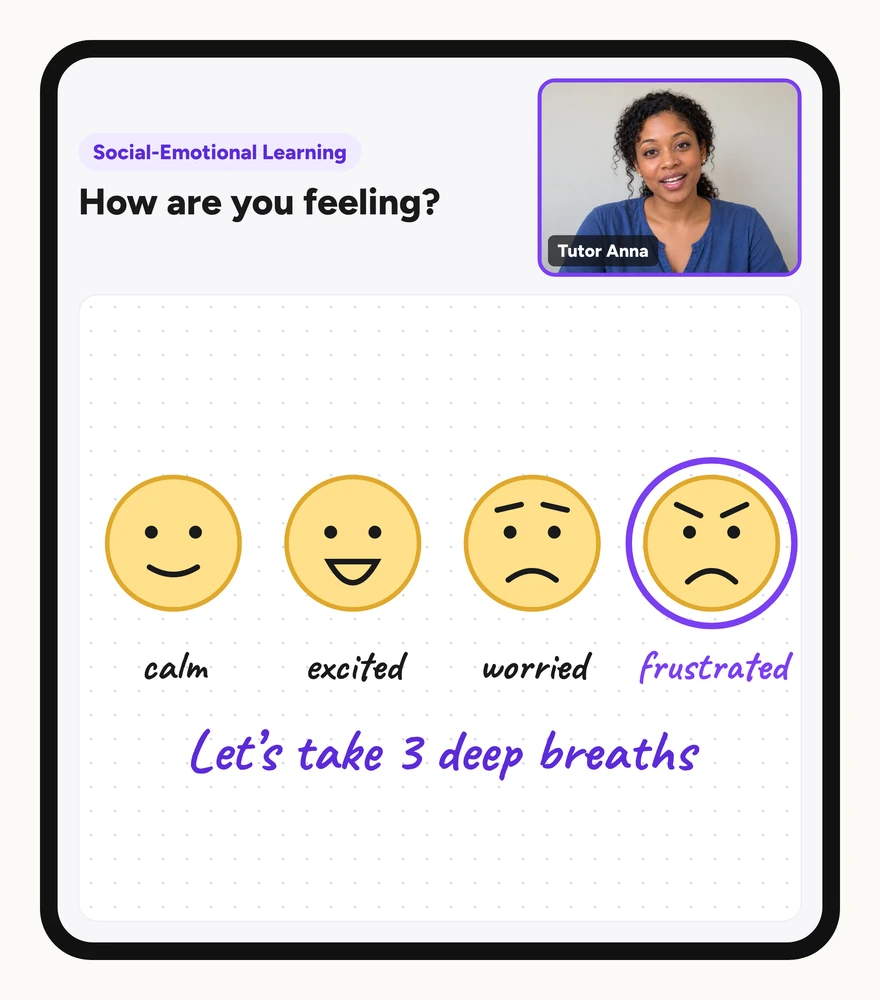
Illustration of an online social-emotional learning session: a tutor on video and a feelings check-in with “frustrated” selected and a breathing tip.

This helped my daughter explore her feelings and emotions in a safe environment. — Nasrin S, SEL Tutoring

Try a class

Top Social Emotional Learning (SEL) Tutors

5 of 192 tutors shown · 5.0 avg rating from 1,238 reviews

Mrs. Hall

Certified classroom teacher

5.0

5 ratings

15 years

Experience

Pre-K - 3rd

Available Mon, Tue, Wed, Thu, Fri

Can support: ADHD

I am an experienced elementary school Teacher with 14 plus years of experience. I love having fun while teaching and laughing often! I have taught…

3rd - 9th

Available Sun, Mon, Tue, Wed

Can support: ADHD, Autism spectrum, Gifted & talented

Hi! I'm Soren, an undergrad student applying my learning to help the youth of today. I dual major in Psychology and Social Work!

K - 4th

Available Sun, Mon, Tue, Fri

Hello! My name is Cherdeeca or Ms. C, and I love helping young learners grow in confidence and academic skills. I work with students in Kindergarten…

K - 6th

7 days a week

Can support: ADHD, Gifted & talented

Hi! I’m Zachary McBride, an experienced educator with 7 years of experience working with students in the classroom. I hold a Master’s degree in…

Pre-K - 8th

Available Tue, Wed, Thu, Sat

Hey family, I'm Keila (Key-luh), and I have 15 years of experience in education. I have served as a classroom teacher, instructional coach, and…

Social-emotional learning that builds emotion vocabulary and communication

Social-emotional learning can give students practice naming emotions, taking turns, considering another perspective, and communicating a request clearly. Tutors can use picture prompts, stories, and simple role-play to explore these skills in an educational setting, with a focused activity suited to the student's current learning needs.

Activities can connect an emotion word to a story detail, compare possible responses to a disagreement, or practise asking for a turn or help. Students can explain their choice and try another way to phrase it. The focus is vocabulary, reflection, and communication that can connect to group work and everyday learning.

Why families seek social-emotional learning support

Finding words for feelings and requests

Students may know they are upset but need more language to describe the feeling or make a request. Tutors can model phrases such as 'I feel frustrated' or 'Could you explain that again?' and let students practise a clear request in a low-pressure activity.

Difficulty making or keeping friends

Students may struggle to join a conversation, take turns, handle disagreement, or understand when a peer is upset. Tutors can teach specific skills such as asking questions, staying on topic, apologizing after a mistake, and reading social cues that signal when to adjust behavior.

Trouble accepting disappointment or waiting

Waiting for a turn and accepting that an option is unavailable are different situations. Tutors can practise asking when a turn will come, choosing an available alternative, or respectfully expressing disappointment. A clear limit does not always mean the same option will become available later.

Social-emotional challenges students may face

Naming emotions beyond happy, sad, or angry

Students can compare words such as nervous, disappointed, embarrassed, and frustrated using pictures or details in a story. Tutors can ask which label fits the available clues and what else would help clarify the interpretation, without treating a single facial expression as proof of an emotion.

Reacting impulsively instead of pausing to think

Tutors can model a short pause before choosing words during a turn-taking activity. Students can identify what they want to communicate, practise a respectful phrase, and consider another response if the first request cannot be met.

Making a clear request during disagreement

Role-play can compare a vague command with a specific request, such as 'Please leave space for my materials' or 'Could we take turns?' Tutors can ask students to explain the need, listen to the response, and seek help from a trusted adult when a disagreement needs support.

Difficulty forgiving themselves after a mistake

A mistake in a learning task can prompt a concrete next-step question: which part needs another try, a different example, or a request for help? Tutors can practise language that describes the task and the next action, rather than turn one result into a judgment about someone's abilities.

Considering more than one interpretation

A brief story can leave a character's intention unclear. Tutors can ask students to identify what the text states, consider plausible interpretations, and choose a question that would clarify the situation. That connects perspective-taking with checking evidence and communicating respectfully.

How tutors teach social-emotional skills

Connect emotion words to available clues

Tutors can compare a story's words, actions, and situation with possible emotion labels. Students can explain which clues support a label and recognize that asking a speaker may be more useful than assuming. More than one feeling can fit a scene.

  1. Choose a simple picture prompt or scene from a story.
  2. Identify the words, actions, and circumstances the prompt actually shows.
  3. Suggest an emotion word and explain which clues support it.
  4. Practise a question or request that would clarify the situation.

Practice perspective-taking to reduce conflict

Tutors can present a scenario where two people interpret the same event differently, such as someone stepping on your foot accidentally versus on purpose. Students can discuss how each interpretation changes the emotional response and practice asking questions or giving the benefit of the doubt before reacting.

Practise a pause and a clear next sentence

A role-play can include a brief pause before a request, a question to clarify a misunderstanding, or asking an adult for help. Tutors can compare which response fits the activity and let students rehearse another option. The lesson provides practice with communication rather than a promised response in every situation.

Practicing social-emotional skills

Original practice activities for emotion vocabulary, reflection, and respectful requests.

From an emotion word to a respectful request

Use a turn-taking role-play with a shared game piece. Practise a pause and a request such as 'Could I use that after your turn?' Compare the request with a vague command, then discuss what information each person needs to plan the next turn.

From a learning setback to a next-step question

Compare 'I cannot do any of this' with 'I need help with the regrouping step.' Students can identify which sentence gives useful information about the task, then practise a request for a worked example or another try. Tutors can keep the discussion focused on the learning activity.

Inside a 25-minute session

What a social-emotional learning session can look like

This illustrative lesson uses a short story and turn-taking role-play to practise emotion vocabulary and one clear request. Tutors can adjust the prompt, language, and pace to suit the learning activity.

  1. 0–3 min

    Introduce a story or picture prompt

    Choose a brief scene involving waiting for a turn. Identify what is happening and what information the prompt provides, without asking students to share a private personal experience.

  2. 3–8 min

    Name the emotion and its physical signs

    Compare emotion words that might fit the scene, such as disappointed or impatient. Students can point to details supporting their choice and discuss what remains uncertain.

  3. 8–15 min

    Practise a pause and a request

    Model a pause followed by 'When will it be my turn?' or 'Could I use that next?' Students can rehearse the wording and explain what the question asks the other person to clarify.

  4. 15–22 min

    Apply the strategy to a new scenario

    Change the role-play so the requested item is unavailable. Practise choosing another activity or respectfully asking for an alternative, distinguishing a wait from a firm limit.

  5. 22–25 min

    Review and plan for the week

    Review the emotion words and request practised. Students can choose another simple classroom or game example and explain which communication step they would try.

Example timings only. The focus and activities can change depending on what the student is working on.

Frequently Asked Questions

Terms of servicePrivacy PolicyNotice at Collection

© 2026 ClassDojo. All Rights Reserved.