


Skip content
Dojo Tutor
Log inTry class

Chemistry Tutoring

Personalized support from experienced teachers, with the flexibility of learning online.

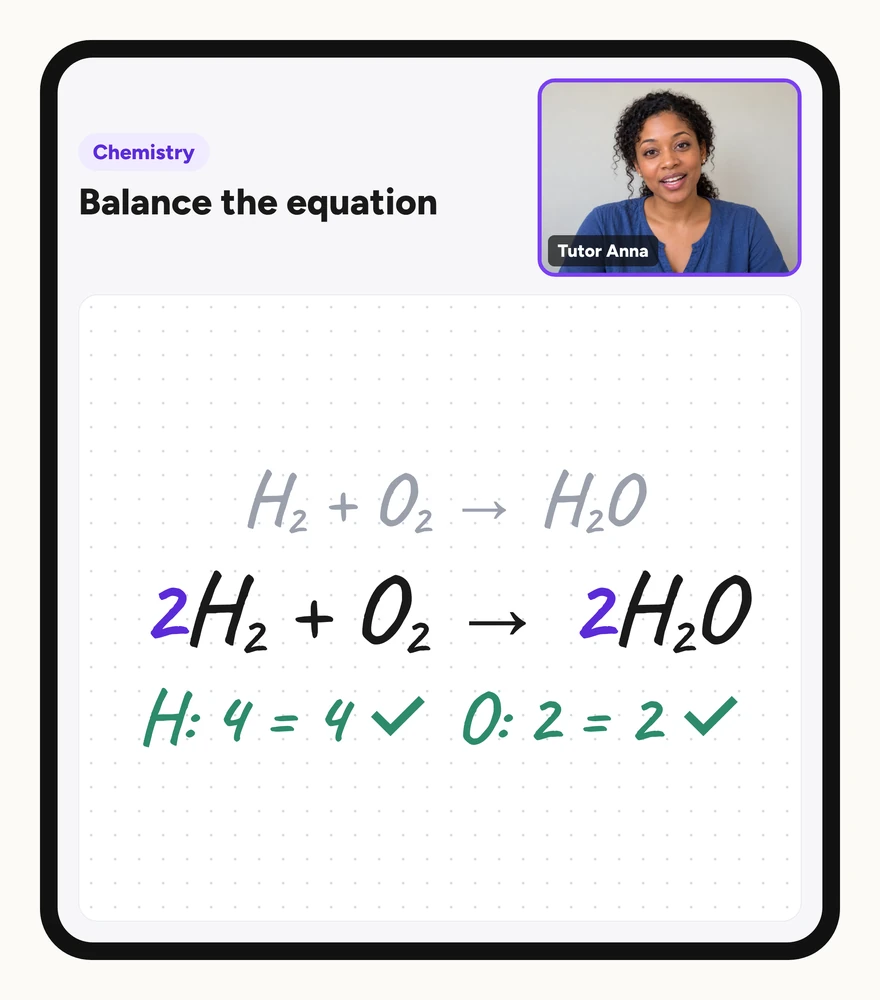
Illustration of an online chemistry lesson: a tutor on video and a whiteboard balancing the equation for water, 2H₂ + O₂ → 2H₂O.

Her tutor has been wonderful and so patient — Sarah M

Try a class

Top Chemistry Tutors

5 of 24 tutors shown · 5.0 avg rating from 1,244 reviews

Dante R.
Super tutor

5.0

56 ratings

5 years

Experience

7th - 12th

Available Mon, Tue, Wed, Thu, Fri

Hi, I'm Dante! I am a professional writer and editor, finally returning to my foremost passion: working with learners to master the English language.…

5th - 12th

Available Mon, Tue, Wed, Thu, Fri, Sat

Hi! I’m a certified flight instructor and an Astrophysics major from UCF. I have extensive experience teaching both academic STEM subjects and…

All grades

Available Mon, Tue, Wed, Thu, Fri, Sat

Hi! My name is Emma and I'm a PhD student studying physiology. I've been teaching anatomy and physiology classes for the past few years, and have…

7th - 12th

7 days a week

Elementary/Middle School Math & Algebra While I haven't been the classroom teacher for elementary or middle school math, I've been tutoring students…

4th - 12th

Available Sun, Mon, Tue, Wed, Thu, Fri

Hello! My name is Ashtyn, and I am currently a medical student with a strong background in both math and science. I earned my bachelor's degree in…

Chemistry tutoring that connects formulas to their meaning

Chemistry asks students to move between symbols, calculations, and physical meaning. A balanced equation can look correct on paper while the student remains unsure what the coefficients represent. A mole conversion can follow the right steps without connecting the units to actual quantities. Tutors can start with the exact point where the procedure stops making sense.

Tutors can connect notation to particle counts, mass relationships, and observable changes. Students might practice identifying bond types from element positions, use unit cancellation to guide stoichiometry, or explain why charge balance matters in an ionic formula. The aim is to give students a way to reason through the next step, check their work, and explain what a calculation describes.

Why families look for Chemistry support

Formulas are memorized but not understood

Students may recall that moles equal mass divided by molar mass without knowing what a mole represents or why the division produces that unit. Tutors can connect the formula to a concrete example, show how units cancel, and ask students to explain the result in their own words before applying it to another problem.

Procedures work on some problems but not others

A method for balancing one equation type may not transfer to a different reaction. Tutors can help students identify what changes between problems—such as polyatomic ions that stay grouped or coefficients that affect multiple elements—and choose a strategy that fits the structure of the current equation.

Where students can get stuck in Chemistry

Counting atoms when coefficients and subscripts combine

In 4H₂O, the coefficient 4 multiplies everything in the formula: four molecules, each with two hydrogen atoms and one oxygen atom, give eight hydrogen and four oxygen total. Students may multiply only the first subscript or forget that the coefficient applies to every element in the compound.

Recalling a mole conversion formula without understanding units

Students may know a formula exists but struggle to set it up in a problem. Tutors can focus on unit cancellation: grams divided by grams per mole yields moles. Writing the units beside each number and checking what cancels can guide the calculation more reliably than memorizing which value goes on top.

Handling non-whole mole ratios in empirical formulas

After dividing mole amounts by the smallest value, students may obtain a ratio such as 1:2:3.5. Rounding 3.5 to 4 changes the ratio; multiplying every part by two gives 2:4:7. Tutors can recognize ratios near familiar fractions while checking measurement precision and the full ratio before choosing a multiplier.

Confusing atomic number with atomic mass

Atomic number counts protons and defines the element; atomic mass is the sum of protons and neutrons. Students may treat atomic number as a ranking by weight or use mass when calculating electrons. Tutors can clarify that a neutral atom has electrons equal to its atomic number, not its mass number.

Predicting bond type without checking element classification

Ionic bonds form between a metal and a nonmetal; covalent bonds form between two nonmetals. Students may guess based on familiarity rather than locate each element on the periodic table. Tutors can demonstrate using the table's layout to classify elements and predict bonding before writing a formula.

How Chemistry tutors make the next step clearer

Use unit cancellation to guide mole conversions

Students can write the units they have and need, then arrange conversion factors so unwanted units cancel. Using a rounded molar mass of 18 g/mol for water, 36 g × (1 mol / 18 g) gives approximately 2 mol. Tutors can connect each factor to its meaning before extending the chain to particles or reaction ratios.

  1. Identify the starting unit and the target unit.
  2. Write a conversion factor with the target unit in the numerator.
  3. Multiply and cancel units to check the setup.
  4. Calculate the numerical result and verify the unit makes sense.

Connect empirical and molecular formulas through mass

An empirical formula gives the simplest whole-number atom ratio. To obtain a molecular formula, compare the given molar mass with the empirical formula's molar mass, then multiply each subscript by the resulting whole-number factor. Using rounded masses, CH₂ is about 14 g/mol; a molecular molar mass of 42 g/mol gives a factor of three and C₃H₆.

Identify the limiting reactant by comparing product yields

Convert the mass of each reactant to moles, then use the balanced equation's coefficients to calculate how much product each reactant could produce. The reactant that produces the least product is limiting. Tutors can set up a proportion for each reactant separately, cross-multiply to find moles of product, and compare the results before converting back to grams if needed.

Putting Chemistry skills into practice

From atomic structure to isotope notation

Cobalt has atomic number 27. For the isotope cobalt-59, the mass number is 59. Subtract atomic number from mass number to find 32 neutrons. A neutral atom has 27 electrons. Students can write the symbol with mass number as a superscript and atomic number as a subscript, then explain what each number represents.

From a balanced equation to a stoichiometry calculation

In 2H₂ + O₂ → 2H₂O, the mole ratio of hydrogen to water is 2:2. Assuming enough oxygen and complete reaction, use rounded molar masses of 2 g/mol for H₂ and 18 g/mol for water: 4 g H₂ corresponds to about 2 mol H₂, which can form about 2 mol or 36 g of water. Students can label the assumptions and cancel units at each step.

Inside a 25-minute session

What a Chemistry tutoring session can look like

This illustrative lesson focuses on mole conversions using unit cancellation. Tutors can choose a different topic—such as balancing equations, atomic structure, or intermolecular forces—and adjust the pace to match the student's current work and understanding.

  1. 0–3 min

    Check understanding of the mole concept

    Ask what a mole represents and how it relates to grams and particles. Clarify that one mole of any substance contains Avogadro's number of particles and has a mass in grams equal to its molar mass.

  2. 3–8 min

    Set up a grams-to-moles conversion

    Convert 36 grams of water to moles. Write the given value with its unit, then the conversion factor 1 mol / 18 g. Show that grams cancel, leaving moles, and calculate 2 moles.

  3. 8–15 min

    Extend to a moles-to-particles conversion

    Convert 2 moles of water to molecules using Avogadro's number. Write 2 mol × (6.02 × 10²³ molecules / 1 mol). Check that moles cancel and the result has the correct unit.

  4. 15–22 min

    Try a multi-step problem independently

    Convert 9 grams of water to molecules in one setup. Students write the chain of conversion factors, cancel units, and calculate the answer. Discuss any step where units did not cancel as expected.

  5. 22–25 min

    Review the strategy and choose next practice

    Ask students to explain how unit cancellation guided the setup. Identify whether the next session should continue with stoichiometry, empirical formulas, or another application of mole conversions.

Example timings only. The topic, depth, and pace can change with the student's needs and prior knowledge.

Frequently Asked Questions

Terms of servicePrivacy PolicyNotice at Collection

© 2026 ClassDojo. All Rights Reserved.