Skip content
Dojo Tutor
Log inTry class

Trigonometry Tutoring

Personalized support from experienced teachers, with the flexibility of learning online.

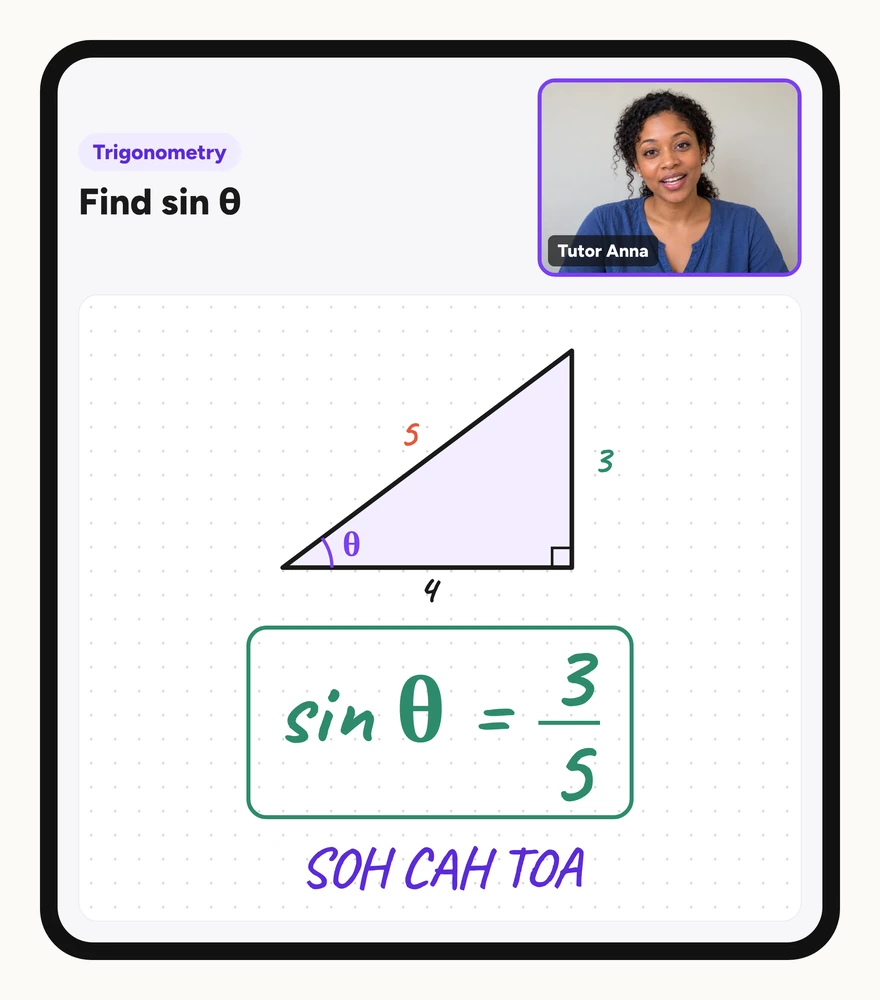
Illustration of an online trigonometry lesson: a tutor on video and a 3-4-5 right triangle showing sin θ = 3/5.

I have seen such a boost in her grades and confidence — Jessica S

Try a class

Top Trigonometry Tutors

5 of 24 tutors shown · 5.0 avg rating from 2,234 reviews

Mr. Maurer or Mr. Mike!

Certified classroom teacher

Super tutor

5.0

331 ratings

9 years

Experience

5th and 6th grade

Available Tue, Wed, Thu, Fri, Sat

Can support: ADHD, Dyslexia, ESL ...

I have taught math for nine years, from 5th grade (most fun! We love fractions!) to high school. Now I teach 6th grade, and what I most like to talk…

6th - 12th

Available Mon, Tue, Wed, Thu, Fri, Sat

Can support: ESL, Gifted & talented

Hello! I'm a mathematics educator with more than 13 years of teaching experience and a strong passion for helping students build confidence in math.…

6th grade

Available Sun, Mon, Tue, Thu

Can support: Gifted & talented

I am a dedicated and passionate educator whose professional journey spans the full spectrum from middle school to pre-university levels. Over the…

6th - 12th

7 days a week

Hi! I became a Math teacher in 2017, and quickly learned how to reach individual students to bring out their best, even if they despise math.

6th grade

Available Sun, Mon, Wed, Fri

I’ve been teaching for six years and specialize in Math for students in grades 6 through 12. I hold a Bachelor of Education with a focus in…

Trigonometry tutoring that connects ratios to triangles

Students may memorize sine, cosine, and tangent without knowing which side to label or when to use each ratio. A rotated triangle can hide the hypotenuse; a word problem can leave students uncertain whether to multiply or divide. Trigonometry tutoring can start by identifying the parts of the triangle relative to the given angle, then connecting those labels to the correct ratio.

Tutors can label opposite and adjacent sides relative to a chosen acute angle while keeping the hypotenuse opposite the right angle. Students can then choose a ratio, solve for a missing side or acute angle, and check whether the answer fits the diagram. Labelled triangles, unit-aware calculations, and inverse functions connect the setup to its meaning.

Why families look for Trigonometry support

The mnemonic is familiar, but the setup is unclear

Students may recall SOH CAH TOA without knowing how to label a triangle or choose the correct ratio for a given problem. Tutors can help students identify the hypotenuse first, then label opposite and adjacent relative to the angle in question before selecting sine, cosine, or tangent.

Solving for an angle versus solving for a side

When the ratio is known and the angle is unknown, students need inverse trigonometric functions. Tutors can explain that inverse sine, cosine, or tangent removes the trigonometric operation to isolate the angle, just as other inverse operations work in algebra.

Where students can get stuck in Trigonometry

Confusing the hypotenuse with another side

The hypotenuse is always opposite the right angle and is the longest side of a right triangle. In a rotated diagram, students may point to a leg instead. Tutors can ask students to locate the 90-degree angle first, then identify the side across from it.

Labeling sides without reference to the angle

Opposite and adjacent are defined relative to a specific acute angle. If the angle changes, the labels change. Tutors can have students mark the angle they are using, then label the side across from it as opposite and the side next to it—other than the hypotenuse—as adjacent.

Choosing the wrong trigonometric ratio

Students may set up sine when the problem involves adjacent and hypotenuse, which requires cosine. Tutors can prompt students to write down which two sides are known or needed, then match those sides to the correct ratio using SOH CAH TOA.

Mixing up the numerator and denominator

In sine equals opposite over hypotenuse, the opposite side goes in the numerator. Reversing the fraction leads to an incorrect ratio. Tutors can ask students to state the ratio aloud and check the setup against the mnemonic before calculating.

Forgetting to use inverse functions when solving for an angle

If sine of an angle equals a known value, students need inverse sine to find the angle measure. Tutors can show that applying the inverse function to both sides isolates the variable, similar to using square roots or logarithms in other equations.

How Trigonometry tutors make the setup clearer

Locate the right angle and hypotenuse before labeling other sides

The first step in any right-triangle trigonometry problem is finding the 90-degree angle. The hypotenuse is the side opposite that angle. Once the hypotenuse is identified, students can label the remaining sides as opposite or adjacent relative to the angle they are working with. This order prevents confusion when the triangle is rotated or drawn in an unfamiliar orientation.

  1. Find the right angle in the triangle.
  2. Identify the hypotenuse as the side opposite the right angle.
  3. Mark the acute angle you will use.
  4. Label the side across from that angle as opposite and the remaining side as adjacent.

Match the known and unknown sides to the correct ratio

Students can list which sides are given and which side or angle they need to find. If the problem involves opposite and hypotenuse, use sine. If it involves adjacent and hypotenuse, use cosine. If it involves opposite and adjacent, use tangent. Writing this match explicitly helps students choose the ratio before setting up the equation.

Use inverse trigonometric functions to solve for an angle

When the unknown is an acute angle in a right triangle, an inverse trigonometric function can recover it from a side ratio. If sin A = 0.5, then A = arcsin(0.5) = 30 degrees. Tutors can check calculator mode and explain that the acute-angle restriction makes this answer appropriate; a general sine equation can have other solutions.

Putting Trigonometry skills into practice

Original examples that show how labeling and ratio selection work together.

From a labeled triangle to the correct ratio

Draw a right triangle with a 90-degree angle at C, an acute angle at A, and sides labeled: hypotenuse 10, opposite 6, adjacent 8. To find angle A, use sine equals opposite over hypotenuse, so sine A equals 6 over 10 or 0.6. Then A equals inverse sine of 0.6, approximately 37 degrees. Students can explain why sine was chosen and check that the opposite side was used in the numerator.

From a word problem to a trigonometric equation

A ladder 13 feet long leans against a wall, reaching 12 feet high. Find the angle the ladder makes with the ground. Draw the triangle: the ladder is the hypotenuse, the wall is opposite the ground angle, and the ground is adjacent. Use sine equals opposite over hypotenuse: sine of the angle equals 12 over 13. The angle equals inverse sine of 12 over 13, approximately 67 degrees. Tutors can ask students to identify which side is which before choosing the ratio.

Inside a 25-minute session

What a Trigonometry tutoring session can look like

This illustrative lesson focuses on setting up and solving a right-triangle problem using sine. Tutors can choose a different ratio, inverse function, or special triangle as needed.

  1. 0–4 min

    Identify the right angle and hypotenuse

    Draw a right triangle or use a diagram from homework. Locate the 90-degree angle and mark the hypotenuse as the side opposite it. Check that the student recognizes the hypotenuse as the longest side.

  2. 4–9 min

    Label opposite and adjacent for a given angle

    Mark one acute angle. Identify the side across from it as opposite and the remaining side as adjacent. Discuss how these labels would change if the other acute angle were used instead.

  3. 9–16 min

    Choose the correct trigonometric ratio

    List the known sides and the unknown quantity. If opposite and hypotenuse are involved, use sine. Set up the equation: sine of the angle equals opposite over hypotenuse. Substitute the given values.

  4. 16–22 min

    Solve and check the setup

    If solving for a side, multiply or divide to isolate the variable. If solving for an angle, apply the inverse sine function. Use a calculator and check that the result makes sense given the triangle's dimensions.

  5. 22–25 min

    Try a related problem

    Work on a similar triangle with a different given angle or a different pair of sides. Students label the triangle independently and explain their ratio choice before calculating.

Example timings only. The topic, ratio, and pace can change with the student's current work and understanding.

Frequently Asked Questions

Terms of servicePrivacy PolicyNotice at Collection

© 2026 ClassDojo. All Rights Reserved.