

Skip content
Dojo Tutor
Log inTry class

Geometry Tutoring

Personalized support from experienced teachers, with the flexibility of learning online.

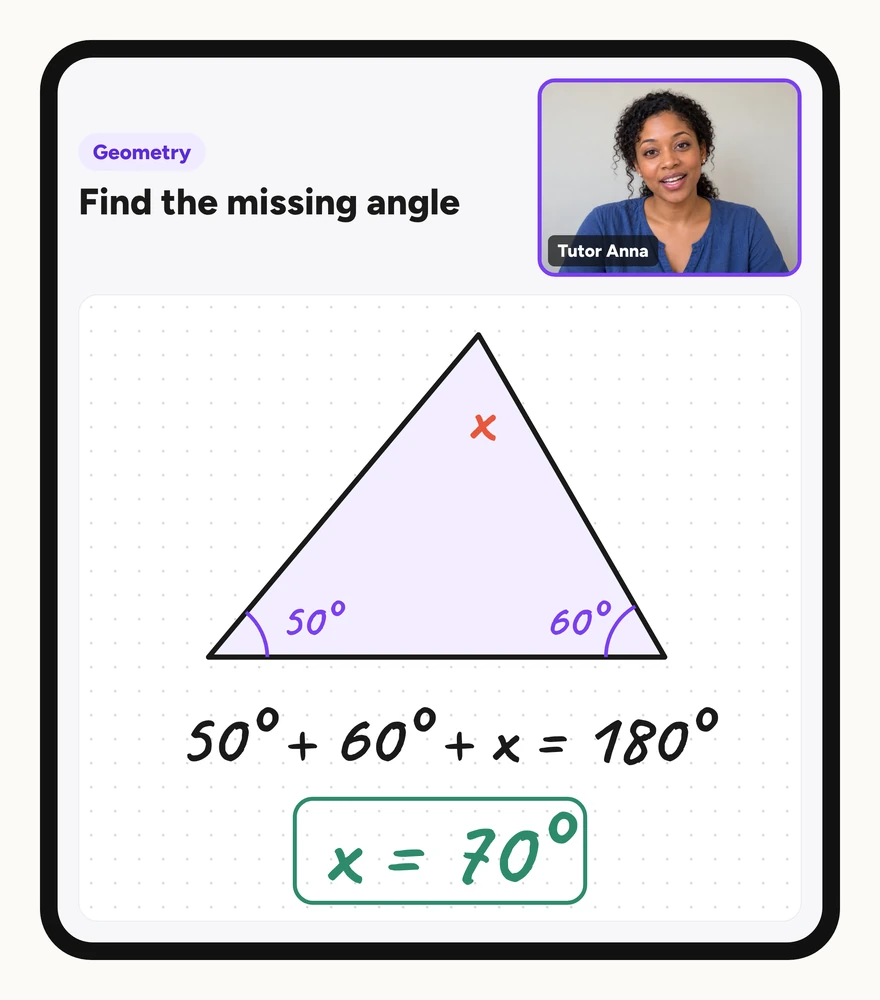
Illustration of an online geometry lesson: a tutor on video and a whiteboard triangle with angles of 50° and 60°, solving for the missing 70° angle.

I have seen such a boost in her grades and confidence — Jessica S

Try a class

Top Geometry Tutors

5 of 12 tutors shown · 5.0 avg rating from 1,561 reviews

Ms Jenna

Certified classroom teacher

5.0

16 ratings

16 years

Experience

3rd - 11th

Available Wed, Thu

Hello families! I have been in math education for 12 years, in both secondary and elementary settings. I started teaching high school math and then…

5th - 12th

Available Mon, Tue, Wed, Thu, Fri, Sat

Hi! I’m Jenni, and I’m so excited to begin this learning journey with you and your family. I’ve spent the past five years in education, primarily…

5th - 12th

7 days a week

Can support: ADHD, Dyslexia, ESL ...

I have been teaching for 15 years, mainly focused on 6th, 7th, 8th grade math and high school level algebra courses. I have taught in Texas and hold…

2nd - 12th

7 days a week

Can support: ADHD, Special ed, Gifted & talented

With 8 years of teaching experience across the Philippines and South Carolina, I’ve helped kids learn math in bright and engaging ways. My expertise…

5th - 12th

7 days a week

Can support: ESL, Gifted & talented

I have taught high school Math in the state of Virginia and North Carolina. My main focus subjects were on Algebra 1 and Geometry in Virginia and NC…

What parents are saying about Geometry tutoring

Mr. B is helping my son gain his confidence back in his math skills. My son looks forward to his tutoring sessions. Mr. B is thorough and pa... tient and tries to help with whatever your biggest concerns are and he is incredibly responsive. Any time I have sent a message I hear back shortly after and Mr. b is ready with feedback and he applies the lesson to material you provide. I am so grateful for his knowledge and help.

Christina - 11th grade, Geometry

The lesson was great! Taaliba's self-confidence with her math capabilities is really increasing!

Mimi - 9th grade, Geometry

Very fun and I was also able to gain confidence in my math skills!

iad - 9th grade, Geometry

Geometry tutoring that connects the drawing to the reasoning

Students may know a formula and still get stuck deciding which sides to use, which angle relationship applies, or how to set up an equation. A diagram can contain several angle pairs; a coordinate problem can ask for slope, distance, midpoint, or a transformation rule. Geometry tutoring can start with the exact point where the visual information stops connecting to the calculation.

Tutors can help students label diagrams, identify relationships, and explain each step. Students might distinguish vertical angles from a linear pair, apply the Pythagorean theorem, write an equation of a perpendicular line, or justify a step in a proof. The aim is to give students a way to explain why a rule fits the situation, alongside practicing the procedure.

Why families look for Geometry support

The diagram looks crowded and the relationships are unclear

Parallel lines cut by a transversal can form eight angles. Tutors can help students identify which angles share a relationship, use color or labels to organize the diagram, and choose the theorem that connects a known angle to an unknown one.

The formula is memorized but the setup is wrong

Students may recall a formula but need help matching it to the diagram or coordinates. Tutors can label each quantity before substituting, then check the result geometrically. For perpendicular lines with finite, nonzero slopes, the slopes are negative reciprocals; a horizontal line and a vertical line form a separate perpendicular case.

Where students can get stuck in Geometry

Confusing angle pair names and their properties

Corresponding angles, alternate interior angles, and same-side interior angles describe different positions when a transversal crosses parallel lines. Corresponding angles are congruent; same-side interior angles are supplementary. Tutors can use diagrams to show position and connect each name to its property before students solve for a variable.

Misidentifying the hypotenuse in a right triangle

The hypotenuse is the longest side of a right triangle, opposite its right angle. In the standard form a² + b² = c², c represents that side, even if the diagram uses a different label. Tutors can mark the right angle and identify the hypotenuse before assigning values to the formula.

Mixing up slope formulas and transformation rules

Slope is calculated as the change in y divided by the change in x. A 90-degree rotation switches coordinates and changes signs in a specific pattern. Students may apply a rotation rule when finding slope, or reverse the fraction. Tutors can clarify which operation the problem requires and check the setup before simplification.

Applying a trigonometric ratio without labeling sides

Opposite, adjacent, and hypotenuse depend on which angle is the reference. In a right triangle, the side opposite a 30-degree angle is different from the side opposite a 60-degree angle. Tutors can ask students to label all three sides relative to the given angle, then choose sine, cosine, or tangent based on which two sides are involved.

Stating a theorem without checking whether conditions are met

Vertical angles are congruent only when formed by two intersecting lines. Corresponding parts are congruent only after triangles are proven congruent. Tutors can ask what must be true before a theorem applies, then help students cite given information or earlier steps in a proof.

How Geometry tutors make the next step clearer

Label the diagram before choosing a relationship

When parallel lines are cut by a transversal, tutors can help students mark congruent angles or supplementary pairs with color or symbols. If one angle measures 138 degrees, corresponding angles also measure 138 degrees, and adjacent angles on the same line are supplementary: 180 − 138 = 42 degrees. Checking position before applying a rule reduces errors.

  1. Identify parallel lines and the transversal.
  2. Mark a known angle measure.
  3. Locate angles in corresponding, alternate interior, or same-side interior positions.
  4. Apply the relationship: congruent angles are equal; supplementary angles sum to 180 degrees.

Connect coordinate formulas to their geometric meaning

The distance formula comes from the Pythagorean theorem. For points (x₁, y₁) and (x₂, y₂), the horizontal distance is |x₂ − x₁| and the vertical distance is |y₂ − y₁|. The distance is the hypotenuse: √[(x₂ − x₁)² + (y₂ − y₁)²]. Tutors can sketch the right triangle on the coordinate plane so students see why squaring eliminates concern about order and why the square root is needed.

Distinguish a proof's logical structure from calculation

A two-column proof lists statements and reasons. Each statement must follow from given information, a definition, a postulate, or a theorem. Tutors can ask what justifies each line: if two angles form a linear pair, the reason is the linear pair postulate and the conclusion is that they are supplementary. Students can then solve the resulting equation separately and return to the proof with the angle measure.

Putting Geometry skills into practice

Original examples of ways to connect a diagram to its calculation.

From a right triangle diagram to the Pythagorean theorem

Draw a right triangle with legs 8 and 15. Mark the right angle and identify the hypotenuse as the unknown side c. Write 8² + 15² = c², calculate 64 + 225 = 289, and take the square root to find c = 17. Then reverse the problem: given hypotenuse 17 and one leg 8, solve 8² + b² = 17² to find the other leg.

From a pair of points to slope and a perpendicular line

Find the slope between (2, 3) and (6, 11) using (11 − 3)/(6 − 2) = 8/4 = 2. A line perpendicular to this one has slope −1/2, the negative reciprocal. To write the equation of the perpendicular line through (6, 11), substitute into y = mx + b: 11 = (−1/2)(6) + b, solve for b = 14, and write y = −(1/2)x + 14.

Inside a 25-minute session

What a Geometry tutoring session can look like

This illustrative lesson focuses on angle relationships with parallel lines and a transversal. Tutors can choose a different topic—such as triangle congruence, coordinate geometry, or transformations—and adjust the pace to match the student's current work.

  1. 0–3 min

    Review the diagram and given information

    Identify two parallel lines cut by a transversal. Mark one angle as 103 degrees and check that students can locate it in the diagram.

  2. 3–8 min

    Find angles using one relationship

    Identify the angle adjacent to 103 degrees on the same line. Because they form a linear pair, they are supplementary: 180 − 103 = 77 degrees. Mark this angle.

  3. 8–15 min

    Apply a second relationship

    Locate the corresponding angle to the 103-degree angle on the other parallel line. Corresponding angles are congruent, so this angle also measures 103 degrees. Check that students distinguish corresponding position from alternate interior position.

  4. 15–22 min

    Solve an equation with a variable

    Suppose an angle is labeled 2x + 10 and corresponds to the 103-degree angle. Set up 2x + 10 = 103, subtract 10 from both sides to get 2x = 93, then divide by 2 to find x = 46.5. Substitute back to verify the angle measure.

  5. 22–25 min

    Check understanding and choose next practice

    Ask students to explain why corresponding angles are equal and why a linear pair sums to 180 degrees. Choose another diagram or return to labeling if the relationships remain unclear.

Example timings only. The topic, diagrams, and pace can change with the student's needs.

Frequently Asked Questions

Terms of servicePrivacy PolicyNotice at Collection

© 2026 ClassDojo. All Rights Reserved.