


Skip content
Dojo Tutor
Log inTry class

Spanish Tutoring

Personalized support from experienced teachers, with the flexibility of learning online.

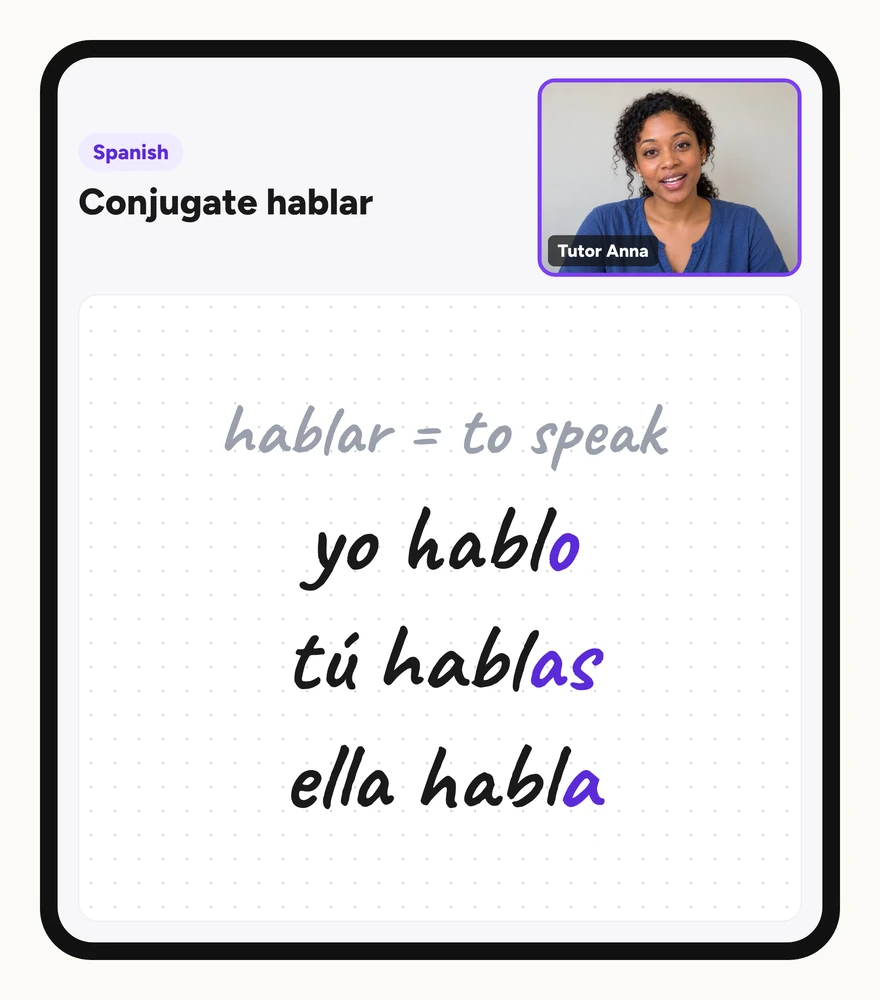
Illustration of an online Spanish lesson: a tutor on video and a whiteboard conjugating the verb hablar: yo hablo, tú hablas, ella habla.

This makes learning Spanish fun for my child — Sierra K, Spanish Tutoring

Try a class

Top Spanish Tutors

5 of 9 tutors shown · 5.0 avg rating from 794 reviews

Ms. Francies

Certified classroom teacher

5.0

118 ratings

5 years

Experience

K - 6th

Available Sun, Sat

Can support: ESL

Hi! My name is Aiyana Francies and I am excited to start this learning journey with you! I have 5 years of experience teaching 4th and 5th grade…

Pre-K - 3rd

Available Mon, Wed, Thu, Fri, Sat

Hello! My name is Alexa, and I am a psychologist who is passionate about teaching young children new things. I live in Mexico and I have 5 years of…

Pre-K - 8th

Available Sun, Tue, Wed, Thu, Fri

Can support: ADHD, Dyslexia, ESL ...

Hello Parents and Guardians, My name is Jazmin Garcia, and I am excited to be part of your child's learning journey this year! I recently graduated…

Pre-K - 8th

Available Mon, Tue, Wed, Thu, Fri

Can support: ESL

Hi! My name is Emma Brosinski, and I’m a passionate and experienced educator who loves helping students build confidence and enjoy learning. I have…

Pre-K - 5th

7 days a week

Can support: Dyslexia, ESL, Gifted & talented

Hi welcome! I'm Tutor Yolie (: I am excited to start this learning journey with you! I have been teaching for 6+ years in the classroom with…

What parents are saying about Spanish tutoring

The excitement in my son's voice was plesaiand joyful to my ears. Micaiah is so happy when pronunciatethe words correctly. I'm thankful to... have a teacher that brings him joy in learning a new language and help build his character.

Sharyn - 4th grade, Spanish

Ms.Chesin is awesome, she is very patient and loves repetition until my daughter feels confident and what she just learned.

Maria - 2nd grade, Spanish

She was very sweet and kind. My daughter loved her and she felt comfortable at the end of the session.

Doris - 2nd grade, Spanish

Spanish tutoring that connects sounds, words, and meaning

Students learning Spanish may need support with pronunciation, vocabulary, verb conjugation, or reading comprehension. A beginner might practice greeting phrases and color words, while an older student might work on distinguishing ser from estar or conjugating verbs across different subjects. Tutors can listen to what students already know and choose a focused next step.

Spanish tutoring can connect spoken practice with written work. Students might repeat a new word, use it in a sentence, and then read or write it. Tutors can explain a grammar pattern with examples, check pronunciation rules like the silent H or the sound of double LL, and help students apply vocabulary in conversation or short reading passages.

Why families look for Spanish support

Pronunciation and spelling feel disconnected

Spanish spelling and sound patterns can differ from English. Tutors can model the silent h in hola, the j sound in a word such as jardín, and the local pronunciation of ll. Students can connect a spoken example to its letters while recognizing that accepted pronunciation varies across Spanish-speaking regions.

Vocabulary is memorized but not used in sentences

Knowing a word list does not always mean students can use those words to express an idea. Tutors can practice vocabulary in context, such as forming sentences with me gusta, describing objects with colors and adjectives, or answering questions about daily routines. Speaking and writing practice can reinforce recall.

Verb conjugation rules are confusing

Spanish verbs change their endings to show who performs the action. Students may struggle to remember which ending matches each subject pronoun, or when to use ser versus estar. Tutors can present conjugation patterns systematically, practice with familiar verbs, and explain the reasoning behind irregular forms.

Where students can get stuck in Spanish

Distinguishing similar sounds and letters

Before a, o, or u, Spanish c has a /k/ sound, as in casa. Before e or i, it is pronounced like /s/ in most of Latin America and like English th in think in much of Spain. The g in gente also differs from the g in gato. Tutors can model the variety being learned and practise a small, consistent set of examples.

Remembering gender agreement with nouns and adjectives

Spanish nouns are masculine or feminine, and adjectives must match. A red car is un coche rojo, while a red bicycle is una bicicleta roja. Students may forget to change the adjective ending or apply the wrong article. Tutors can show the pattern with pairs of examples and ask students to explain the match.

Conjugating verbs without understanding the subject

Students may memorize verb endings but struggle to choose the correct form in a sentence. For the verb hablar, yo hablo means I speak, while ellos hablan means they speak. Tutors can connect each ending to its subject pronoun and practice with sentences that make the subject clear.

Mixing up ser and estar

Ser and estar both translate as to be in many sentences, but their uses depend on meaning and construction. Compare Soy estudiante, which identifies a role, with Estoy cansado, which describes a state, and Estoy en casa, which gives a person's location. Tutors can teach these uses in context rather than make permanence a universal deciding rule.

Reading without checking accent marks

Accent marks indicate which syllable to stress and can change a word's meaning. Papá with an accent means father, while papa without an accent means potato. Students may overlook the accent or pronounce the word incorrectly. Tutors can point out the mark, model the pronunciation, and explain its role.

How Spanish tutors make the next step clearer

Teach pronunciation rules with consistent examples

Tutors can introduce the silent h with hola, hilo, and hermano, then read those words in short sentences. For ll, examples such as llama and silla can show the pronunciation used in the variety being studied. Many speakers pronounce ll like y, while other accepted regional pronunciations differ.

  1. Introduce the pronunciation rule with one example word.
  2. Show two or three more words that follow the same pattern.
  3. Have students repeat each word and identify the sound.
  4. Read a short sentence containing one of the words to check meaning.

Connect verb conjugation to the subject pronoun

For a regular -ar verb such as hablar in the present tense, yo pairs with hablo, tú with hablas, and él or ella with habla. Tutors can connect the subject to the ending, then ask students to use a form in a sentence. Irregular verbs and other tenses need their own patterns.

Use vocabulary in sentences, not just lists

After introducing new words, tutors can ask students to form sentences using me gusta, tengo, or a descriptive phrase. For example, after learning color words, students might say mi mochila es azul or me gusta el color verde. This connects vocabulary to grammar and gives students practice expressing their own ideas in Spanish.

Putting Spanish skills into practice

Original examples that connect vocabulary, grammar, and pronunciation.

From vocabulary to a complete sentence

Learn the words cabeza, ojos, nariz, and boca. Then form the sentence Yo tengo dos ojos y una nariz. Students can identify the body parts, count them, and explain what the sentence means. Tutors can ask students to create a similar sentence with different vocabulary.

From one verb form to another subject

Start with yo hablo español. Change the subject to tú and ask students to adjust the verb: tú hablas español. Then try nosotros: nosotros hablamos español. Students can explain which part of the verb changed and why, connecting the ending to the subject pronoun.

Inside a 25-minute session

What a Spanish tutoring session can look like

This illustrative lesson introduces the verb tener and practices forming sentences with yo tengo. Tutors can choose different vocabulary or grammar depending on the student's level and current work.

  1. 0–3 min

    Review familiar vocabulary

    Check a few words the student already knows, such as colors or classroom objects. This gives a starting point and builds confidence before introducing new material.

  2. 3–8 min

    Introduce the verb tener

    Explain that tener means to have. Show the yo form: yo tengo. Model a sentence like yo tengo un lápiz and have the student repeat it.

  3. 8–15 min

    Practice with different objects

    Ask the student to form sentences using yo tengo with other vocabulary: yo tengo una mochila, yo tengo un cuaderno. Check pronunciation and meaning for each sentence.

  4. 15–22 min

    Connect speaking to writing

    Have the student write one or two sentences using yo tengo. Check spelling, capitalization, and the sentence structure. Read the sentences aloud together.

  5. 22–25 min

    Review and choose next practice

    Recap the verb form and ask the student to explain what yo tengo means. Decide whether to continue with tener for other subjects or introduce related vocabulary in the next session.

Example timings only. Tutors adapt the topic, activities, and pace to fit the student's needs.

Frequently Asked Questions

Terms of servicePrivacy PolicyNotice at Collection

© 2026 ClassDojo. All Rights Reserved.