
Skip content
Dojo Tutor
Log inTry class

Reading Tutoring

Personalized support from experienced teachers, with the flexibility of learning online.

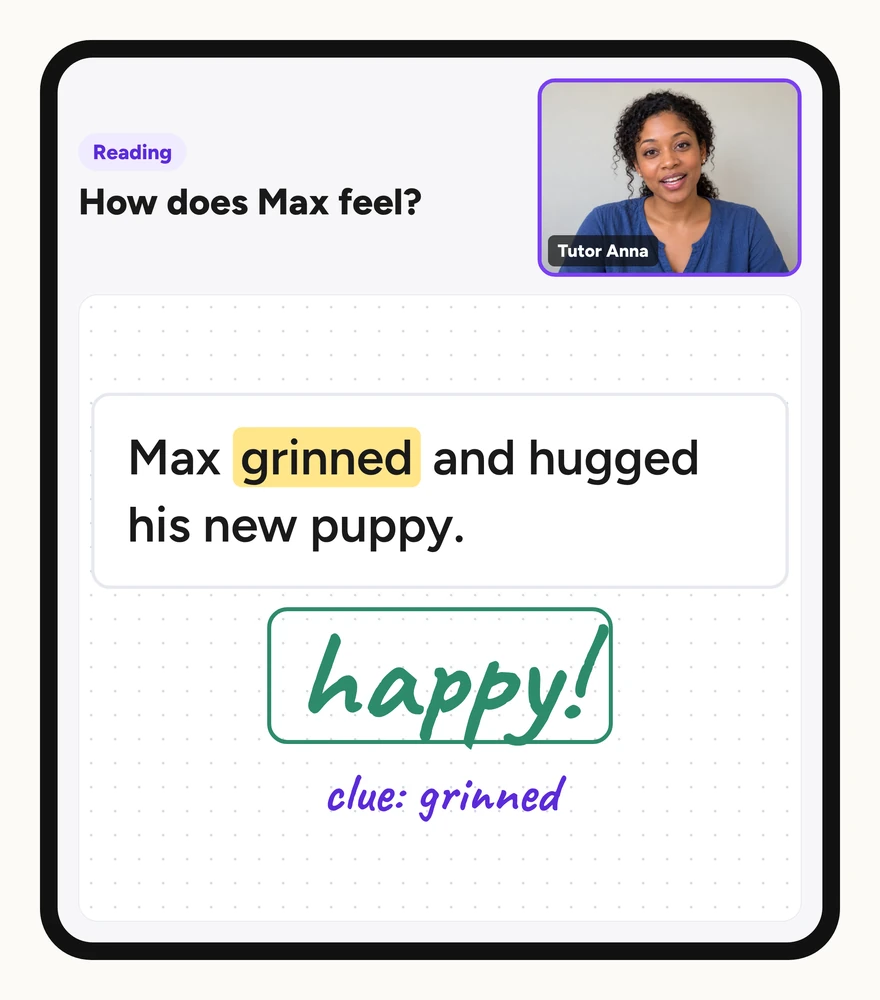
Illustration of an online reading lesson: a tutor on video and a sentence about Max with the clue word “grinned” highlighted to show he feels happy.

His comprehension and reading skills have improved significantly — Perthenia S, Reading Tutoring

Try a class

Top Reading Tutors

5 of 300+ tutors shown · 4.9 avg rating from 703 reviews

Ms. Angel

Certified classroom teacher

Super tutor

5.0

117 ratings

8 years

Experience

K-2nd grade

Available Mon, Tue, Thu, Fri

Can support: Special ed

Hello! My name is Ms. Angel, and I am excited to support your child through tutoring. I have experience teaching 2nd grade and currently teach 1st…

K - 3rd

7 days a week

Can support: Special ed

Hi families! My name is Ms.Shermae, and I’m an elementary and Special Education teacher who is passionate about helping children learn, grow, and…

2nd - 8th

Available Mon, Tue, Wed, Thu, Fri

Can support: ADHD, Behavioral, Special ed ...

I’ve been teaching since 1997, and I truly enjoy helping students figure out that “hard” doesn’t have to mean impossible. My background includes…

1st - 7th

Available Sun, Mon, Tue, Wed, Thu, Fri

Hi! I'm Brianna and I absolutely love working with children on their academic needs! I have been tutoring for a few years now and also have recently…

3rd grade, 4th grade

Available Tue, Thu

Hi, my name is Ms. Silvera and I am excited to start this learning journey with you! I have been teaching for 5 years, working with learners in…

What parents are saying about Reading tutoring

Ms. Johnson, is amazing. Elijah gravitated to Ms. Johnson and really enjoyed meeting her. I really am happy that Elijah and Ms. Johnson is a... perfect fit for his reading needs.

Ruth - 5th grade, Reading

Ms Van Horn is always patient, encouraging, and amazing. She gets so much accomplished in the little time available to her. We love working ... with her.

Amy - 1st grade, Reading

It's always a good time with Miss. Marissa. Amora has come such a long way and she's more confident when reading now.

Nakia - 2nd grade, Reading

Reading help that connects the words to their meaning

Reading difficulties can show up in different places. Students may know individual letter sounds but struggle to blend them, guess the end of an unfamiliar word, or read a passage accurately without understanding its meaning. A tutor can listen to the reading and ask a few questions to identify which part needs attention.

Reading tutoring can connect word-reading practice with vocabulary, phrasing, and comprehension. For emerging readers, that might mean working with a specific sound-spelling pattern. For more experienced readers, it might mean breaking apart a longer word, comparing an inference with the text, or explaining a paragraph in their own words.

Sound familiar?

Why families look for Reading support

Reading involves frequent stops and guesses

When an unfamiliar word interrupts every sentence, it can be hard to hold onto the meaning. Tutors can check the sounds or spelling patterns that need practice, then choose short words and sentences that let students apply that learning.

The words sound right, but the meaning is unclear

Accurate reading does not answer every comprehension question. Tutors can ask students to explain a sentence, identify an important detail, or show the words that support an answer. That helps separate a vocabulary question from a difficulty with inference or summarizing.

Where students can get stuck in Reading

Knowing sounds but not blending a word

Students may produce individual sounds without joining them into a recognizable word. Tutors can model blending with a short word, then ask students to connect the sounds while attending to the letters. The next check is whether the same approach transfers to another word.

Guessing before reaching the end

Recognizing the beginning of a word can lead to a guess that misses its ending. Tutors can ask students to check every part of the printed word, including a final consonant or suffix, before using the sentence to confirm that the reading makes sense.

Losing track of parts in a longer word

Longer words can contain familiar parts that are harder to recognize together. In unhelpful, students can notice un-, help, and -ful, read the parts, and blend the whole word. Discussing how the parts affect meaning adds a vocabulary check.

Pronouncing a word without understanding it

A word can be read accurately and still interrupt comprehension. Tutors can pause to discuss its meaning, use the surrounding sentence for clues, and check a glossary or dictionary when needed. Context supports a possible meaning; it does not always establish one.

Giving an answer without text evidence

An inference needs a connection to what the text actually says. Tutors can separate a stated detail from an interpretation, then ask which words support that interpretation. When students summarize, they can also distinguish the main point from an interesting but less important detail.

How Reading tutors make the next step clearer

Connect a sound pattern to the whole word

A short set of words can make a spelling pattern easier to examine. In team, leaf, and seat, ea represents the long e sound. Tutors can point out that pattern while keeping attention on the other letters. It is a pattern in these words, rather than a rule that every pair of vowels makes one sound.

  1. Notice the spelling pattern in a word.
  2. Connect the sounds to the letters and blend the whole word.
  3. Read another word with the same pattern.
  4. Use the word in a sentence and check its meaning.

Break a longer word into useful parts

Tutors can help students notice a familiar base, prefix, suffix, or sound-spelling pattern within a longer word. Students then read the parts and put them back together. The tutor can check the spoken word and meaning rather than suggest that one splitting rule works for every unfamiliar word.

Make the evidence behind an answer visible

Before answering a comprehension question, students can point to a relevant sentence and explain how it connects to their answer. Tutors can ask whether the text states the idea directly or leaves the reader to infer it. This gives students something concrete to revisit when an answer is plausible but unsupported.

Putting Reading skills into practice

Original examples of ways to connect word reading and comprehension.

From one familiar word to a changed sound

Read map, then change the final letter to make mat. Next, change the first letter to make sat. Students can identify which sound changed and reread each whole word. Tutors can check whether the response matches all the printed letters, rather than a remembered word shape.

From a stated detail to a supported inference

Try this short text: The gardener put on gloves and picked up a small shovel. A tray of seedlings waited beside an empty flower bed. First identify a stated detail. Then ask what the gardener might do next and which details support that prediction. Planting the seedlings is an inference, not a sentence copied from the text.

Inside a 25-minute session

What a Reading tutoring session can look like

This illustrative lesson practices the long e sound spelled ea in a small group of words, then connects word reading to a sentence. Tutors can choose a different pattern or comprehension task as needed.

  1. 0–3 min

    Listen to a familiar starting point

    Read a few familiar words or a short sentence. Check whether a pause comes from an unfamiliar spelling, word meaning, or another part of the reading.

  2. 3–8 min

    Look closely at a spelling pattern

    Introduce team, leaf, and seat. Point out that ea represents the long e sound in these words. The same letters can represent other sounds in other words, so keep this practice set focused.

  3. 8–15 min

    Blend and check the whole word

    Read the words together, then try them independently. Compare sea with seat to check whether students attend to the final consonant as well as the vowel pattern.

  4. 15–22 min

    Read for meaning

    Read the original sentence A seal rests on the beach. Ask where the seal rests, then return to a word that needed support. Reread for accuracy and natural phrasing.

  5. 22–25 min

    Review the pattern and next practice

    Revisit a word from the lesson and ask students to explain what helped them read it. Choose a short next practice or return to blending if the pattern is still uncertain.

Example timings only. Activities and pace can change with the reader's needs.

Frequently Asked Questions

Terms of servicePrivacy PolicyNotice at Collection

© 2026 ClassDojo. All Rights Reserved.