
Skip content
Dojo Tutor
Log inTry class

Preschool Tutoring

Personalized support from experienced teachers, with the flexibility of learning online.

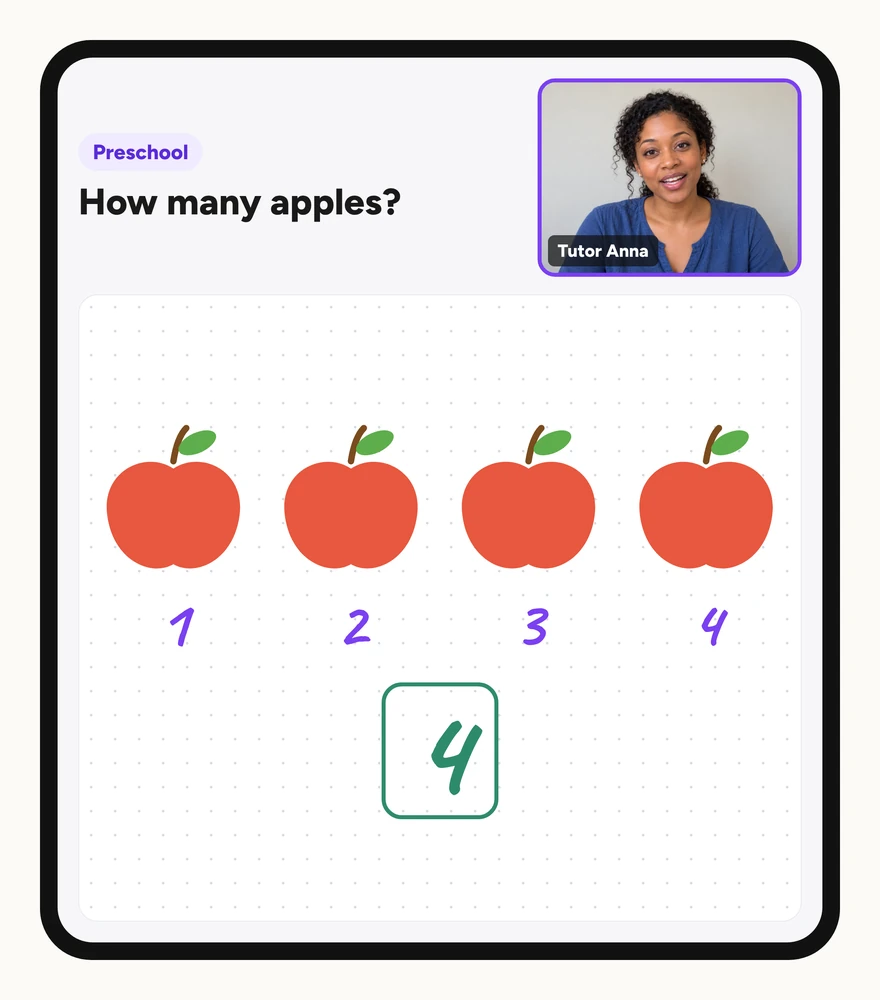
Illustration of an online preschool lesson: a tutor on video and four apples counted one through four.

I have seen such a boost in her grades and confidence — Jessica S

Try a class

Top Preschool Tutors

5 of 180 tutors shown · 5.0 avg rating from 1,239 reviews

Esther Okelola

5.0

2 ratings

8 years

Experience

Pre-K - 4th

Available Wed, Thu

I am excited to support your student’s learning journey with 8 years of experience teaching Pre-K through 3rd-grade students. My Bachelor’s in…

1st - 4th

Available Sun, Fri, Sat

Can support: ESL

Hi! I’m Michelle, an experienced educator with 12 years of teaching experience, including several years teaching 3rd grade. I am passionate about…

Pre-K - 5th

Available Tue, Thu

Hi I am Ms.Bri! I have been teaching for 19 years, and I am a National Board Certified teacher. I have worked with students in kindergarten - 5th…

Pre-K - 7th

7 days a week

Hello! My name is Tanya Smith, and I have over 7 years of experience tutoring children ages 14 and younger. I specialize in core subjects and am…

Pre-K - 4th

Available Mon, Wed

Can support: ADHD

With 21 years of teaching experience, I've had the pleasure of working with kids in grades 3rd and below in subjects like Reading, Math, Spelling,…

What parents are saying

Ms. Johnson, is amazing. Elijah gravitated to Ms. Johnson and really enjoyed meeting her. I really am happy that Elijah and Ms. Johnson is a... perfect fit for his reading needs.

Ruth - 5th grade, Reading

Miss Field has been an awesome asset to Caleb’s learning experience. His improvement is noticeable since he started working with her. We app... reciate her so much.

Justin - 2nd grade, Math

I love that Ms. Vanessa engaged Montrail by asking him what are some of the things that he liked. She allowed him to express his emotions an... d then gave him reassurance. By the end of class, his mood had changed! I like the idea that she asked questions that made him utilize his critical thinking skills! She also gave pointers on things that he can benefit from during the tutoring sessions.

Tyler - 3rd grade, Science

Preschool tutoring that makes letters, sounds, and numbers concrete

Preschool learning can look different from one child to the next. Some children are exploring letter names and sounds; others are beginning to count objects or make letter shapes. Tutors can choose a small starting point based on what children can already recognize, say, or show.

Pictures, objects, and short activities can give early learning a clear purpose. Children might find objects that begin with a familiar sound, count a small group without skipping anything, or trace one letter. Blending and word-building activities can be introduced when the relevant sounds and letters are familiar, with the pace adapted to the child.

Why families look for preschool support

Letter names and sounds are still being learned

Children may recognize some letters and need more practice with others. Tutors can introduce a letter, connect its shape to a sound and a familiar picture, and return to it in a short matching or tracing activity.

Counting and number recognition need more practice

Students may count objects accurately within a small range but lose track with larger sets or skip numbers in the counting sequence. Tutors can use objects, pictures, and number lines to make counting visible, then connect the spoken number to its written form.

Blending sounds into words is a new challenge

When children are ready to connect familiar sounds, tutors can model joining them into a short spoken word. Printed words can be added using letter-sound relationships children already know. Recognizing letters and blending sounds can develop at different paces.

Learning needs that can show up in preschool

Confusing letters that look similar

Lowercase b and d can be hard to distinguish. Tutors can show where the tall stroke and rounded part sit in each letter, trace the shape, and compare it with a model. A small amount of focused practice can keep the task manageable.

Saying sounds without blending them into a word

Children may recognize the separate sounds in a short word without joining them together. Tutors can model connecting familiar sounds, then invite children to try. If blending is still difficult, the activity can return to listening for a beginning sound or recognizing a known letter.

Skipping or counting the same object twice

Reciting number words and counting a set are related but different skills. Tutors can arrange a small group of objects and invite children to move or point to each object once while counting. Asking how many there are altogether connects the final number word to the whole set.

Identifying the beginning sound but not the ending

Children may notice the first sound in a familiar word more readily than the last. Tutors can say a short word slowly, help children listen for a target sound, and model the mouth movement. The task can stay with one sound until it becomes clearer.

Writing letters without consistent formation

Children may recognize a letter but need support making its shape. Tutors can model one letter with a clear starting point and direction, then offer tracing or another supported attempt. The focus can stay on a few deliberate movements rather than a full page of writing.

How preschool tutors make early skills clearer

Connect each letter to a sound and a picture

Tutors can introduce one letter at a time by showing its shape, saying its sound, and linking it to a familiar word and image, such as S for snake or A for apple. Students can trace the letter, say the sound, and find other pictures that start with the same sound, building recognition through multiple connections.

  1. Show the letter and say its name.
  2. Model the sound and connect it to a picture.
  3. Have the student trace or write the letter.
  4. Find or color other objects that start with the same sound.

Use objects and pictures to make counting concrete

Tutors can present small groups of objects or pictures and ask students to touch and count each one, then write or circle the matching numeral. Counting aloud while pointing helps students connect the number word to the quantity and prevents skipping or double-counting.

Model blending sounds into a whole word

With familiar sounds, tutors can stretch a short word such as fin and model joining its sounds. Children can listen and repeat before working with print. When letters are introduced, tutors can check the sounds against those letters and then discuss what the word means.

Putting preschool skills into practice

Original examples of ways to connect letter sounds, counting, and blending.

From letter sounds to spelling a simple word

For children who know the relevant sounds and letters, say sun and listen for its three sounds. Choose s, u, and n in order, then connect the sounds to read the word. If that is too much at once, stay with identifying /s/ and matching it to the first letter.

From counting objects to writing the numeral

Arrange four blocks where each can be seen. Children can touch or move one block at a time while counting, then choose the numeral 4. Rearrange the same blocks and count again to explore how the arrangement can change while the quantity stays four.

Inside a 25-minute session

What a preschool tutoring session can look like

This illustrative lesson uses a familiar /m/ sound as a starting point. Letter recognition and, when appropriate, blending can build from it. Tutors can simplify the activity or change the goal to match current skills and attention.

  1. 0–3 min

    Review a familiar letter or number

    Check a previously learned letter sound or count a small set of objects together. This warm-up helps the student settle in and shows what is already secure.

  2. 3–8 min

    Connect a sound to a letter and picture

    Show M and connect /m/ to a picture of a mouse. Invite children to say the sound and trace or point to the letter. A matching activity can provide another way to recognize it.

  3. 8–15 min

    Build from familiar sounds

    If /a/ and /t/ and their letters are familiar, model connecting /m/ /a/ /t/ to read mat. Otherwise, continue identifying /m/ in spoken words and matching M to its sound.

  4. 15–22 min

    Try another example independently

    Offer a related activity with less prompting. Children might select M from a small letter set or, if ready, blend map using familiar letters. Adjust the task when it becomes unclear rather than require a complete word.

  5. 22–25 min

    Review a small step and choose what comes next

    Return to the letter or sound from the lesson and invite children to show what they remember. Acknowledge their effort and choose whether to repeat the activity or make a small change next time.

Example timings only. Preschool sessions are flexible and may include movement, games, or shorter activities to maintain engagement.

Frequently Asked Questions

Terms of servicePrivacy PolicyNotice at Collection

© 2026 ClassDojo. All Rights Reserved.