Skip content
Dojo Tutor
Log inTry class

Middle School Tutoring

Personalized support from experienced teachers, with the flexibility of learning online.

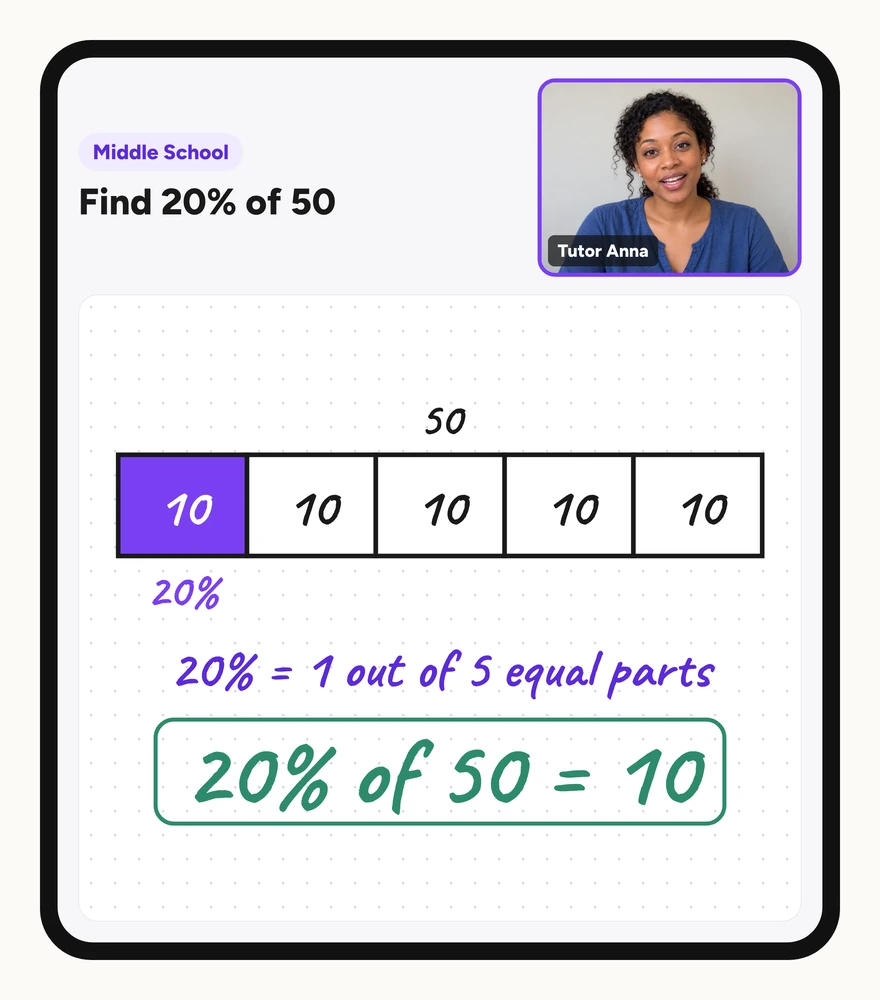
Illustration of an online middle school lesson: a tutor on video and a bar model splitting 50 into five parts to show 20% of 50 is 10.

I have seen such a boost in her grades and confidence — Jessica S

Try a class

Top Middle School Tutors

5 of 132 tutors shown · 5.0 avg rating from 2,447 reviews

Mrs.Blackwood-Salmon

Certified classroom teacher

Super tutor

4.9

336 ratings

7 years

Experience

3rd - 6th

7 days a week

My name is Mrs. Blackwood-Salmon, and I am excited to be your child’s 3rd–5th-grade tutor. Teaching is truly my passion, and I strive to create a…

Pre-K - 7th

Available Fri

I have taught in 1st and 5th grade classrooms in Indiana. I hold a Bachelor's Degree in Elementary Education and am a licensed elementary teacher.

K-2nd grade

Available Mon, Tue, Wed, Thu, Fri, Sat

Can support: ADHD, Dyslexia, ESL ...

Hi, my name is Kristine, and I’m thrilled to begin this learning journey with you! I’ve been teaching for 13 years and have loved every moment of it.…

K-6th grade

Available Mon, Thu, Fri, Sat

Can support: ADHD, Dyslexia, ESL ...

I have been in education for the past 15 years. I started with student teaching in second grade and during this time I was tutoring at STARS math and…

K-5th grade

Available Sun, Mon, Tue, Fri, Sat

Can support: ADHD, Dyslexia, ESL ...

Hello! My name is Melinda. I’m excited to start this learning journey with you and your child! I live in Alaska, where I’ve spent the past 24 years…

What parents are saying

Mrs Burkhart is awesome! Ashley has gained so much confidence in her math skills. She is positive and encouraging. It has been a great ex... perience.

Allison - 6th grade, Math

She’s been great ! My son has really improved his basic math skills. He’s a lot more confident in what he’s doing in math now. It was the pe... rfect way to begin 6th grade year. Thank you !

Iesha - 6th grade, Math

My son extremely enjoyed the session and I am very pleased it is nice to have help I appreciate her patience her kindness and support thank ... you

Angela - 6th grade, Back-to-School Boost

Middle-school tutoring that builds reasoning across subjects

Middle-school students may encounter different challenges across their day: solving multi-step equations, analyzing evidence in a text, organizing an essay, or understanding force and motion in science. A student who confidently solves one-step equations may struggle when variables appear on both sides; a reader who decodes fluently may need support distinguishing fact from inference or matching a claim to relevant evidence.

Tutors can start with the specific point where understanding breaks down. That might mean connecting a slope to its real-world rate of change, explaining how to support a thesis with textual evidence, distinguishing chloroplasts from mitochondria, or revising a paragraph to strengthen its argument. The goal is to help students explain their reasoning, check their work, and transfer strategies to new problems.

Why families seek middle-school support

Earlier skills are affecting new material

Integer operations can affect equation solving; fraction fluency can affect slope calculations; vocabulary gaps can slow comprehension. Tutors can identify which building blocks need attention alongside current homework, then practice a foundational skill before adding complexity.

The steps are memorized but the reasoning is unclear

Students may apply a procedure without understanding when it applies or why it works. Tutors can ask students to explain a step, connect an equation to a graph, or identify the evidence behind a reading answer. This helps students check their own work rather than rely on recall alone.

Organization and planning need more support

Longer assignments can require outlining an essay, planning a multi-step solution, or distinguishing main ideas from supporting details. Tutors can help students break a task into manageable parts and check progress at each stage.

Learning needs that can show up in middle school

Algebra: combining like terms and isolating variables

Students can identify the same variable part before combining like terms and keep each equation balanced while solving. In 4y − y + 6 = 21, combining the y terms gives 3y + 6 = 21, so y = 5. Substituting gives 20 − 5 + 6 = 21, checking the result in the original equation.

Algebra: interpreting slope and intercepts in context

A slope representing cost per person is different from a point representing the total cost for one group size. Tutors can label quantities and units, connect rise over run to the rate of change, and identify the y-intercept as the model's value when x = 0.

Reading: distinguishing fact from opinion and inference from evidence

Students may identify an opinion as fact when it contains numbers, or offer an inference without locating supporting text. Tutors can ask whether a statement can be verified, identify signal words like 'best' or 'absolutely,' and prompt students to point to the sentence that supports their answer.

Reading: using context clues for unfamiliar vocabulary

Pronouncing a word does not guarantee understanding it. Tutors can guide students to read the surrounding sentence, search for clues before and after the unfamiliar word, and connect those clues to propose a meaning. A dictionary can confirm the definition when context alone is insufficient.

Writing: organizing and developing paragraphs

Students may list facts without explaining their connection or add words without adding useful information. Tutors can help students plan a paragraph with one main point, select relevant supporting details, and explain how the evidence connects to the claim. Each sentence should contribute to the paragraph's purpose.

Science: distinguishing related concepts

Tutors can compare photosynthesis with aerobic respiration by tracing inputs, outputs, and energy transfers. Chloroplasts in photosynthetic plant cells capture light energy to build sugars. Respiration begins in the cytoplasm, with later stages in mitochondria, and transfers energy from glucose into ATP. Plant cells respire as well as photosynthesize.

How tutors help middle-school students explain their reasoning

Connect equations to their graphical or real-world meaning

An equation in slope-intercept form y = mx + b can be graphed by plotting the y-intercept b and using the slope m as rise over run. In a real-world problem, the slope might represent dollars per item and the y-intercept a fixed fee. Tutors can ask students to identify what each number represents in context, graph a point, and check whether the line matches the situation.

  1. Identify the slope and y-intercept in the equation.
  2. Explain what each value represents in the problem context.
  3. Plot the y-intercept and use rise over run to find another point.
  4. Check that the graph matches the relationship described.

Support reading answers with specific text evidence

Tutors can teach a multi-step process: read the question carefully, locate relevant details in the text, and explain how those details support the answer. For inference questions, students can distinguish what the text states directly from what the reader concludes, then identify the words or phrases that make the inference reasonable.

Plan writing before drafting and revise with a clear goal

An outline or graphic organizer can separate brainstorming from drafting. Students can identify their thesis, choose supporting evidence, and plan how each paragraph will develop the argument. Tutors can then help students revise one feature at a time—such as adding a missing explanation, choosing a more precise word, or ensuring each sentence connects to the main point—before editing for grammar and punctuation.

Connecting skills across middle-school subjects

Original examples showing how students can move from a procedure to an explanation.

From solving an equation to checking the solution

Solve 8x − 12 = 12 by adding 12 to both sides to get 8x = 24, then dividing by 8 to get x = 3. Check by substituting: 8(3) − 12 = 24 − 12 = 12. Tutors can ask why the same operation is applied to both sides and what the check confirms about the solution.

From identifying a detail to explaining an inference

Read this original text: The artifact was handled carefully and placed in a protective container. Ask what the word 'fragile' might mean. Students can identify 'handled carefully' and 'protective container' as clues, propose 'easily broken' as a meaning, and explain which words in the sentence support that definition.

Inside a 25-minute session

What a middle-school tutoring session can look like

This illustrative lesson focuses on solving two-step equations in Algebra. The topic, activities, and pace can change depending on the student's current work and needs. Tutors adapt the session to address the specific difficulty the student is experiencing.

  1. 0–3 min

    Identify what the student already knows

    Review a one-step equation like x + 7 = 15 to check whether the student can isolate the variable using inverse operations. Confirm understanding before adding a second step.

  2. 3–8 min

    Introduce a two-step equation

    Present 3x + 4 = 19. Discuss the order of operations: undo addition or subtraction first, then undo multiplication or division. Subtract 4 from both sides to get 3x = 15.

  3. 8–15 min

    Complete the solution and check

    Divide both sides by 3 to get x = 5. Substitute 5 back into the original equation: 3(5) + 4 = 15 + 4 = 19. Ask the student to explain why substitution confirms the solution is correct.

  4. 15–22 min

    Practice with a new problem

    Try 5y − 9 = 16. The student works through adding 9 to both sides, then dividing by 5, and checks the solution independently. The tutor observes and prompts as needed.

  5. 22–25 min

    Review the strategy and plan next steps

    Recap the two-step process and the importance of checking solutions. Identify whether the student is ready for equations with variables on both sides or needs more practice with the current skill.

Example timings only. Sessions can focus on Reading, Writing, Science, or another Math topic, and tutors adjust the pace and depth to match the student's understanding.

Frequently Asked Questions

Browse tutors by subject

Browse tutors by specialty

Terms of servicePrivacy PolicyNotice at Collection

© 2026 ClassDojo. All Rights Reserved.