Skip content
Dojo Tutor
Log inTry class

Math Tutoring

Personalized support from experienced teachers, with the flexibility of learning online.

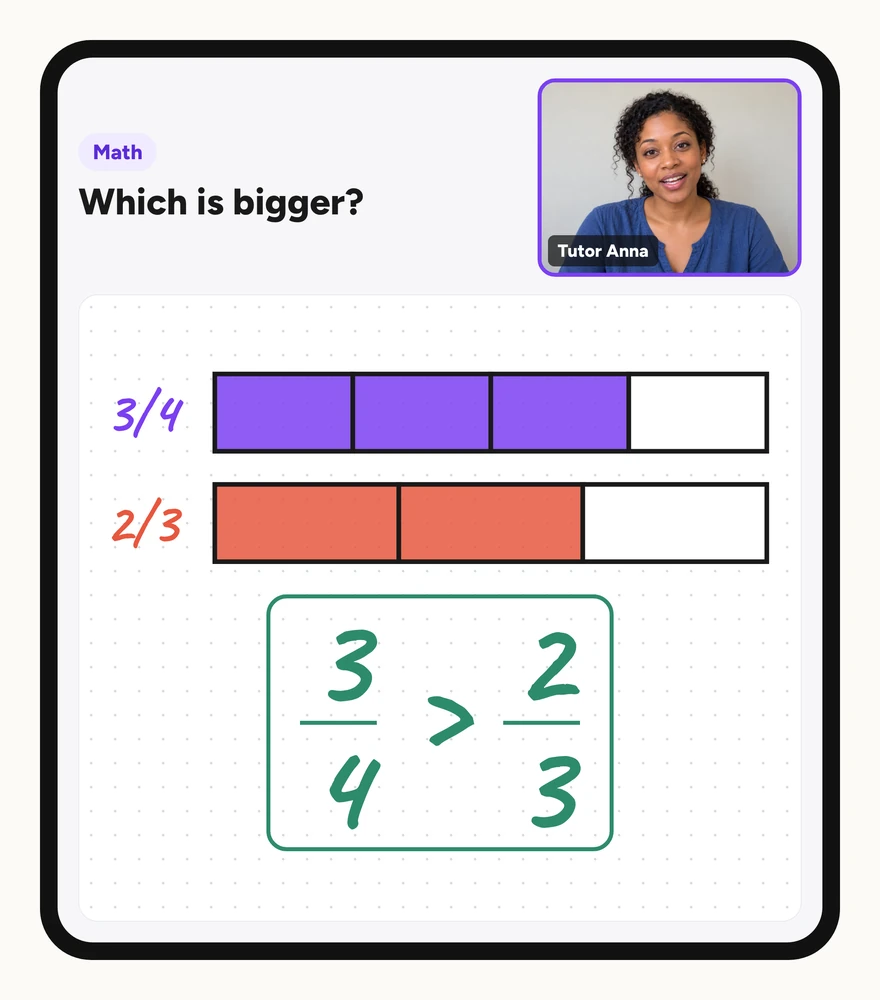
Illustration of an online math lesson: a tutor on video and fraction bars comparing 3/4 and 2/3.

I have seen such a boost in her grades and confidence — Jessica S, Math Tutoring

Try a class

Top Math Tutors

5 of 300+ tutors shown · 4.7 avg rating from 903 reviews

Ms. Grant

Certified classroom teacher

Super tutor

5.0

57 ratings

26 years

Experience

Pre-K - 5th

Available Mon, Tue, Wed

I am an educator with 27 years experience from prek to eighth grade. I have been a principal, assistant principal, and a classroom teacher. I love…

2nd - 6th

Available Mon, Tue, Wed, Thu, Fri

Hi! I am Ms.Melanie and I look forward to working with you. Some things to know about me is that I absolutely love my job! I have a great passion for…

3rd grade, 4th grade

Available Mon, Tue, Wed

Hello! I have been in the educational system for 18 years and I have a Masters plus 30 credits in Elementary Education. My first five years of…

3rd to 6th grade

Available Mon, Tue, Wed, Thu, Fri, Sat

Hi families! I’m Jordan, a dedicated educator with a strong background in middle school math and a passion for helping students build confidence in…

3rd - 7th

7 days a week

I am a passionate educator who believes every child can grow into a confident, curious problem-solver and avid reader. I help students discover that…

What parents are saying about Math tutoring

Miss Field has been an awesome asset to Caleb’s learning experience. His improvement is noticeable since he started working with her. We app... reciate her so much.

Justin - 2nd grade, Math

Mrs. Boehm is an awesome tutor! I would love for Gracen to continue to work with her because she had Gracen engaged and excited to learn. I ... love how calm and caring she is. The way that she taught Gracen was with grace and kindness. I am excited for Gracen to work with Mrs. Boehm again.

Armenta - 3rd grade, Math

She’s making big strides in math and is so excited for her tutor time each week. She actually enjoys the lessons! We are lucky to have found... Mrs Strong!

Melissa - 3rd grade, Math

Math help that connects the answer to the reasoning

Students may know a rule and still get stuck deciding when to use it. Regrouping can feel like moving digits without a reason; fractions can become a list of steps; negative signs can change an otherwise sound solution. Math tutoring can start with the exact point where the calculation stops making sense.

Tutors can connect written work to base-ten drawings, equal groups, number lines, and equations. Younger students might exchange ten ones for one ten. Older students might explain a sign change or check an equation by substitution. The aim is to give students a way to explain and check the next step, alongside practicing the calculation.

Sound familiar?

Why families look for Math support

Earlier skills are making new work harder

Multiplication facts can affect long division and fraction work. Place value can affect regrouping and decimals. Tutors can check these building blocks alongside current homework, then choose a smaller skill to revisit before adding another step.

The steps are familiar, but the reasoning is unclear

Students may remember to carry a digit or change a sign without knowing why. Tutors can ask students to show the same idea with a drawing or number line, then connect that representation to the written calculation.

Where students can get stuck in Math

Losing place value during regrouping

In 48 + 27, eight ones plus seven ones make fifteen ones: one ten and five ones. Writing both digits in the ones column hides that exchange. Drawing the tens and ones can show why the extra ten belongs in the next column.

Counting every group instead of using a known fact

Students may rebuild each multiplication fact from one. Connecting related facts gives another route: if 6 × 4 = 24, then 7 × 4 is one more group of four, or 28. The same fact family connects 24 ÷ 6 with multiplication.

Treating a fraction's parts as separate whole numbers

A denominator names the size of the parts; a numerator counts them. That meaning matters when finding equivalent fractions or converting mixed numbers. For example, 2⅓ is seven thirds because the two wholes contain six thirds, with one more third remaining.

Applying sign rules without tracking the operation

Adding a negative and subtracting a negative describe different changes. In 6 + (−12) + 14, students can combine the first two terms to get −6, then add 14 to get 8. Showing each intermediate value makes the sign changes easier to check.

Skipping steps in a longer problem

A correct setup can still lead to an incorrect answer if a carried digit, unit, or final substitution is missed. Tutors can ask students to write a short reason beside each line and check whether the result fits the original question.

How Math tutors make the next step clearer

Show the exchange behind carrying and borrowing

Base-ten drawings can connect a regrouping step to the quantity it represents. In 52 − 28, exchange one ten for ten ones: five tens and two ones become four tens and twelve ones. Students can then subtract within each place instead of treating borrowing as a change to a digit.

  1. Represent 52 as five tens and two ones.
  2. Exchange one ten: four tens and twelve ones.
  3. Subtract two tens and eight ones to leave 24.
  4. Check with 24 + 28 = 52.

Build a new multiplication fact from a known one

An array gives students something to count, split, and compare. Six rows of four contain 24 objects. Adding one more row adds four objects, making seven rows of four, or 28. Tutors can connect the picture, repeated addition, and multiplication notation before asking for recall.

Choose a check that matches the problem

A useful check depends on the task. Students can use multiplication to check a division result, substitution to check an equation, or estimation to spot an unreasonable total. Tutors can ask students to explain what their check confirms, including whether they answered the question and used the correct units.

Putting Math skills into practice

Original examples of ways to connect a practiced skill to a related problem.

From skip counting to equal groups

Count 6, 12, 18, 24 while drawing four groups of six. Then cover the list and ask what 4 × 6 means in the picture. For a related problem, add another group: 5 × 6 = 30. Students can explain what changed instead of starting the count again from one.

From an answer to a checked solution

For 3x + 4 = 19, subtract 4 from both sides to get 3x = 15, then divide by 3 to get x = 5. Check the original equation: 3(5) + 4 = 19. Tutors can ask why the same operation is applied to both sides and what the check tells us.

Inside a 25-minute session

What a Math tutoring session can look like

This illustrative lesson focuses on two-digit addition with regrouping. Tutors can choose a different skill or adjust the pace to match the student's current work.

  1. 0–3 min

    Check tens and ones

    Represent 37 as three tens and seven ones. Try an addition problem without regrouping to check whether the place-value columns are understood.

  2. 3–8 min

    Find the step that needs attention

    Try 48 + 27. Ask what happens when eight ones and seven ones are combined, and where the extra ten should go.

  3. 8–15 min

    Connect a model to the written method

    Draw fifteen ones, exchange ten of them for one ten, and leave five ones. Add the tens, including the new ten, to reach 75.

  4. 15–22 min

    Try a related problem

    Work on 29 + 16. Students show the exchange themselves and explain why the sum has four tens and five ones.

  5. 22–25 min

    Check and choose the next practice

    Check that 75 − 27 returns 48. Review the exchange that made regrouping necessary, then choose another problem or return to the model if the step is still unclear.

Example timings only. The topic, activities, and pace can change with the student's needs.

Frequently Asked Questions

Terms of servicePrivacy PolicyNotice at Collection

© 2026 ClassDojo. All Rights Reserved.