
Skip content
Dojo Tutor
Log inTry class

Kindergarten Tutoring

Personalized support from experienced teachers, with the flexibility of learning online.

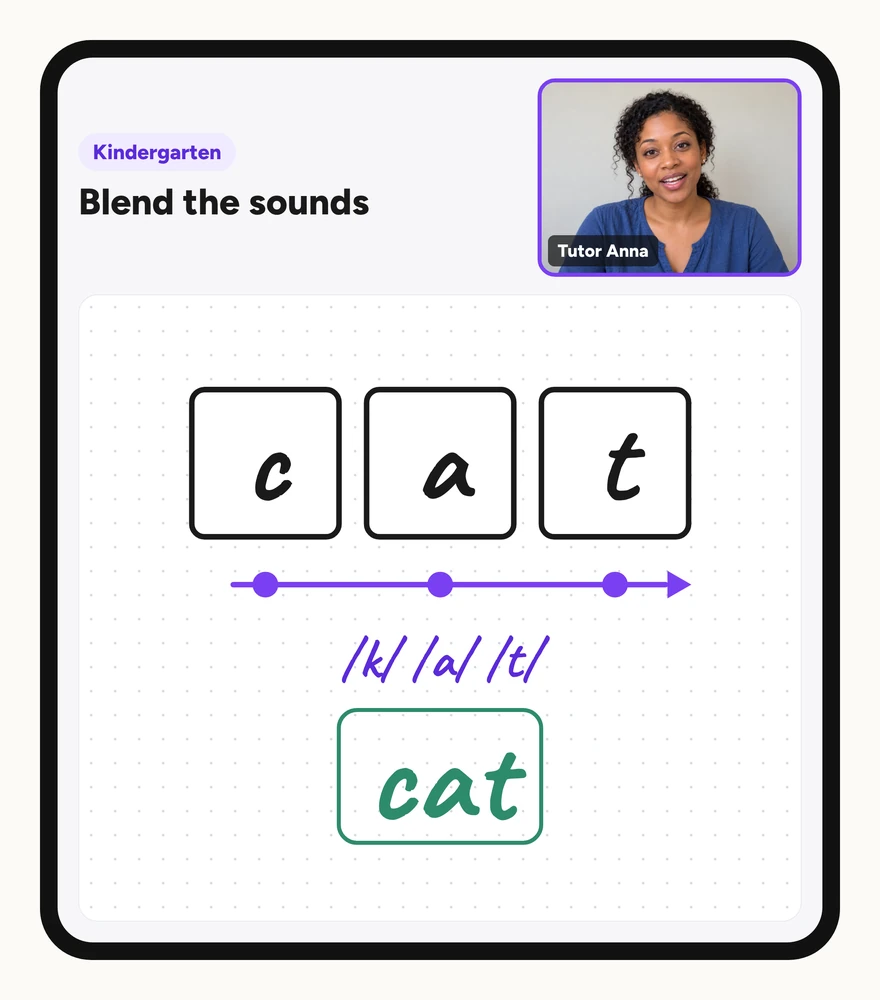
Illustration of an online kindergarten lesson: a tutor on video and sound boxes blending c, a, t into the word “cat.”

I have seen such a boost in her grades and confidence — Jessica S

Try a class

Top Kindergarten Tutors

5 of 252 tutors shown · 5.0 avg rating from 2,897 reviews

Ms. Jess

Certified classroom teacher

Super tutor

5.0

502 ratings

6 years

Experience

K-5th grade

Available Mon, Tue, Wed, Thu, Fri, Sat

Can support: Special ed, Autism spectrum

I have been teaching and working with learners from Kindergarten to 12th grade in subjects such as Reading, Writing, Science, and Math. My teaching…

K - 6th

Available Mon, Wed, Thu, Fri, Sat

With 44 years of teaching experience, I have taught a wide variety of grades and subjects, including all grades from Kindergarten to 12th grade. I…

K-4th grade

Available Mon, Tue, Wed, Thu

Can support: ADHD, Special ed, Autism spectrum

I am a 23rd year educator that absolutely loves teaching. I am a graduate of Alcorn State University and of Freed-Hardeman University. I received my…

Kindergarten, 1st grade, 2nd grade

Available Thu, Fri

Can support: ADHD, ESL, Autism spectrum

I have been a teacher in North Carolina for 19 years, working with learners of all ages and abilities. I have experience teaching multiple grades, as…

K - 4th

Available Tue, Fri

Hi, my name is Mrs. Gilda and I am excited to start this learning journey with you! With several years of teaching experience, I’ve had the joy of…

What parents are saying

Miss Jones is excellent. She fully engages herself with teaching my son Cole and he loves all the different interactive games. Thank you!

Brooke - Kindergarten, Summer Boost

Dr. MK is so patient and makes the most of the time in the session. I have seen my son progress so much this summer that he is ready for Ki... ndergarten. I would highly recommend her as a tutor!

Melissa - Kindergarten, Summer Boost

She's amazing, and I can see the growth in my child. I appreciate Dr. Wilson and her patience with Dakota.

Kiara - Kindergarten, Reading

Kindergarten tutoring that builds early Reading, Writing, and Math skills

Kindergarten learning can involve recognizing letters, connecting sounds to print, counting objects, and forming letters or numerals. Students may need support with different parts of those tasks, such as blending sounds, keeping track while counting, or comparing quantities. Tutors can begin with the skill students can currently show rather than assume a fixed starting level.

Tutors can start with what students already know and add one clear next step. That might mean practicing a specific letter sound, blending a short word, writing letters on lines, counting objects and matching them to numerals, or explaining a simple addition picture. Concrete materials, drawings, and spoken explanations give kindergartners ways to show their thinking before moving to written work.

Why families look for kindergarten support

Letter recognition or sounds are still developing

Students may recognize some letters but confuse others that look similar, such as b and d, or struggle to recall the sound each letter makes. Tutors can practice a small set of letters with visual cues, multisensory activities, and repeated exposure rather than introduce the entire alphabet at once.

Blending sounds into words takes extra time

Knowing individual letter sounds does not automatically lead to reading whole words. Tutors can model blending with short words, ask students to connect the sounds while looking at the letters, and check whether the spoken word matches the print before moving to a new example.

Writing letters or staying on lines is challenging

Students may form letters inconsistently, reverse them, or spread them far apart. Tutors can demonstrate correct formation, use lines with clear boundaries, and give specific feedback about where each stroke starts and stops. Keeping letters close together in a word is a separate skill that also needs practice.

Learning needs that can show up in kindergarten

Reading: distinguishing similar letters

Letters like b, d, and p share features but differ in orientation. Tutors can use visual mnemonics, such as describing b as having a belly or d as having a different direction, and provide repeated practice with words containing these letters to reinforce the distinctions.

Reading: blending sounds without dropping letters

Students may say sounds separately but lose one when blending a word. Tutors can point to the letter or group of letters representing each sound, then blend the sounds while keeping attention on the print. The check is that the spoken word matches the written word; two letters can work together to represent one sound.

Reading: recognizing sight words without relying only on memory

High-frequency words include both regular and irregular spellings. Tutors can connect sounds to letters where possible, point out an unexpected spelling, and practice the word in meaningful sentences. Repeated exposure in context supports recognition alongside phonics instruction.

Writing: forming letters with correct directionality

Students may start letters at the wrong place or write them backwards. Tutors can give step-by-step instructions, such as starting at the top line and going down, then adding a curve or crossbar. Practicing one letter at a time with immediate feedback helps establish correct habits.

Writing: spacing letters within words

Students may leave large gaps between letters in a single word or run words together. Tutors can model keeping letters in a word close together while leaving space between words, and provide visual examples on lined paper to show the difference.

Math: counting objects accurately with one-to-one correspondence

Students may count too quickly, skip objects, or count the same object twice. Tutors can slow the counting, touch or move each object as it is counted, and ask students to verify the total by counting again or matching objects to numerals.

Math: writing numerals with correct formation

Numerals like 3 and 5 have specific starting points and curves. Tutors can model formation, describe the strokes aloud, and provide lined practice. Reversals and incorrect shapes can be corrected with repeated modeling and immediate feedback.

Math: understanding that adding means combining quantities

Students may count two groups separately without connecting them to a total. Tutors can combine three counters with two more, count the resulting five, and relate the action to 3 + 2 = 5. The situation determines the operation; the word and alone is not a reliable instruction to add.

How tutors support kindergarten learning

Connect letter sounds to words and pictures

Tutors can introduce a letter sound with a picture cue, such as showing a cat for the letter C. Students practice the sound, identify other words that begin with the same sound, and write the letter while saying it aloud. This multisensory approach reinforces the connection between the symbol, sound, and meaning.

  1. Show the letter and say its sound.
  2. Display a picture of an object that begins with that sound.
  3. Ask students to name other words starting with the same sound.
  4. Practice writing the letter while repeating the sound.

Model blending with short, decodable words

Tutors can choose simple consonant-vowel-consonant words like cat or sit. They model saying each sound, then blending them smoothly without pausing between sounds. Students repeat the process, checking that the spoken word matches the letters. Tutors can then introduce a new word with one changed letter to reinforce the pattern.

Use concrete objects to show addition and subtraction

Tutors can present a small number of objects, such as counters or drawings. For addition, students count each group and then count all objects together to find the total. For subtraction, students start with a set, remove some, and count what remains. Connecting the action to an equation helps students see what each number represents.

Connecting kindergarten skills to new tasks

Original examples that build from a practiced skill to a related challenge.

From knowing sounds to blending a new word

Practice the sounds for m, a, and t separately. Then blend them to read mat. Change the first letter to s and read sat. Ask students to explain which sound changed and check that they attend to all three letters before saying the word.

From counting objects to writing an addition equation

Show three red blocks and two blue blocks. Count each color, then count all five blocks together. Write 3 + 2 = 5 and ask students to explain what each number represents. Try another example with different quantities to check understanding.

Inside a 25-minute session

What a kindergarten tutoring session can look like

This illustrative lesson focuses on blending sounds to read short words with the short vowel a. Tutors can choose a different letter, sound pattern, Math skill, or writing task depending on the student's current needs. The pace and activities can be adjusted, and one session does not need to cover all subjects.

  1. 0–3 min

    Review known letter sounds

    Show letters m, a, t, and s. Ask students to say each sound. Check which sounds are secure and which need more practice before blending.

  2. 3–8 min

    Model blending a short word

    Write mat. Point to each letter and say its sound, then blend them smoothly: m-a-t, mat. Ask students to repeat while watching the letters.

  3. 8–15 min

    Practice blending with one letter changed

    Change m in mat to s and blend sat. Then change t to p and blend sap. Reusing the sounds reviewed at the start lets students focus on which letter changed and how it changes the spoken word. Tutors can introduce a new sound separately when students are ready.

  4. 15–22 min

    Use the word in a sentence

    Read the sentence The cat sat on a mat. Check that students can locate and read the practiced words within the sentence and understand its meaning.

  5. 22–25 min

    Review and choose next practice

    Ask students to read one word from the lesson and explain how they figured it out. Decide whether to continue with the same vowel sound or introduce a new letter.

Example timings only. Tutors adapt the topic, activities, and pace to match what the student is ready to practice.

Frequently Asked Questions

Terms of servicePrivacy PolicyNotice at Collection

© 2026 ClassDojo. All Rights Reserved.