

Skip content
Dojo Tutor
Log inTry class

High School Tutoring

Personalized support from experienced teachers, with the flexibility of learning online.

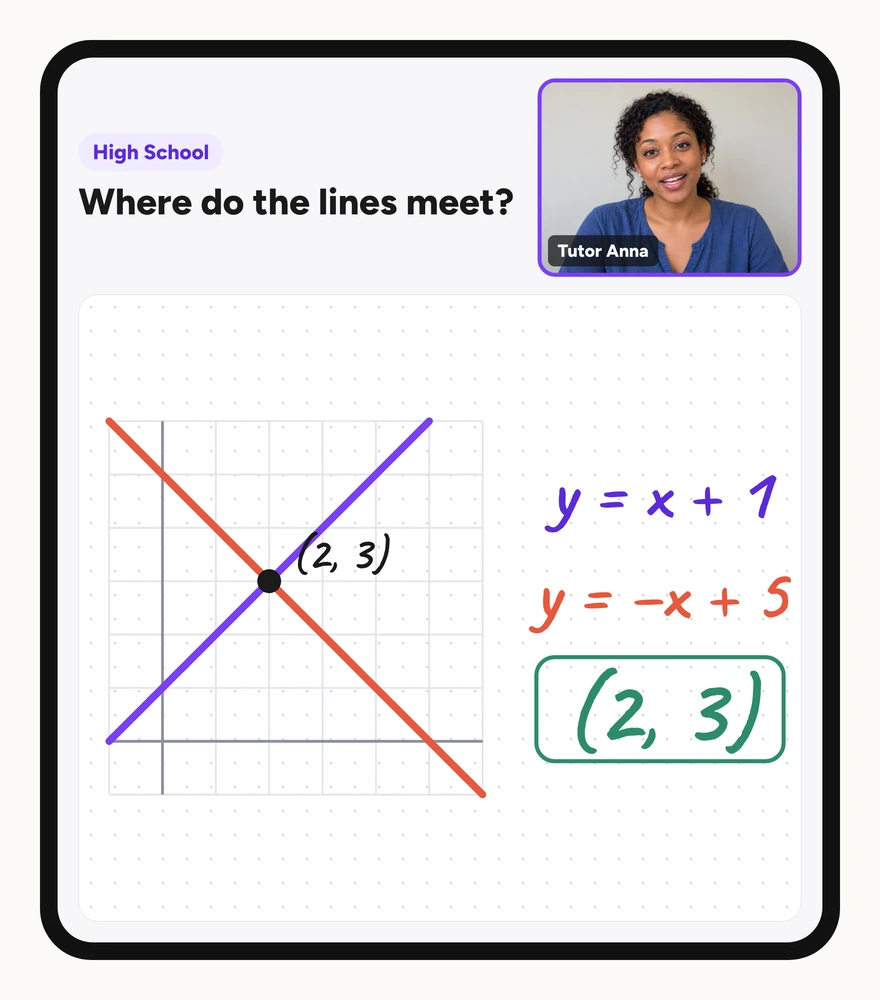
Illustration of an online high school lesson: a tutor on video and a graph of y = x + 1 and y = −x + 5 crossing at (2, 3).

I have seen such a boost in her grades and confidence — Jessica S

Try a class

Top High School Tutors

5 of 144 tutors shown · 4.9 avg rating from 936 reviews

K-2nd grade

Available Sun, Tue, Wed, Thu, Sat

Can support: ESL, Special ed

I have been an educator for 23 years. I have taught grade Kinder, 1st, 2nd and 4th grade. I have taught kinder for 15 years so my heart always go out…

Cara S.

Certified classroom teacher

5.0

5 ratings

6 years

Experience

Pre-K - 2nd

7 days a week

Hi! I’m Cara! I have over 20 years of experience working with children, including 15 years working in a daycare setting where I focused on preschool…

k-2nd grade

Available Mon, Wed

Can support: ADHD, ESL, Behavioral ...

My name is Greer Stewart! I am a dedicated educator with 7 years of experience teaching 1st grade, and I have also provided tutoring for students of…

K-3rd grade

Available Thu, Sat

Can support: ADHD, Behavioral, Speech ...

Hi! I am Ms.Douglas and I am so excited to work with you! I have worked with students from Pre-K to 5th grade with all ability levels, various…

Pre-K - 3rd

Available Sun, Fri, Sat

Can support: ADHD, Dyslexia, ESL ...

Hi! I’m Ms. Rachel — a Certified elementary teacher with 10 years of experience specializing in early literacy (science of reading),phonics, building…

What parents are saying

LéAnna was so excited after this lesson! She is VERY Confident in her ability to ace this test!! Never seen her so excited about math befo... re :-) Melissa is an Awesome tutor!!

Jen - 9th grade, Math

She has a great repore with my student, who listens to her guidance. Amber has been a big help with my middle school student who struggled w... ith math from 6-8 grade. It's been such a big help to have her work with my student.

Michele - 9th grade, Summer Boost

Ryan is loving tutoring and actually looks forward to it. His confidence in school has gone up tremendously this year! Thank you Jessica!

Jodi - 9th grade, Math

High-school tutoring across Math, Science, English, and test prep

High-school students may need support in different subjects for different reasons. A physics problem can stall on the algebra inside it. An essay can have a clear argument but need sharper evidence. A biology term can be memorized without understanding the process it describes. Tutoring can start with the specific point where the work stops making sense, rather than review an entire unit.

Tutors can connect a formula to the reasoning behind it, a reading strategy to the structure of a test passage, or a revision goal to a clearer sentence. Students might check whether a solution satisfies the original equation, explain how a quotation supports a claim, or distinguish the role of organelles across cell types. The aim is to give students a way to explain, verify, and apply what they are learning.

Sound familiar?

Why families look for high-school support

Earlier gaps are limiting new work

Algebra skills affect chemistry stoichiometry and physics equations. Vocabulary affects reading comprehension on the SAT. Tutors can identify a building block that needs attention and practice it alongside current assignments, rather than assume the student must master every prior topic before moving forward.

The steps are memorized, but the reasoning is unclear

Students may follow a procedure without understanding when it applies or why it works. Tutors can ask students to explain a step, check a result, or connect a formula to the quantities it describes. That helps distinguish a calculation error from a conceptual gap.

Test passages and prompts require new strategies

Standardized tests ask students to analyze unfamiliar passages, interpret data, and write under time pressure. Tutors can model how to identify the question type, locate relevant evidence, and check whether an answer fits before moving on.

Where high-school students can get stuck

Algebra: skipping intermediate steps and losing track of signs

Jumping from one line to the next without writing the work can lead to dropped variables, incorrect sign changes, or confusion about which operation to apply. In a system of equations, substituting an expression and then simplifying requires careful tracking of parentheses and like terms. Writing each step gives students and tutors a clear place to check.

Geometry: confusing angle relationships and congruence postulates

Parallel lines cut by a transversal create several angle pairs. Corresponding angles are equal; alternate interior angles are equal; same-side interior angles are supplementary. Students may mix these relationships or apply a triangle congruence postulate without verifying that the given information matches its conditions. Diagrams with tick marks and angle arcs provide the evidence; tutors can ask students to name the relationship before setting up an equation.

Biology: memorizing terms without connecting structure to function

Tutors can connect a cell structure to its role: the inner mitochondrial membrane provides a setting for reactions that transfer energy into ATP. A diagram can also distinguish a bacterial cell, which lacks a membrane-bound nucleus, from a typical nucleated eukaryotic cell. Students can explain a structure's function as well as name it.

Chemistry: treating formulas as separate numbers instead of representing substances

Molar mass connects a chemical formula to a measurable quantity. To find the molar mass of water, count two hydrogen atoms at approximately one gram per mole each and one oxygen atom at sixteen grams per mole, giving eighteen grams per mole total. Students can then convert a given mass in grams to moles by dividing by the molar mass. Skipping the unit or miscounting atoms leads to incorrect stoichiometry.

Physics: applying formulas without checking units or direction

Force, velocity, and acceleration are vector quantities with both magnitude and direction. In a friction problem, students must calculate the normal force, multiply by the coefficient of friction to find the friction force, then subtract friction from the applied force to determine the net force available for acceleration. Confusing which forces oppose motion or forgetting to convert grams to kilograms before using F = ma produces an incorrect result.

Reading comprehension: answering from memory instead of the passage

SAT and school reading questions reward answers supported by the text. Students may choose a plausible response based on prior knowledge without checking whether the passage actually makes that claim. Tutors can ask students to identify the sentence or paragraph that supports their answer and distinguish a stated detail from an inference.

Writing: including evidence without explaining its relevance

A quotation or data point does not automatically prove a claim. Students need to introduce the evidence, explain how it supports the argument, and connect it to the thesis. Tutors can help students add that explanation in their own words, rather than assume the reader will infer the connection.

How high-school tutors make the next step clearer

Show every algebraic step and check the solution

For 16/(x + 1) = 4/(x + 1)², first exclude x = −1. Multiplying both sides by (x + 1)² gives 16(x + 1) = 4, so x = −3/4. Substitution yields 64 on each side. Tutors can connect denominator restrictions, multiplying the entire equation, and checking the original expression.

  1. Identify the common denominator and multiply every term.
  2. Cancel factors and simplify to isolate the variable.
  3. Solve for x and check whether any value makes a denominator zero.
  4. Substitute the solution into the original equation to verify.

Connect a biology process to the structures involved

Transcription occurs in the nucleus, where DNA unzips and messenger RNA is assembled using complementary base pairing. In RNA, uracil pairs with adenine because thymine cannot leave the nucleus. Translation occurs in the cytoplasm, where ribosomes read the mRNA sequence and assemble amino acids into proteins. Tutors can ask students to explain why each step happens in its location and what each molecule contributes.

Distinguish what a passage states from what it implies

Inference questions require evidence, even when the answer is not stated directly. Tutors can model reading the question first, locating the relevant section, and comparing each answer choice to the text. Students can underline key phrases and explain how those words support their choice, rather than rely on a general impression.

Putting high-school skills into practice

Original examples that connect a procedure to its reasoning.

From a system of equations to a verified solution

Solve y equals 3x minus 5 and y equals negative 2x plus 10 by setting the expressions equal: 3x minus 5 equals negative 2x plus 10. Combine like terms to get 5x equals 15, so x equals 3. Substitute into either equation to find y equals 4. Check by substituting both values into the other equation. Tutors can ask what the solution represents and why the check matters.

From a chemistry formula to a molar conversion

Using rounded atomic molar masses, carbon dioxide has 12 g/mol from carbon and 2 × 16 g/mol from oxygen, giving about 44 g/mol. Converting 88 g gives 88 g × (1 mol / 44 g), or approximately 2 mol. Students can explain the units and the precision assumed in the calculation.

Inside a 25-minute session

What a high-school tutoring session can look like

This illustrative lesson focuses on solving a system of linear equations by substitution and checking the result. Another session might address a biology concept, a physics free-body diagram, an essay revision, or SAT reading strategies, depending on the student's current work.

  1. 0–3 min

    Identify the starting point

    Review the system of equations and check whether both are solved for the same variable. Confirm that students understand the goal: find the values of x and y that satisfy both equations.

  2. 3–10 min

    Set the expressions equal and solve for one variable

    Since both equations equal y, set 3x minus 5 equal to negative 2x plus 10. Combine like terms by adding 2x to both sides and adding 5 to both sides, yielding 5x equals 15. Divide by 5 to find x equals 3.

  3. 10–16 min

    Substitute to find the second variable

    Substitute x equals 3 into y equals 3x minus 5 to get y equals 9 minus 5, so y equals 4. Write the solution as the ordered pair (3, 4).

  4. 16–22 min

    Check the solution in both equations

    Substitute x equals 3 and y equals 4 into the second equation: 4 equals negative 2 times 3 plus 10, which simplifies to 4 equals 4. The check confirms the solution satisfies both equations.

  5. 22–25 min

    Explain the process and choose the next practice

    Ask students to explain why setting the expressions equal works and what the check verifies. Identify whether the next practice should focus on another system, a related skill, or a different subject area.

Example timings only. Tutors adjust the topic, depth, and pace to match the student's needs and the subject.

Frequently Asked Questions

Browse tutors by subject

Browse tutors by specialty

Terms of servicePrivacy PolicyNotice at Collection

© 2026 ClassDojo. All Rights Reserved.