
Skip content
Dojo Tutor
Log inTry class

Elementary Tutoring

Personalized support from experienced teachers, with the flexibility of learning online.

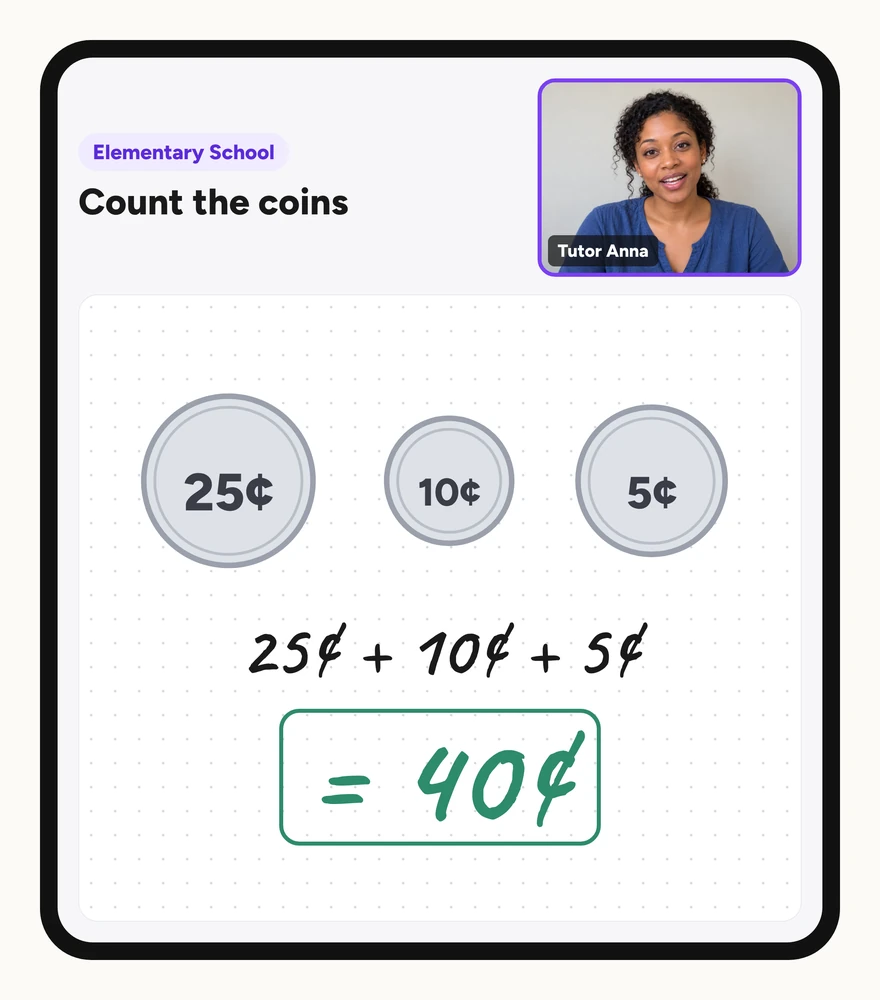
Illustration of an online elementary lesson: a tutor on video and a quarter, a dime, and a nickel added up to 40 cents.

I have seen such a boost in her grades and confidence — Jessica S

Try a class

Top Elementary Tutors

5 of 216 tutors shown · 4.9 avg rating from 2,504 reviews

Pre-K - 2nd

Available Sun, Tue, Wed, Thu, Sat

Can support: ESL

Hello! My name is Janice Taylor, and I specialize in helping students from Kindergarten through 2nd grade grow stronger in reading and math. With a…

Mrs. Calambo

Certified classroom teacher

Super tutor

5.0

873 ratings

12 years

Experience

Pre-K - 3rd

7 days a week

Hi, my name is Mrs. Calambo and I am excited to start this learning journey with you! With 12 years of experience teaching kids from Kindergarten to…

K - 5th

Available Mon, Tue, Wed, Thu, Fri, Sat

Can support: Dyslexia, ESL, Special ed ...

Hi families! I’m an experienced and caring educator with 8 years of teaching experience in both General and Special Education. I’m passionate about…

Pre-K - 4th

Available Thu

Can support: ADHD, Special ed

Hello! My name is Monique, and I have several years of teaching experience working with children in both virtual and classroom settings. Since 2018,…

Pre-K - 2nd

Available Mon, Tue, Wed, Fri

Can support: ESL, Speech, Gifted & talented

I have been teaching for 5 years and have experience with learners from Preschool to 5th grade in subjects such as Reading, Writing, and Math. I have…

What parents are saying

Ms. Johnson, is amazing. Elijah gravitated to Ms. Johnson and really enjoyed meeting her. I really am happy that Elijah and Ms. Johnson is a... perfect fit for his reading needs.

Ruth - 5th grade, Reading

Miss Field has been an awesome asset to Caleb’s learning experience. His improvement is noticeable since he started working with her. We app... reciate her so much.

Justin - 2nd grade, Math

I love that Ms. Vanessa engaged Montrail by asking him what are some of the things that he liked. She allowed him to express his emotions an... d then gave him reassurance. By the end of class, his mood had changed! I like the idea that she asked questions that made him utilize his critical thinking skills! She also gave pointers on things that he can benefit from during the tutoring sessions.

Tyler - 3rd grade, Science

Elementary tutoring across Reading, Writing, Math, and Science

Elementary students may need support with decoding a new vowel pattern, explaining a paragraph, organizing a few sentences, understanding place value, or connecting a science concept to an example. Tutoring can start with the specific task that is causing difficulty, whether that means blending sounds in a kindergarten word, checking regrouping in a fourth-grade subtraction problem, or identifying text evidence in a fifth-grade passage.

Tutors can adapt lessons to the student's current work rather than follow a fixed grade-level script. A second grader might practice skip counting and equal groups. A fifth grader might break a decimal multiplication into parts or locate the main idea in a longer text. Concrete models, spoken explanations, and written steps give students ways to show their reasoning and identify what to practice next.

Sound familiar?

Why families look for elementary support

Different subjects reveal different needs

Students may read fluently but need help summarizing, spell words accurately but need support organizing a paragraph, or recall addition facts but lose track of place value. Tutors can examine the current task and choose a focused starting point for the skill that needs attention.

Earlier skills are affecting new learning

Difficulty with letter sounds can slow word reading. Uncertainty about equal groups can make multiplication harder to explain. Tutors can check these building blocks alongside current homework, practice a smaller skill, and then return to the original problem to connect the two.

The steps are memorized, but the reasoning is unclear

Students may follow a procedure without understanding why it works. Tutors can ask for a drawing, a spoken explanation, or a check that connects the written work to its meaning. That gives students a way to verify their answer and adjust when something does not make sense.

Learning needs that can show up across elementary grades

Reading: blending sounds into a recognizable word

Younger students may produce individual sounds without joining them smoothly. Tutors can model blending with a short word like cat, then ask students to say the sounds closer together while looking at the letters. The next check is whether the same approach works with a new word like map.

Reading: checking all the letters in a longer word

A familiar beginning can lead to a guess that misses the ending. In the word stripe, students might say strip if they do not attend to the final e. Tutors can prompt students to check every letter, notice a known part like the silent e pattern, and blend the whole word before using the sentence to confirm meaning.

Reading: locating evidence for a comprehension answer

Students may offer a plausible response without pointing to what the text says. Tutors can ask which sentence supports the answer and whether the passage states the idea directly or leaves the reader to infer it. An inference still needs a connection to the words on the page.

Writing: completing a thought instead of a phrase

Descriptive words alone do not make a sentence. The bright yellow sun needs a verb to tell what the sun does or what is being said about it. Tutors can ask students to finish the thought, then check capitalization and the sentence ending in a separate pass.

Writing: adding detail that serves a purpose

A request for more information can lead to extra adjectives without clearer meaning. Tutors can ask what the reader needs to know: where an action happens, why a point matters, or which example supports an idea. Students can also remove a detail that does not fit the paragraph's focus.

Math: understanding the exchange in regrouping

In 52 minus 28, students cannot subtract eight ones from two ones. Exchanging one ten for ten ones gives four tens and twelve ones, which still equals 52. Drawing that exchange can show why the written digits change before students subtract to get 24.

Math: distinguishing the number of groups from the size of each group

Four boxes with six crayons in each contain 24 crayons total. Students can draw the boxes, count the groups, and connect the picture to four times six. Asking what each number represents helps distinguish the number of groups from the amount in one group.

Science: connecting a term to a concrete example

Students may remember a scientific label without explaining its role. Tutors can compare a metal conductor with the insulating plastic coating around a wire, then ask what each material does. A diagram or everyday example can connect the term to the function being studied.

How tutors make elementary work easier to explain

Connect a spelling pattern to reading the whole word

A small set of words can make a pattern easier to examine. In team, leaf, and seat, the letters ea represent the long e sound. Tutors can point out that pattern while keeping attention on the other letters in each word. Students then blend the whole word, use it in a sentence, and try another word with the same pattern. This is a pattern in these words, not a rule that every pair of vowels makes one sound.

  1. Notice the spelling pattern in a word.
  2. Connect the sounds to the letters and blend the whole word.
  3. Read another word with the same pattern.
  4. Use the word in a sentence and check its meaning.

Show the exchange behind carrying and borrowing

Draw thirty-six as three tens and six ones, then add two tens and eight ones. The fourteen ones can be exchanged for a ten and four ones. Adding the tens, including the exchanged ten, gives sixty-four. Students can connect that drawing to 36 + 28 and verify the total by calculating 64 − 28.

  1. Add the ones: eight plus seven equals fifteen ones.
  2. Exchange ten ones for one ten, leaving five ones.
  3. Add the tens, including the new ten: four plus two plus one equals seven tens.
  4. Check the result with subtraction or estimation.

Build a new multiplication fact from a known one

An array gives students something to count and compare. Six rows of four contain 24 objects. Adding one more row adds four objects, making seven rows of four, or 28. Tutors can connect the picture, repeated addition, and multiplication notation before asking for recall. This approach helps students see relationships between facts rather than rebuild each product from one.

Connecting skills across elementary work

Original examples that show how to connect a practiced skill to a related problem.

From blending sounds to reading a new word

Read cat by blending the sounds. Then change the first letter to make bat. Next, change the vowel to make bet. Students can identify which sound changed and reread each whole word. Tutors can check whether the response matches all the printed letters rather than a remembered word shape.

From a stated detail to a supported inference

Use this original practice text: The flag stretched out. Loose papers slid across the yard. First identify a stated detail: the flag stretched and papers moved. Then ask what the weather might be like and which words support that prediction. It may be windy is an inference, and students can explain how the details suggest wind without the text stating it directly.

From skip counting to equal groups

Count by sixes: six, twelve, eighteen, twenty-four. Draw four groups of six objects. Then cover the list and ask what four times six means in the picture. For a related problem, add another group: five times six equals thirty. Students can explain what changed instead of starting the count again from one.

Inside a 25-minute session

What an elementary tutoring session can look like

This illustrative lesson focuses on one Math need: two-digit addition with regrouping. Another session could focus on a Reading, Writing, or Science need instead. Tutors adapt the topic, activities, and pace to match the student's current work.

  1. 0–3 min

    Check place value understanding

    Represent 37 as three tens and seven ones using drawings or base-ten blocks. Try an addition problem without regrouping, such as 32 plus 15, to check whether the student understands the place-value columns.

  2. 3–8 min

    Identify the step that needs attention

    Try 36 + 28. Ask what happens when six ones and eight ones are combined. Students can identify fourteen ones and explain why one group of ten can move to the tens column.

  3. 8–15 min

    Connect a model to the written method

    Show fourteen ones, exchange ten for one ten, and leave four ones. Combine the original three tens and two tens with the exchanged ten to make six tens. Connect the drawing to the written sum of 64.

  4. 15–22 min

    Try a related problem independently

    Try 27 + 35. Students represent the twelve ones, exchange ten of them, and explain why the sum has six tens and two ones. Tutors can prompt for a drawing or spoken explanation when a step needs clarification.

  5. 22–25 min

    Check and choose the next practice

    Check that 64 − 28 returns 36. Ask students to explain why exchanging ten ones changes the representation without changing the total. Choose another example or revisit the place-value drawing as needed.

Example timings only. The lesson can focus on a different subject or skill depending on what the student needs.

Frequently Asked Questions

Browse tutors by subject

Browse tutors by specialty

Terms of servicePrivacy PolicyNotice at Collection

© 2026 ClassDojo. All Rights Reserved.