Skip content
Dojo Tutor
Log inTry class

9th Grade Tutoring

Personalized support from experienced teachers, with the flexibility of learning online.

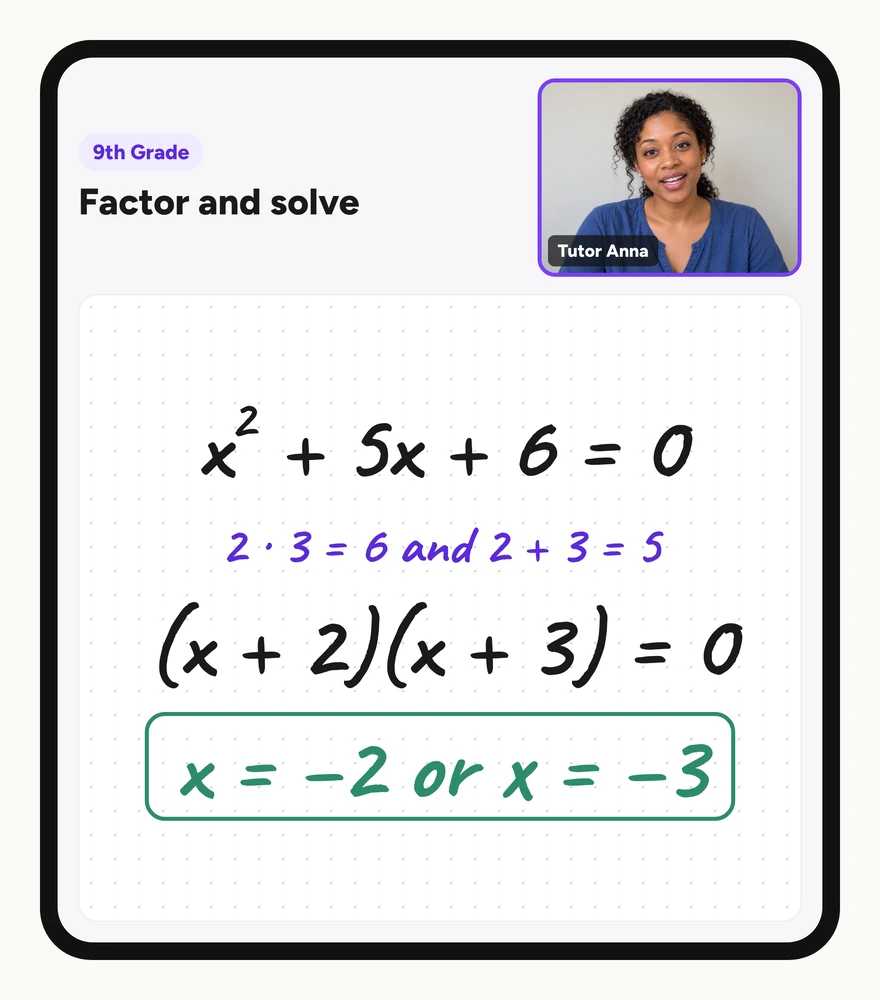
Illustration of an online 9th grade lesson: a tutor on video and a whiteboard factoring x² + 5x + 6 = 0 to find x = −2 or x = −3.

I have seen such a boost in her grades and confidence — Jessica S

Try a class

Top 9th Grade Tutors

5 of 96 tutors shown · 5.0 avg rating from 2,099 reviews

Ms. Jamie

Certified classroom teacher

5.0

9 ratings

10 years

Experience

K - 9th

Available Sun

Can support: ADHD, Dyslexia, Behavioral ...

Hi! My name is Ms. Jamie, and I am excited to start this learning journey with you! With nine years of teaching experience in Connecticut, I’ve had…

Pre-K - 6th, 8th - 12th

7 days a week

Can support: Special ed

Special education inclusion teacher and tutor dedicated to supporting diverse learners with patience, structure, and individualized strategies. I…

K - 12th

Available Tue, Thu, Fri, Sat

Can support: ADHD, Dyslexia, Behavioral ...

I'm a certified special education teacher, instructional designer, and high school educator with over a decade of experience supporting learners of…

K-4th grade

Available Sun, Mon, Wed, Thu, Fri

Can support: ADHD, Dyslexia, ESL ...

I’ve been a teacher for over 20 years. I absolutely love working with kids. My teaching certifications include grades 1-8; special education grades…

All grades

Available Mon, Tue, Fri

Can support: ADHD, ESL, Behavioral ...

I have been teaching for 8 years and have experience in a variety of subjects, including AVID, World History, and U.S. History. For 5 years, I also…

What parents are saying

LéAnna was so excited after this lesson! She is VERY Confident in her ability to ace this test!! Never seen her so excited about math befo... re :-) Melissa is an Awesome tutor!!

Jen - 9th grade, Math

She has a great repore with my student, who listens to her guidance. Amber has been a big help with my middle school student who struggled w... ith math from 6-8 grade. It's been such a big help to have her work with my student.

Michele - 9th grade, Summer Boost

Ryan is loving tutoring and actually looks forward to it. His confidence in school has gone up tremendously this year! Thank you Jessica!

Jodi - 9th grade, Math

Ninth-grade tutoring that connects reasoning to the work

Ninth graders may encounter Algebra, Geometry, Biology, Physics, Chemistry, or English across the same semester. A difficulty in one class can look like forgetting a step, misreading a question, or losing track of what a variable represents. Tutoring can start with the exact point where the work stops making sense, whether that means revisiting a prerequisite skill or clarifying a new concept.

Tutors can ask students to explain their reasoning, show their setup, and check their result. A substitution method may need a clearer connection between two equations. A literary analysis may need stronger evidence. A Physics problem may need attention to units and sign conventions. The goal is to give students a way to verify the next step and explain their choices, alongside practicing the procedure.

Sound familiar?

Why families look for ninth-grade support

The procedure is memorized, but the reasoning is unclear

Students may apply a formula or rule without understanding when it applies or what the result represents. Tutors can ask students to explain what each step accomplishes, connect an algebraic manipulation to a graph or real-world context, and verify the answer by substitution or estimation.

Earlier gaps are making new material harder

Fraction operations can affect rational expressions. Slope can affect linear systems. Vocabulary can affect reading comprehension in science or literature. Tutors can identify a building block that needs review and connect it to the current assignment, rather than assume the entire course needs reteaching.

Written work needs more than a correct calculation

A literary thesis may need textual evidence and explanation. A lab conclusion may need reasoning beyond the data. A word problem may need units and context. Tutors can help students distinguish a complete answer from a partial one and revise for clarity and support.

Learning needs that can show up in ninth grade

Algebra: losing track of what a solution represents

In a system of equations comparing two savings plans, the solution may come out as a decimal number of months. Tutors can help students interpret decimal results in context, such as deciding whether the answer means partway through a month or the next whole month, and check whether it fits the original question.

Geometry: confusing angle relationships

When parallel lines are cut by a transversal, corresponding angles are equal. Adjacent angles forming a straight line are supplementary and sum to 180 degrees. Tutors can ask students to identify the relevant pair and check whether an obtuse or acute result fits the diagram before setting up an equation.

Biology: memorizing terms without connecting concepts

Students may recall that organism, population, community, ecosystem, and biosphere form a hierarchy without explaining what distinguishes each level. Tutors can use sorting activities and examples to reinforce that a population contains one species while a community contains multiple species in the same area.

Chemistry: calculating molar mass without understanding the formula

Using rounded atomic molar masses, water has two hydrogen contributions of about 1 g/mol and one oxygen contribution of about 16 g/mol, giving approximately 18 g/mol for H₂O. Tutors can distinguish that amount-per-mole calculation from the mass of a single molecule, then check atom counts and units in a conversion.

Physics: applying a formula without checking units or direction

For a constant-mass object, net force, mass, and acceleration are related by F = ma. Students can label units and define a positive direction before substituting. In a stopping problem, spreading the same change in momentum over a longer time reduces the average force; the comparison depends on holding that momentum change fixed.

Reading and Writing: selecting evidence without explaining its relevance

A quotation does not automatically support a literary claim. Tutors can help students introduce the evidence, explain its relevance, and choose a verb that matches what the text establishes. A stronger-sounding word is useful only when the evidence supports that interpretation.

How tutors make ninth-grade concepts clearer

Connect algebraic steps to their purpose

When solving a system by substitution, students set two expressions for the same variable equal to each other, solve for the remaining variable, then substitute back to find the other. Tutors can ask what each equation represents, why setting them equal is valid, and how to check the solution by plugging both values into the original equations.

  1. Identify which variable is already isolated or can be isolated easily.
  2. Set the two expressions equal and solve for one variable.
  3. Substitute that value into either original equation to find the other variable.
  4. Check the solution in both original equations to verify correctness.

Use analogies and examples to clarify science concepts

Impulse equals the average net force multiplied by the time interval and also equals the change in momentum. For the same momentum change, a longer stopping time means a smaller average force. Tutors can use a padded landing surface to illustrate the relationship, then ask students to label quantities and units in a calculation.

Build literary analysis from text to interpretation

Tutors can help students select a relevant quotation, explain what it shows, and connect that interpretation to the thesis. Students can compare a general verb with a more precise one and check whether the text justifies the stronger wording, rather than intensify a claim without evidence.

Connecting skills across ninth-grade subjects

Original examples that show how reasoning supports a procedure or interpretation.

From a formula to a verified solution

Solve the system y = 2x + 1 and y = –x + 7 by setting 2x + 1 = –x + 7. Add x to both sides to get 3x + 1 = 7, then subtract 1 and divide by 3 to find x = 2. Substitute into y = 2x + 1 to get y = 5. Check: does (2, 5) satisfy both equations? Tutors can ask students to explain each algebraic step and verify the result.

From a biology term to a concrete example

Compare a mushroom, water, sunlight, and a soil sample. The mushroom is a living component; water and sunlight are nonliving environmental factors. A soil sample contains nonliving mineral material as well as organisms and organic matter. Students can explain which component a question refers to instead of treating a mixed sample as one living organism.

Inside a 25-minute session

What a ninth-grade tutoring session can look like

This illustrative lesson focuses on solving a system of linear equations by substitution and interpreting the solution in context. Tutors can choose a different topic in Algebra, Geometry, Biology, English, or another subject depending on the student's current work.

  1. 0–3 min

    Identify what the problem asks

    Read a word problem about two savings plans and identify the two equations. Check that students understand what each variable represents and what the solution will tell us.

  2. 3–8 min

    Set up the substitution

    Since both equations are solved for the same variable, set the two expressions equal. Explain why this step is valid: if both equal y, they must equal each other.

  3. 8–15 min

    Solve for one variable

    Combine like terms and isolate the variable. If the result is a decimal, discuss what it represents in the context. Can the answer stay a decimal, or does the question call for the next whole month?

  4. 15–22 min

    Find the other variable and check

    Substitute the first solution into either original equation to find the second variable. Then check both values in both original equations to verify the solution is correct.

  5. 22–25 min

    Interpret and choose the next practice

    Discuss what the solution means in the real-world context. Review the substitution method and identify whether the next practice should focus on another system, a different solution method, or a related algebraic skill.

Example timings only. The topic, depth, and pace can change with the student's needs and the subject being studied.

Frequently Asked Questions

Browse tutors by specialty

Terms of servicePrivacy PolicyNotice at Collection

© 2026 ClassDojo. All Rights Reserved.