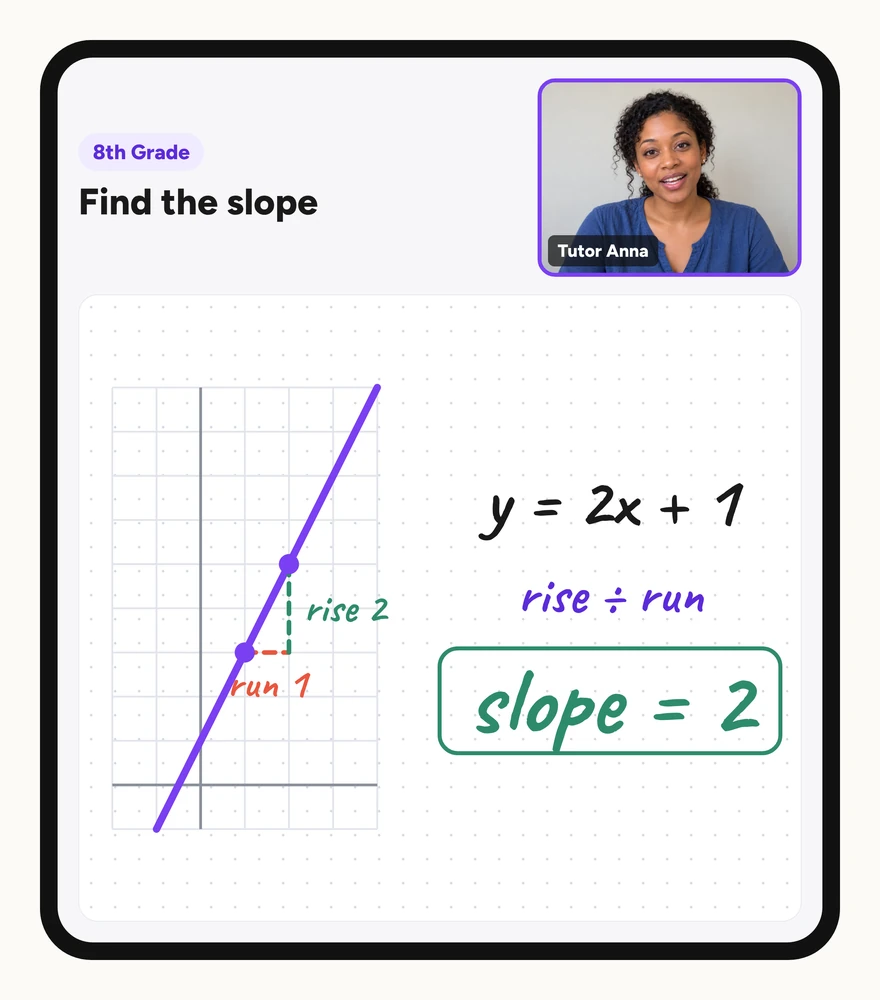
Eighth graders may encounter Algebra equations with variables on both sides, read complex historical or scientific texts, write multi-paragraph essays with evidence, and apply geometric transformations or scientific formulas. A difficulty in one area does not mean every subject needs the same support. Tutors can use current assignments to identify whether a student needs help isolating a variable, supporting an inference, organizing a counter-argument, or checking the sign of a slope.
Tutoring can connect procedures to their reasoning. Students might solve an inequality and then explain why the sign flips when dividing by a negative, identify context clues before defining an unfamiliar word, or revise a paragraph by adding an explanation rather than simply more words. The goal is to give students strategies they can apply independently, including checking their work and explaining each step.
Why families seek eighth-grade support
Procedures are memorized but reasoning is unclear
Students may follow steps to solve an equation or simplify an expression without understanding why each operation is needed. Tutors can ask students to explain what a step accomplishes, connect inverse operations to the goal of isolating a variable, and check solutions by substitution to verify correctness.
Reading accurately without grasping the argument or evidence
Decoding a passage does not guarantee comprehension of its main idea or supporting details. Tutors can help students identify thesis statements, distinguish stated facts from inferences, locate textual evidence, and explain how a detail supports a claim.
Writing that lists ideas without developing them
A draft may contain several points but lack the explanation or evidence a reader needs. Tutors can guide students to choose relevant details, explain their connection to the thesis, address counter-arguments, and revise for clarity before checking grammar and mechanics.
Learning needs that can appear in eighth grade
Algebra: losing track of terms when solving equations
In equations with variables on both sides or multiple steps, students may forget to apply an operation to every term or drop a constant when combining like terms. Writing each step on a new line and checking by substitution can help locate errors. For example, solving 3x + 6 = x + 18 requires subtracting x from both sides to get 2x + 6 = 18, then subtracting 6 and dividing by 2 to find x = 6.
Algebra: confusion about when inequality signs flip
Students may remember that dividing or multiplying by a negative number flips the inequality sign but apply the rule inconsistently or at the wrong step. Tutors can demonstrate with a number line or specific values, showing that if −2x < 8, dividing both sides by −2 reverses the inequality to x > −4.
Algebra: reducing fractions incorrectly
To simplify −4/10, divide numerator and denominator by their common factor of two, giving −2/5. Tutors can ask students to multiply both parts of −2/5 by two to recover −4/10, checking that the value has been preserved.
Geometry: applying transformations without preserving properties
Rigid transformations—translations, reflections, and rotations—preserve shape, size, side lengths, and angle measures. Students may move points inconsistently or confuse the direction of a reflection. Tutors can have students write coordinate rules, such as (x, y) → (x + 6, y − 2) for a translation, and verify that all points shift the same distance in the same direction.
Reading: pronouncing multisyllabic or historical terms without understanding them
Multisyllabic words such as transportation, unfamiliar, or observation may be guessed from their first letters. Tutors can help students examine recognizable parts, model pronunciation, and check meaning with context or a glossary. Reading the whole word and understanding it are related but separate checks.
Reading: answering comprehension questions without citing evidence
Students may offer plausible inferences or opinions without identifying which sentences in the text support their answers. Tutors can teach a process: read the entire sentence, search before and after an unfamiliar word or key detail, connect clues to form a meaning, and cite specific words as evidence.
Writing: including evidence without explaining its relevance
A quotation or fact does not automatically prove a point. In an argumentative or informative essay, students need to introduce evidence, explain how it supports the thesis, and address potential counter-arguments. Tutors can model the structure: claim, evidence, explanation, and conclusion.
Writing: confusing sentence boundaries and creating run-ons or fragments
Students may join two independent clauses with only a comma, or write a dependent clause as a complete sentence. Tutors can help identify subjects and verbs, use periods or conjunctions appropriately, and check that each sentence expresses a complete thought.
Science: memorizing formulas without understanding their application
Formulas for wave speed, density, or percent change require students to identify which values correspond to which variables and to include correct units. Tutors can guide students to rearrange one formula rather than memorize multiple versions, and to check whether the calculated answer makes sense in context.
How tutors help eighth graders reason through their work
Solve equations by performing inverse operations on both sides
For a two-step equation such as 5x + 3 = 18, subtract 3 from both sides to get 5x = 15, then divide by 5 to find x = 3. Checking 5(3) + 3 = 18 confirms the solution. Tutors can explain why this sequence suits this equation; expressions with parentheses, fractions, or variables on both sides may first need other steps.
- Identify the variable term and any constants on the same side.
- Subtract or add to move constants to the opposite side.
- Divide or multiply to isolate the variable.
- Substitute the solution into the original equation to verify both sides are equal.
Use context clues to determine word meaning
Students can examine the words around an unfamiliar term, propose a meaning, and check that it fits the full sentence. In the original sentence 'The fragile ornament needed thick padding because it could break if dropped,' the references to padding and breaking support the meaning easily damaged. A dictionary can resolve a meaning that the context does not establish.
- Read the full sentence containing the unfamiliar word.
- Look for clues before and after the word, such as examples or descriptions.
- Connect the clues to propose a meaning.
- Find evidence in the sentence that supports the proposed meaning.
Organize an argumentative paragraph with claim, evidence, and explanation
An effective body paragraph states a clear point, provides relevant evidence, and explains how that evidence supports the thesis. Students should avoid simply listing facts or repeating the evidence in different words. Tutors can provide sentence frames—such as 'I believe that ___ because ___' for the claim and a transitional phrase plus 'for example' for evidence—then guide students to add original reasoning that connects the evidence to the argument.
Connecting skills across eighth-grade subjects
Original examples that show how reasoning supports calculation, comprehension, and composition.
From solving to checking an Algebra solution
Solve 2x − 7 = 11 by adding 7 to both sides to get 2x = 18, then dividing by 2 to find x = 9. Check by substituting: 2(9) − 7 = 18 − 7 = 11. Tutors can ask students to explain why adding 7 undoes subtracting 7, and what the check confirms about the solution.
From a stated detail to a supported inference in Reading
Read this original miniature text: The box held a fragile glass ornament. The label asked handlers to avoid dropping it because the glass could break. Students can explain fragile using the reference to breaking, then distinguish that supported meaning from extra claims the text does not establish, such as the ornament's age or value.
Inside a 25-minute session
What an eighth-grade tutoring session can look like
This illustrative lesson focuses on solving two-step equations with checking by substitution. Another session might address slope-intercept form, reading comprehension with evidence, or essay revision. Tutors adapt the topic and pace to the student's current assignment.
0–3 min
Review the goal and a simpler example
Confirm that the goal is to isolate the variable. Solve a one-step equation like x + 5 = 12 together, subtracting 5 from both sides to get x = 7, and check by substitution.
3–8 min
Introduce a two-step equation
Present 3x + 4 = 19. Ask which operation to undo first. Subtract 4 from both sides to get 3x = 15, explaining that constants are typically moved before dealing with coefficients.
8–15 min
Complete the solution and check
Divide both sides by 3 to find x = 5. Substitute into the original equation: 3(5) + 4 = 15 + 4 = 19. Discuss why checking confirms the solution is correct and helps catch errors.
15–22 min
Practice independently with support
The student solves 2x − 7 = 11 independently, writing each step. The tutor observes, prompts if the student forgets to apply an operation to both sides, and reviews the substitution check together.
22–25 min
Recap the process and assign next practice
Review the sequence: undo addition or subtraction, then undo multiplication or division, and always check by substitution. Identify a similar problem for the student to try before the next session.
Example timings only. The subject, number of problems, and pacing can change based on the student's needs and the complexity of the material.