


Skip content
Dojo Tutor
Log inTry class

7th Grade Tutoring

Personalized support from experienced teachers, with the flexibility of learning online.

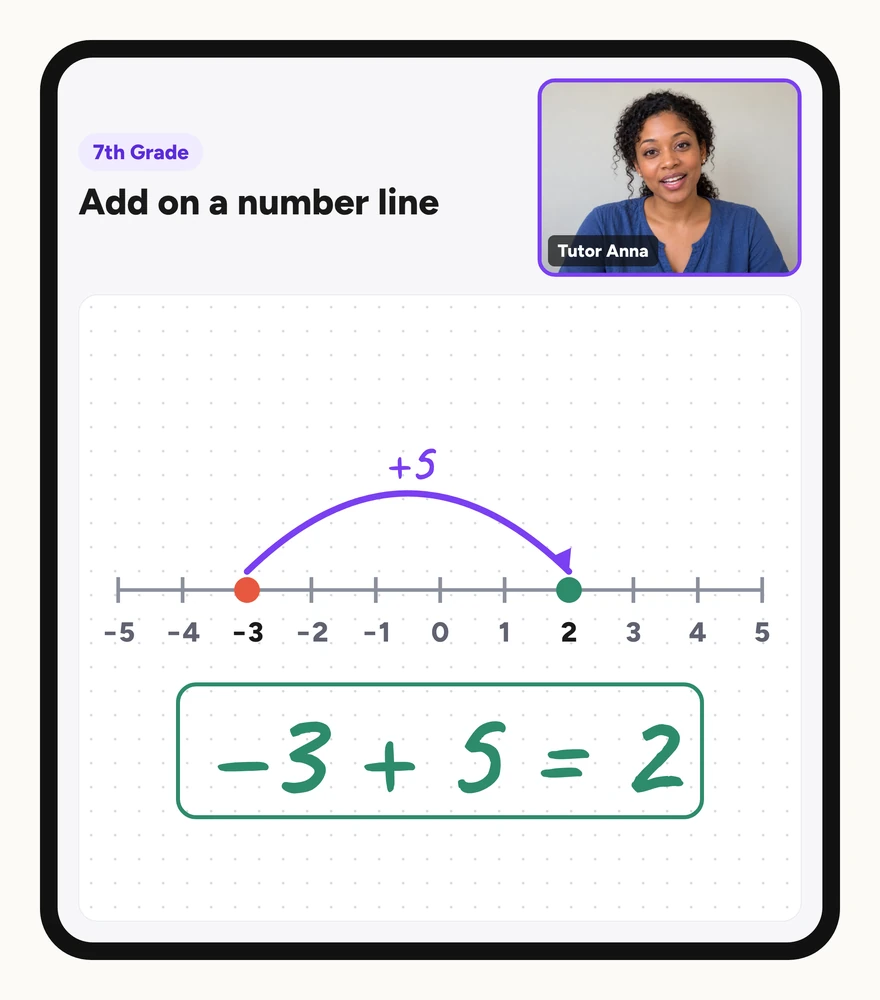
Illustration of an online 7th grade lesson: a tutor on video and a number line showing −3 + 5 = 2.

I have seen such a boost in her grades and confidence — Jessica S

Try a class

Top 7th Grade Tutors

5 of 120 tutors shown · 5.0 avg rating from 1,177 reviews

K-6th grade

Available Mon, Tue, Wed, Thu

I have been teaching for 18 years and have experience teaching Spanish from Pre-K to University level, as well as French for grades 9-12. My teaching…

6th - 12th

Available Thu, Fri

Can support: ADHD, Gifted & talented

I have been teaching for 12 years, primarily focusing on math for learners in grades 9-12. I have experience teaching in Mississippi, where I am…

All grades

7 days a week

**Business Education:** I have over 10 years of experience as a high school business educator and currently teach courses including Entrepreneurship,…

Tutor Cody

Certified classroom teacher

5.0

24 ratings

6 years

Experience

3rd - 8th

Available Tue, Wed, Thu, Fri, Sat

Can support: ADHD, Behavioral, Special ed ...

Hi! My name is Cody, and I have been working in education for over 10 years, including 6 years as a teacher. I am passionate about helping students…

K - 7th

Available Tue, Fri, Sat

Can support: ESL

Hi! I'm Valerie, and I've been a teacher for over 18 years. I love helping students build confidence, discover their strengths, and realize that…

What parents are saying

Kadence really enjoys Ms. Allen. Kadence says she is patient, kind, and explains things in a way Kadence is able to understand and learn. We... would love to continue with Ms. Allen regularly if possible.

Kyndra - 7th grade, Math

Thank you. Learning to say consonant has given him unbelievable confidence. So many things are starting to click for him. Thank you 1k times... .

SUSAN - 7th grade, General Tutoring

Jessica is a wonderful, positive influence in Dean's life! He loves working with her!

Mary - 7th grade, Reading

Seventh-grade tutoring across Math, Science, Reading, and Writing

Seventh graders may encounter different challenges across their school day: solving multi-step equations, explaining how evidence supports a claim, organizing a paragraph with a clear thesis, or distinguishing conduction from convection. Tutoring can start with the specific point where understanding breaks down, whether that means checking an integer operation, identifying the main idea in a passage, or revising a sentence for clarity.

Tutors can connect procedures to reasoning. In algebra, that might mean explaining why both sides of an equation receive the same operation. In science, it might mean distinguishing the products of photosynthesis from those of cellular respiration. In reading, it might mean separating a stated fact from an inference. In writing, it might mean adding an explanation after presenting evidence. The goal is to help students articulate the next step and check their work independently.

Why families seek seventh-grade support

Procedures are memorized but reasoning remains unclear

Students may apply keep-change-flip for fraction division or combine like terms without understanding why those steps work. Tutors can ask students to explain a step in their own words, connect it to a model or example, and check whether the reasoning transfers to a new problem.

Reading accurately without grasping the argument

Students can decode a passage accurately yet need help identifying the author's purpose or distinguishing a verifiable claim from an opinion. Tutors can ask what evidence would support a statement and how a detail connects to the main idea. Signal words can provide clues, but they do not replace checking the whole claim.

Writing includes evidence but lacks explanation

A paragraph may present a thesis and quote relevant details without showing how those details support the claim. Tutors can help students add reasoning after each piece of evidence, ensuring the connection is clear to the reader rather than assumed.

Where seventh graders can get stuck

Algebra: Combining like terms without recognizing the variable

In 7x + 3x + 4y + 2y + 8, students can group terms with the same variable part, including exponents. Combining the x terms gives 10x and combining the y terms gives 6y, while the constant remains 8. The result is 10x + 6y + 8; x and x² would not be like terms.

Algebra: Misinterpreting slope in context

Students may confuse a line's starting value with its rate of change or reverse rise and run. If a tank loses six litres over three minutes at a constant rate, its volume changes by −2 litres per minute. Tutors can label both axes, calculate vertical change divided by horizontal change, and connect the negative slope to the falling volume.

Algebra: Solving equations without checking the solution

After solving 2x + 3x − 4 = 21, students can check their result in the original equation. Combining like terms gives 5x − 4 = 21, so x = 5. Substitution gives 10 + 15 − 4 = 21, providing a check on the arithmetic and the operations used.

Science: Confusing photosynthesis and cellular respiration

In photosynthetic plant cells, chloroplasts use light energy, carbon dioxide, and water to build sugars and release oxygen. Aerobic respiration transfers energy from glucose into ATP while producing carbon dioxide and water. It begins with glycolysis in the cytoplasm, with later stages in mitochondria. Plants carry out respiration as well as photosynthesis.

Science: Misunderstanding convection and pressure

Students may describe convection as simply hot air rising without explaining the full cycle. Tutors can clarify that heated air molecules spread apart, creating lower density and rising; cooler air then moves in to replace it, and the cycle continues. This movement creates convection currents that drive weather patterns and ocean circulation.

Reading: Identifying opinion signal words

Words such as best or wonderful can signal a judgment, but a number alone does not establish that a statement is factual or accurate. Tutors can ask whether a claim can be checked, what evidence supports it, and whether it expresses a preference. Students can explain their classification using the whole sentence.

Writing: Outlining without a clear structure

Students may begin drafting before organizing their ideas, leading to paragraphs that wander or repeat. Tutors can introduce a simple outline that identifies the thesis, lists supporting points, and assigns each point to a paragraph. Investing time in planning can make drafting faster and more focused.

Writing: Confusing linking verbs with action verbs

In the sentence The tower appears unstable, appears is a linking verb connecting the subject to the adjective unstable. Students may misidentify it as an action. Tutors can explain that linking verbs connect the subject to a description or state of being, while action verbs show what the subject does.

How tutors clarify seventh-grade concepts

Use inverse operations to isolate a variable

For an equation in the form ax + b = c, students can undo the addition or subtraction, then divide by the nonzero coefficient. In 8x − 12 = 12, adding 12 to both sides gives 8x = 24, then dividing by 8 gives x = 3. Other equation structures may need a different sequence. Substitution checks that 8(3) − 12 = 12.

  1. Identify the operations applied to the variable.
  2. Undo addition or subtraction first by performing the inverse operation on both sides.
  3. Undo multiplication or division next.
  4. Substitute the solution into the original equation to verify correctness.

Distinguish stated facts from inferences in reading

Tutors can ask students to identify details the text states directly, then explain what those details suggest. For example, if a passage describes leaves blowing and a jacket flapping, students can infer it may be windy. The inference is supported by the stated actions, but the word windy does not appear in the text. This distinction helps students provide evidence for their answers.

Add explanation after presenting evidence in writing

A thesis might claim that a character is determined. After quoting or paraphrasing evidence, students should explain how that evidence demonstrates determination. Tutors can prompt: Why does this detail matter? How does it support your claim? The explanation connects the evidence to the thesis rather than leaving the reader to infer the connection.

  1. State the claim or thesis clearly.
  2. Select a relevant piece of evidence from the text or data.
  3. Explain in your own words how the evidence supports the claim.
  4. Check that the explanation does more than repeat the evidence.

Connecting skills in seventh-grade work

Original examples that show how reasoning supports procedures across subjects.

From a graph to a rate of change

A graph shows a line passing through the points (0, 200) and (10, 400). The y-intercept is 200, representing a starting value such as a booking fee. The slope is rise over run: 200 divided by 10 equals 20, representing a rate such as cost per person. Students can explain what each number means in context, rather than simply labeling coordinates.

From a stated detail to a supported inference

Read this original text: The reading room has padded seats. A sign asks visitors to speak quietly. Ask why the room might be comfortable for reading. Students can cite padded seats as evidence of physical comfort and the quiet rule as evidence of a calm environment, then explain how each detail supports the inference.

Inside a 25-minute session

What a seventh-grade tutoring session can look like

This illustrative lesson focuses on solving two-step equations in algebra. Tutors adapt the topic, examples, and pace to match the student's current coursework and understanding.

  1. 0–3 min

    Review one-step equations

    Solve x + 5 = 12 by subtracting 5 from both sides. Check that the student understands performing the same operation on both sides to maintain balance.

  2. 3–8 min

    Introduce a two-step equation

    Present 3x + 4 = 19. Identify the two operations applied to x: multiplication by 3 and addition of 4. Discuss the order in which to undo them.

  3. 8–15 min

    Solve step by step

    Subtract 4 from both sides to get 3x = 15. Then divide both sides by 3 to find x = 5. Emphasize that each operation is applied to the entire side of the equation.

  4. 15–20 min

    Check the solution

    Substitute x = 5 into the original equation: 3(5) + 4 equals 15 + 4 equals 19. The solution is confirmed. Discuss why checking is important and what it reveals about the work.

  5. 20–25 min

    Try a new problem independently

    The student solves 5y − 7 = 18 with guidance as needed. Review the steps, check the solution, and identify what to practice next, such as equations with negative numbers or variables on both sides.

Timings are illustrative. Tutors adjust the pace and may revisit a step or move to a different topic depending on the student's needs.

Frequently Asked Questions

Browse tutors by specialty

Terms of servicePrivacy PolicyNotice at Collection

© 2026 ClassDojo. All Rights Reserved.