Skip content
Dojo Tutor
Log inTry class

6th Grade Tutoring

Personalized support from experienced teachers, with the flexibility of learning online.

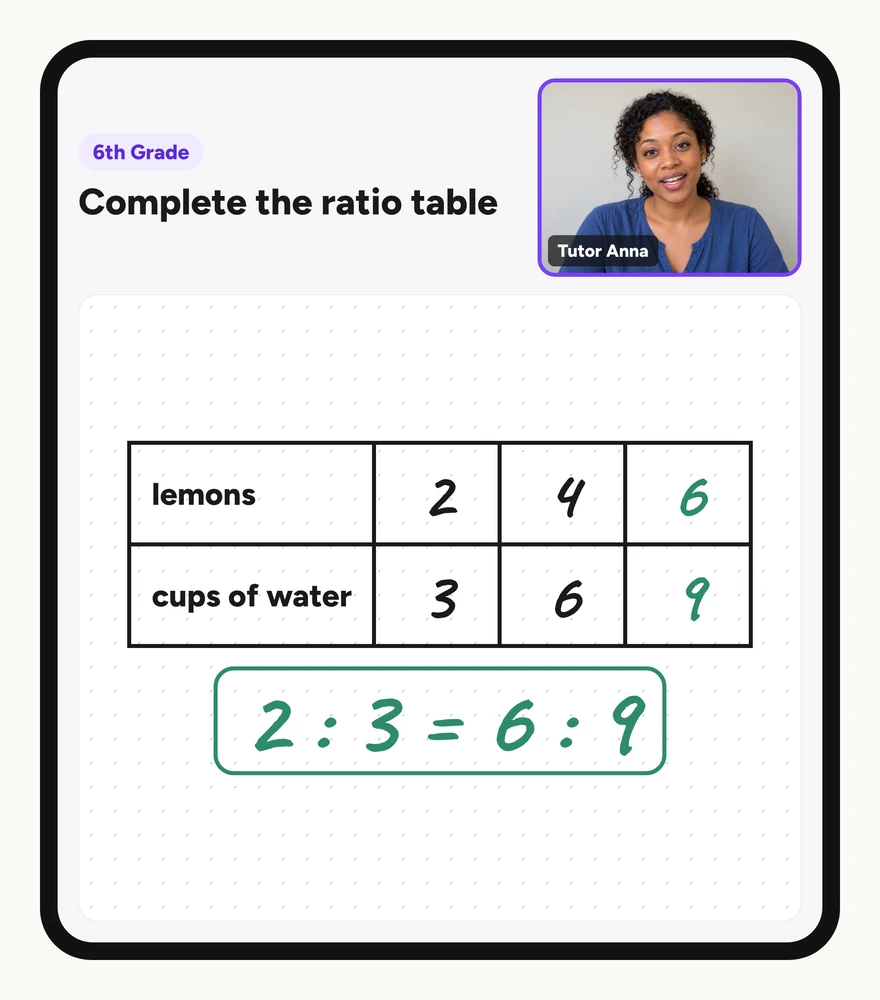
Illustration of an online 6th grade lesson: a tutor on video and a ratio table showing 2 lemons to 3 cups of water scaled up to 6 to 9.

I have seen such a boost in her grades and confidence — Jessica S

Try a class

Top 6th Grade Tutors

5 of 168 tutors shown · 5.0 avg rating from 999 reviews

Dr. B

Certified classroom teacher

Super tutor

4.9

69 ratings

15 years

Experience

6th - 10th

Available Sun, Mon, Tue

Can support: Gifted & talented

I have been teaching for roughly 15 years. I love my job. I have taught all subjects, but my passion is math.

5th and 6th grade

Available Sun, Mon, Thu, Sat

Can support: ADHD, ESL, Special ed ...

I have been teaching for the last 8 years, with 5 years spent teaching at a high school and the other 3 years teaching at summer school. My…

4th to 6th grade

Available Sun, Mon, Tue, Thu, Fri, Sat

Can support: ADHD

I have been an enthusiastic teacher for 4 years, specializing in Social Studies, Sociology, and Economics for 6th-12th graders. Throughout my career,…

6th - 12th

Available Tue, Wed, Thu

Can support: ADHD, Dyslexia, Autism spectrum ...

I LOVE MATH and so does my cat Fibonacci!! I have been teaching for 13 years in the Chicagoland area, and have taught a variety of grades and…

K - 9th

Available Mon, Tue, Wed, Sat

Can support: ADHD, Behavioral, Special ed ...

I have been teaching for 20 years, covering a wide range of grade levels and subjects. My experience has mostly been in New Jersey, but I am always…

What parents are saying

Mrs Burkhart is awesome! Ashley has gained so much confidence in her math skills. She is positive and encouraging. It has been a great ex... perience.

Allison - 6th grade, Math

She’s been great ! My son has really improved his basic math skills. He’s a lot more confident in what he’s doing in math now. It was the pe... rfect way to begin 6th grade year. Thank you !

Iesha - 6th grade, Math

My son extremely enjoyed the session and I am very pleased it is nice to have help I appreciate her patience her kindness and support thank ... you

Angela - 6th grade, Back-to-School Boost

Sixth-grade tutoring across Math, Science, Reading, and Writing

Sixth graders may encounter new demands in several subjects at once: multi-digit operations and early algebra in Math, longer texts with inference questions in Reading, organized paragraphs and evidence-based responses in Writing, and conceptual reasoning in Science. A difficulty in one area does not predict the same need everywhere else.

Tutors can start with the work that is causing confusion right now. That might mean explaining why a decimal point moves during multiplication, helping a student locate text evidence for a claim, revising a paragraph to add a missing explanation, or connecting a science concept like energy transformation to a concrete example. The goal is to make the reasoning visible, so students can check their own next step.

Sound familiar?

Why families look for sixth-grade support

Earlier skills are affecting new work

Long division with remainders can slow fraction operations. Difficulty identifying main ideas can make inference questions harder. Tutors can check these building blocks alongside current assignments and choose a smaller skill to revisit before adding complexity.

The steps are memorized, but the reasoning is unclear

Students may follow a procedure without understanding when to apply it or how to check the result. Tutors can ask students to explain a step, connect it to a model or example, and verify the answer fits the original question.

Writing needs more than grammar corrections

A draft can be spelled correctly and still lack a clear point or supporting explanation. Tutors can help students add relevant detail, organize ideas into focused paragraphs, and distinguish revision of content from a later editing pass.

Learning needs that can show up in sixth grade

Math: placing the decimal in a product or quotient

In 12.5 × 4, the five represents five tenths. One way to calculate is 12 × 4 = 48 and 0.5 × 4 = 2, giving 50 altogether. Tutors can compare that result with an estimate near 12 × 4, helping students catch a decimal-place error such as writing 500.

Math: confusing the setup in a proportion

In a comparison where four items cost $10 and six items have an unknown cost, students may put unlike quantities in corresponding positions of a proportion. Tutors can label items and dollars, find the unit price of $2.50 per item, and check that six items would cost $15 before comparing another method.

Math: treating exponents as multiplication

Students may calculate 2³ as 2 × 3 = 6 instead of 2 × 2 × 2 = 8. Tutors can show that the exponent tells how many times the base is used as a factor, then check the calculation with a different small example.

Reading: selecting a plausible answer that misses the main idea

A multiple-choice option may mention a story detail without capturing what the whole passage is about. Tutors can ask students to eliminate obviously incorrect choices first, then compare the remaining options by checking which one covers the entire text rather than a single argument or event.

Reading: determining word meaning without checking all the letters

Students may guess at a multisyllabic word after reading only the first few letters. Tutors can prompt students to decode all parts—including prefixes, suffixes, and vowel patterns—then blend the whole word and confirm its meaning in context.

Writing: providing evidence without explaining its relevance

A quotation or fact does not automatically show why it supports a claim. In a debate or argumentative paragraph, students can state their position, select relevant evidence, and then explain in their own words how that evidence connects to the argument.

Writing: adding words without adding useful information

A request for more detail can lead to longer sentences that repeat the same idea. Tutors can ask what the reader needs to know—where, why, or how something happened—and help students add one relevant detail or remove repetition.

Science: recalling a term without explaining the concept

Students may define photosynthesis as making food with light but struggle to identify the inputs—carbon dioxide, water, and light energy—or outputs like glucose and oxygen. Tutors can connect the term to a diagram of a plant cell, trace the process step by step, and ask students to explain each part's role.

Science: confusing similar concepts

Gravity and friction both affect motion, but gravity pulls objects toward Earth while friction resists motion between surfaces. Tutors can use concrete examples—a dropped ball versus a ball rolling on carpet—and ask students to identify which force is acting in each situation.

How tutors make sixth-grade concepts clearer

Connect decimal operations to place value

When multiplying a decimal by a whole number, students can first ignore the decimal and multiply as with whole numbers, then count the total decimal places in the factors to position the decimal in the product. For 0.50 × 3, multiply 50 × 3 = 150, then place the decimal two places from the right to get 1.50. Tutors can ask students to estimate first—half a dollar times three is about one and a half dollars—so the decimal placement can be checked for reasonableness.

  1. Multiply the digits as if they were whole numbers.
  2. Count the decimal places in all factors.
  3. Place the decimal in the product that many places from the right.
  4. Check the result with an estimate or context.

Distinguish what a text states from what it implies

Tutors can ask students to identify a sentence that directly answers the question, then check whether the answer requires an inference. For example, if a passage describes dripping icicles and birds gathering twigs, students can infer that winter is ending and spring is approaching, but they should point to those details as evidence rather than rely on outside knowledge alone.

Organize a paragraph with a clear job for each sentence

Before drafting, students can decide the paragraph's main point, choose supporting details, and plan an explanation. A topic sentence introduces the idea, supporting sentences provide evidence or reasons, and a concluding sentence can restate the point in a new way without adding unrelated information. Tutors can ask whether every sentence contributes to that purpose.

Use a concrete example to explain a science principle

For energy transformation, tutors can trace energy types in a familiar system. In a wind turbine, moving air has kinetic energy; spinning gears convert it to mechanical energy; and the generator produces electrical energy that travels through wires. Students can identify each type and explain what changes at each stage, rather than memorize definitions in isolation.

Connecting skills across sixth-grade work

Original examples that show how a concept can be checked or extended.

From a division algorithm to a unit-price comparison

Compare six notebooks for $9.60 with eight notebooks for $9.60. Divide each total by its number of notebooks: 9.60 ÷ 6 = 1.60 and 9.60 ÷ 8 = 1.20. Students can label each result dollars per notebook and explain why the second package has the lower unit price, assuming the notebooks are comparable.

From a stated detail to a supported inference about character change

Read this original miniature passage: At first, the narrator kept a sketchbook closed when others were nearby. Later, the narrator displayed a drawing at an art fair. Ask what change the passage suggests. Students can connect the contrast between keeping work private and displaying it to an inference about growing willingness to share, while recognizing that the text does not state every feeling directly.

From a vocabulary term to a real-world force example

Define friction as resistance between two surfaces. Then ask students to identify friction in a scenario: a soccer ball rolling on grass slows down because friction opposes its motion. Compare with a ball rolling on smooth tile, where lower friction allows it to travel farther. Students can explain how surface texture affects the amount of friction.

Inside a 25-minute session

What a sixth-grade tutoring session can look like

This illustrative lesson focuses on one Math need: dividing decimals to find unit price. Another session might address a Reading inference question, a Writing revision task, or a Science concept like forces or energy. Tutors adapt the topic and pace to the student's current work.

  1. 0–3 min

    Identify the question and known information

    Present a comparison: six notebooks cost $9.60. What is the price per notebook? Check that the question asks for cost per item, then predict whether the answer should be a little above or below two dollars.

  2. 3–8 min

    Set up the division

    Write $9.60 ÷ 6 notebooks. Connect the division to sharing the total cost equally among six items. Keep the decimal point visible and discuss how ones, tenths, and hundredths will be divided.

  3. 8–15 min

    Work through the algorithm

    Six goes into nine ones once, leaving three ones. Exchange those three ones for thirty tenths and add the six tenths already present, making thirty-six tenths. Dividing by six gives six tenths. The result is $1.60 per notebook; multiplying $1.60 by six checks the calculation.

  4. 15–22 min

    Check the result for reasonableness

    Check that six notebooks at $1.60 total $9.60. Compare with the estimate: a price below two dollars is reasonable. Discuss why $16 or $0.16 per notebook would not match the original total.

  5. 22–25 min

    Try a related problem and review

    Compare eight notebooks for $9.60. Students calculate 9.60 ÷ 8 = 1.20, label the units, and compare $1.20 with $1.60 per notebook. Review the division or unit labels that need further practice.

Example timings only. The subject, problem type, and pace can change depending on the student's needs and the assignment at hand.

Frequently Asked Questions

Browse tutors by specialty

Terms of servicePrivacy PolicyNotice at Collection

© 2026 ClassDojo. All Rights Reserved.