Skip content
Dojo Tutor
Log inTry class

5th Grade Tutoring

Personalized support from experienced teachers, with the flexibility of learning online.

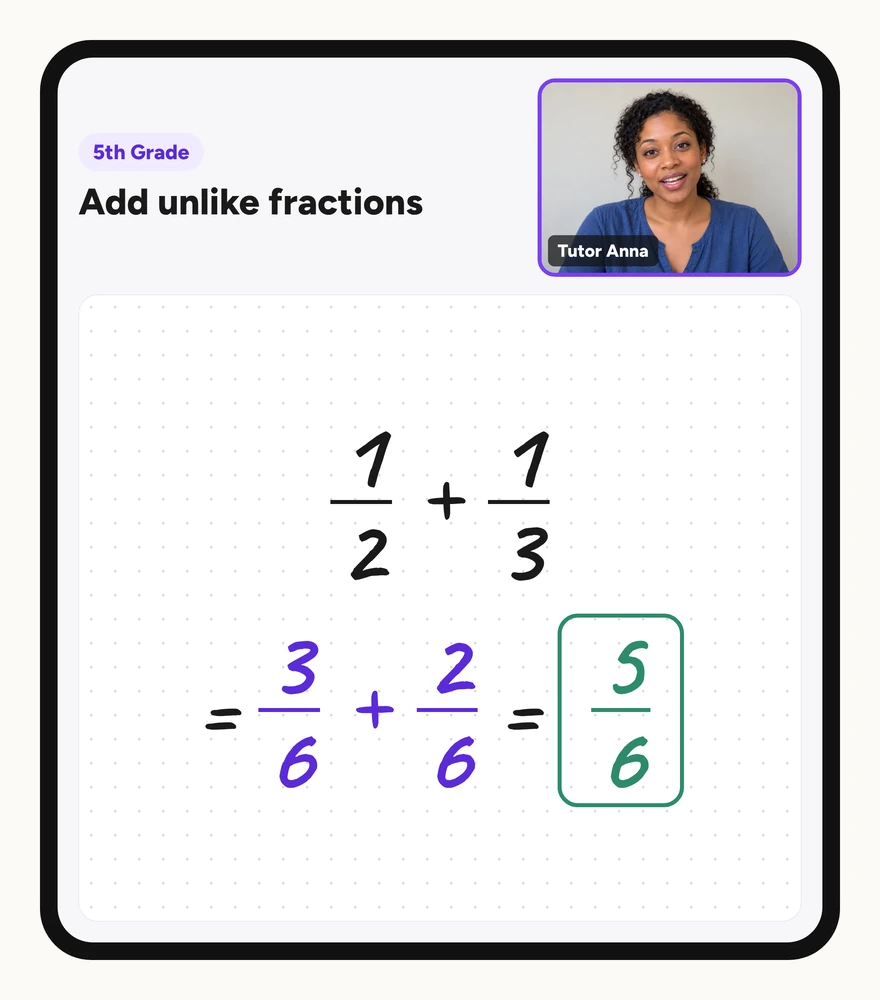
Illustration of an online 5th grade lesson: a tutor on video and a whiteboard adding 1/2 + 1/3 by rewriting them as sixths to get 5/6.

I have seen such a boost in her grades and confidence — Jessica S

Try a class

Top 5th Grade Tutors

5 of 240 tutors shown · 5.0 avg rating from 1,667 reviews

Mrs. McKay

Certified classroom teacher

Super tutor

5.0

58 ratings

16 years

Experience

4th to 6th grade

Available Wed

Mrs. McKay is a veteran educator with nearly twenty years of experience teaching middle school students at a Catholic school. Throughout her career,…

K - 7th

Available Sun, Tue, Thu, Sat

Can support: Special ed, Gifted & talented

Hi! My name is Raye Lynn Weaver, and I’ve been an educator for over 21 years. I’ve taught PreK through 7th grade in math, reading, and writing, and…

K - 4th

Available Mon, Tue, Wed, Thu, Fri, Sat

I have been teaching for 16 years, working in schools for 27, guiding kids from 4K all the way through 6th grade in the great state of Wisconsin. My…

Pre-K - 6th

Available Tue

Can support: ADHD, Dyslexia, ESL ...

🌟 Hi! I'm Lauren, and I can't wait to meet your learner! 🌟 Teaching isn't just what I do—it's who I am. With more than 22 years of experience…

Pre-K - 8th

Available Mon, Tue, Thu, Sat

Can support: ADHD, ESL, Behavioral ...

I’m a passionate educator with 9 years of classroom experience teaching Kindergarten through 3rd grade. Outside of teaching, I enjoy staying active…

What parents are saying

Ms. Johnson, is amazing. Elijah gravitated to Ms. Johnson and really enjoyed meeting her. I really am happy that Elijah and Ms. Johnson is a... perfect fit for his reading needs.

Ruth - 5th grade, Reading

It was nice, because she helps me prepare for 6th grade, and she helps me feel more confident!

Honesty - 5th grade, Math

Awesome. Very helpful and impressionable on my son. He wants this to be a permanent thing he loved it so much.

tytianna - 5th grade, Math

Fifth-grade tutoring across Math, Reading, Writing, Science, and Spelling

Fifth graders encounter longer words, multi-step calculations, and questions that ask them to explain their reasoning. A student may decode a passage fluently but struggle to summarize it, multiply decimals correctly but lose track of place value, or draft a narrative without organizing the events. Tutoring can start with the specific point where understanding breaks down.

Tutors can connect current schoolwork to targeted practice. That might mean breaking a multisyllabic word into recognizable parts, using a model to show decimal multiplication, adding sensory details to a story, reviewing a spelling pattern before a suffix, or explaining how energy transforms in a science example. The goal is to give students a way to check their work and explain the next step.

Sound familiar?

Why families look for fifth-grade support

Decoding longer words interrupts reading flow

Students may recognize short words but pause at multisyllabic vocabulary. Tutors can help students identify familiar prefixes, suffixes, base words, or vowel patterns within longer words, then blend the parts and check the meaning in context.

Math procedures work until a new step appears

Students may follow steps for whole-number operations but struggle when decimals, fractions, or larger numbers change the calculation. Tutors can use place-value models, grids, or number lines to show why a procedure works, then connect the representation to the written method.

Writing contains ideas but lacks organization or detail

A draft may list events or facts without explaining their connection or importance. Tutors can help students plan a paragraph's purpose, add relevant details, and revise for clarity before checking grammar and spelling.

Learning needs that can show up in fifth grade

Reading: decoding multisyllabic words

Words like observation or hypothesis can stop a reader mid-sentence. Tutors can guide students to break the word into syllables or recognizable parts—ob-ser-va-tion—then blend them together and confirm the pronunciation and meaning. Recognizing common prefixes like un- or re- and suffixes like -ness or -tion can make unfamiliar words more approachable.

Reading: distinguishing main idea from supporting details

Students may retell interesting facts without identifying the paragraph's central point. Tutors can ask what the section is mostly about, then help students distinguish a main idea from an example or elaboration. Numbering paragraphs can make it easier to locate information when answering questions.

Math: multiplying decimals and placing the decimal point

In 7 × 2.6, students can use an area model or place-value chart to multiply 7 × 2 and 7 × 0.6 separately, then add the partial products. Tutors can show that the decimal placement depends on counting tenths and ones, not on memorizing a rule about moving points without understanding why.

Math: adding and subtracting decimals with alignment

When adding 3.48 and 0.75, aligning the decimal points ensures that tenths are added to tenths and hundredths to hundredths. Tutors can connect decimal addition to money—three dollars and 48 cents plus 75 cents—to reinforce place-value reasoning.

Writing: adding sensory details and description

A sentence like The character appeared in the room can be expanded with details about what the character sees, hears, or feels. Tutors can prompt students to show emotion through actions and dialogue rather than simply stating how a character feels, making the writing more vivid.

Spelling: applying suffix rules with Y-ending words

When adding a suffix to a word ending in Y, students may forget whether to change Y to I. The rule depends on the suffix: change Y to I before -ed or -es (carry becomes carried, baby becomes babies), but keep the Y before -ing to avoid two I's in a row (crying, studying). Tutors can practice the pattern with multiple examples.

Science: distinguishing conductors from insulators

Students may know that metals conduct electricity but struggle to explain why rubber coating on a cord keeps users safe. Tutors can use concrete examples—a plug, a toaster cord, or a circuit diagram—to show that conductors allow current to flow while insulators block it, connecting the concept to everyday objects.

How tutors make fifth-grade work easier to explain

Use an area model to show decimal multiplication

To multiply 7 × 2.6, students can build a grid with rows for 7 and columns for 2 and 0.6. Multiply 7 × 2 to get 14, then 7 × 0.6 to get 4.2, and add the partial products: 14 + 4.2 = 18.2. The model shows why the decimal appears where it does, rather than treating placement as a separate rule to memorize.

  1. Draw a place-value chart or area model with 7 rows.
  2. Separate 2.6 into 2 and 0.6.
  3. Multiply 7 × 2 = 14 and 7 × 0.6 = 4.2.
  4. Add the partial products to get 18.2.

Break multisyllabic words into manageable parts

For an unfamiliar word such as unhelpful, tutors can identify the prefix un-, the base help, and the suffix -ful. Students can read the parts, blend the whole word, and discuss how un- changes the meaning. They can then try another word with a familiar part and check its meaning in the sentence.

Plan a paragraph with a clear purpose

Before drafting, students can decide what a paragraph should accomplish: compare two ideas, explain a cause, or describe a setting. Tutors can help students choose supporting details, select transitions that fit the relationship, and check whether each sentence contributes to the main point. Revision can focus on missing explanations or repetition.

Connecting skills across fifth-grade work

Original examples that show how a skill can transfer to a related task.

From identifying a spelling pattern to reading new words

Practice the EA vowel team in words like team, leaf, and seat, where EA makes the long E sound. Then try a new word: bead. Students can recognize the pattern, blend the sounds, and use the word in a sentence. Tutors can note that EA can represent other sounds in different words, so the pattern applies to this set rather than every word containing EA.

From a stated detail to a supported inference

Read this original text: The gardener put on gloves and picked up a small shovel. A tray of seedlings waited beside an empty flower bed. First identify a stated detail: the gardener has gloves and a shovel. Then ask what the gardener might do next. Planting the seedlings is an inference supported by the tools and the empty bed, not a sentence copied from the passage.

Inside a 25-minute session

What a fifth-grade tutoring session can look like

This illustrative lesson focuses on one Math need: multiplying a whole number by a decimal using an area model. Another session might address a Reading, Writing, Science, or Spelling need instead. Tutors adjust the topic and pace to match the student's current work.

  1. 0–3 min

    Check place-value understanding

    Review that 2.6 means 2 ones and 6 tenths. Ask the student to represent the number on a place-value chart or explain it in words, checking that tenths are understood as parts of one whole.

  2. 3–8 min

    Set up the area model

    Draw a grid to represent 7 × 2.6. Separate 2.6 into 2 and 0.6, creating two columns. Label the rows for 7 and discuss what each section of the grid will show.

  3. 8–15 min

    Multiply and find partial products

    Calculate 7 × 2 = 14 in the first section and 7 × 0.6 = 4.2 in the second. Discuss why 7 × 0.6 equals 4.2, connecting it to 7 × 6 tenths. Write both partial products in the grid.

  4. 15–22 min

    Add the partial products

    Combine 14 and 4.2 to get 18.2. Check the place value: 1 ten, 8 ones, and 2 tenths. Ask the student to explain why the decimal point appears after the 18.

  5. 22–25 min

    Try a related problem and review

    Work on 5 × 3.4 using the same model. The student sets up the grid, calculates partial products, and adds them. Review the connection between the model and the written calculation, then choose a next practice or revisit the model if the step remains unclear.

Example timings only. The topic, activities, and pace can change depending on the student's needs. Tutors adapt the lesson rather than follow a fixed format.

Frequently Asked Questions

Terms of servicePrivacy PolicyNotice at Collection

© 2026 ClassDojo. All Rights Reserved.