



Skip content
Dojo Tutor
Log inTry class

4th Grade Tutoring

Personalized support from experienced teachers, with the flexibility of learning online.

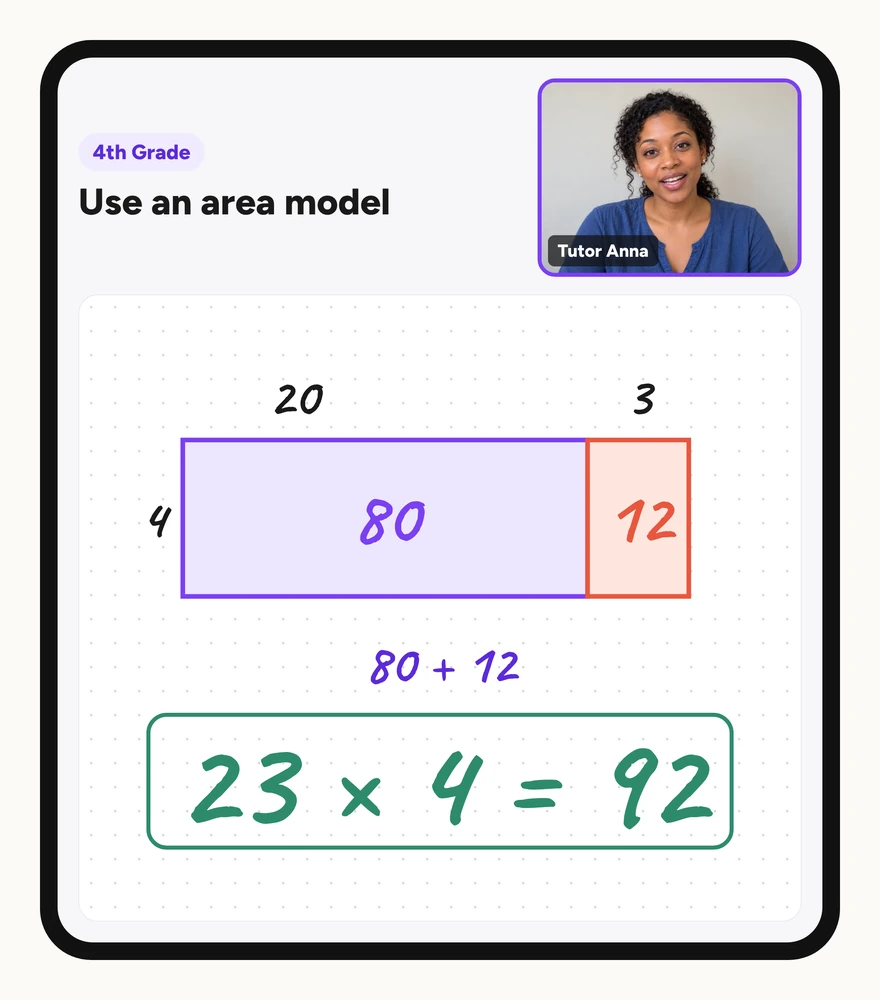
Illustration of an online 4th grade lesson: a tutor on video and an area model splitting 23 × 4 into 80 + 12 = 92.

I have seen such a boost in her grades and confidence — Jessica S

Try a class

Top 4th Grade Tutors

5 of 276 tutors shown · 5.0 avg rating from 1,496 reviews

Mrs.Analisa

Certified classroom teacher

5.0

16 ratings

14 years

Experience

Yes, I have tutored my Special Education students in grades 1st-4th primarily.

Available Wed, Thu

Can support: ADHD, Dyslexia, Special ed ...

I am a founding tutor who took a break! I tutored with Class Dojo from 12/2021-10/2025. I loved tutoring with Class Dojo and had a great rating from…

1st - 5th

Available Mon, Tue, Wed, Thu

Hi, my name is Josh! I am excited to start this learning journey with you! With three years of teaching experience in music for kids from…

1st to 6th grade

Available Tue, Wed, Thu

With 9 years of teaching experience, I have had the opportunity to work with learners of all ages and abilities. My passion for teaching started with…

Pre-K - 4th

Available Mon

Can support: Special ed, Autism spectrum

Hi, my name is Mrs. Hudgins and I am excited to start this learning journey with you! With 12 years of teaching experience in Special Education for…

Pre-K - 5th

Available Wed, Thu

For the past 8 years, I have been teaching learners in Kindergarten through 5th grade in Florida. During my time as a teacher, I have taught a…

What parents are saying

I enjoy seeing my son interacting and engaged with Ms. Laura. She's patient, knowledgeable and knows how to captive my son to read based on ... my son's interests. I feel over joy that I selected the right tutor when my son says, "I really like my tutor" ❤️.

Edith - 4th grade, Reading

The excitement in my son's voice was plesaiand joyful to my ears. Micaiah is so happy when pronunciatethe words correctly. I'm thankful to... have a teacher that brings him joy in learning a new language and help build his character.

Sharyn - 4th grade, Spanish

Cecilia’s confidence is getting so much better! We have tried so hard to help her with her multiplication facts but her working memory coupl... ed with some anxiety has made this difficult for her to master so it was so amazing to her working faster even with out the multiplication table …. For the most part. Thank you for all you do!

Leanne - 4th grade, Math

Fourth-grade tutoring that builds understanding across Reading, Writing, Math, and Science

Fourth graders encounter longer words, multi-step problems, and questions that ask them to explain their reasoning. A student may decode a passage fluently but struggle to summarize it, set up a multiplication problem correctly but lose track during regrouping, or know a science vocabulary term without connecting it to the concept. Tutoring can start with the specific point where understanding breaks down.

Tutors can use current assignments to identify a focused next step. That might mean breaking a word into recognizable parts, connecting a multiplication model to the standard algorithm, planning a paragraph before drafting sentences, or explaining how energy moves through a food chain. The goal is to give students a way to show their thinking, check their work, and practice the skill that will make the next problem clearer.

Sound familiar?

Why families look for fourth-grade support

Skills from earlier grades are affecting new work

Multiplication facts can slow down multi-digit multiplication and division. Difficulty blending sounds can make longer words harder to decode. Tutors can check these building blocks alongside current homework, then choose a smaller skill to revisit before adding another layer.

The answer is there, but the explanation is missing

Students may select a correct multiple-choice answer or solve a problem without being able to explain why their method works or how a text detail supports their response. Tutors can ask students to show their reasoning with a drawing, point to evidence, or describe the steps in their own words.

Writing contains ideas but needs organization

A draft may include several facts or observations without a clear main point or logical order. Tutors can help students plan what each paragraph should accomplish, choose relevant details, and explain connections before revising sentences for clarity and correctness.

Learning needs that can show up in fourth grade

Reading: decoding longer words with multiple parts

Students may recognize prefixes, suffixes, and base words in isolation but struggle to blend them in context. In a word like unhelpful, tutors can guide students to identify un-, help, and -ful, read each part, then blend the whole word and discuss how the parts affect meaning.

Reading: distinguishing main idea from interesting details

Students may retell a passage by listing facts without identifying the central point. Tutors can ask what the passage is mostly about, which details support that idea, and which details are less important. Summarizing in one or two sentences can clarify the distinction.

Writing: completing sentences and organizing paragraphs

A sentence fragment may contain descriptive words but lack a subject or predicate. Tutors can ask what is being said about the subject, help students complete the thought, then check capitalization and punctuation. At the paragraph level, students can plan a topic sentence and supporting details before drafting.

Writing: using evidence without explaining its relevance

Quoting or citing a detail does not automatically show how it supports an answer. Tutors can prompt students to state their point, select relevant evidence, and explain the connection in their own words rather than assume the reader will infer the relationship.

Math: keeping place value aligned during multi-digit operations

In problems like 314 minus 178, students may forget to regroup or misalign columns. Tutors can use place-value drawings to show exchanging one hundred for ten tens, or one ten for ten ones, then connect that model to the written algorithm step by step.

Math: understanding what each number represents in multiplication

In 23 times 14, students may multiply digits without recognizing that 23 times 10 and 23 times 4 are partial products. An area model can show how the problem breaks into smaller parts, and tutors can connect those parts to the standard algorithm's regrouping steps.

Science: memorizing terms without connecting them to processes

Students may recall that producers make their own food and consumers eat other organisms, but struggle to trace energy flow through a food chain or explain what happens when one population changes. Tutors can use diagrams and scenarios to connect vocabulary to relationships in an ecosystem.

How tutors make fourth-grade work easier to explain

Break longer words into recognizable parts

Tutors can help students identify a prefix, suffix, or familiar base within a multisyllabic word. Students read each part, blend the whole word, and check the meaning. For example, in the word uncomfortable, students can recognize un-, comfort, and -able, then explain that it means not able to be comfortable.

  1. Identify a prefix, base word, or suffix.
  2. Read each part separately.
  3. Blend the parts into the whole word.
  4. Check the meaning and use the word in a sentence.

Connect a multiplication model to the standard algorithm

An area model can show how 23 times 14 breaks into four smaller products: 20 times 10, 20 times 4, 3 times 10, and 3 times 4. Students add those partial products to find the total. Tutors can then show the same problem using the standard algorithm and explain how regrouping corresponds to combining those parts.

Plan a paragraph's purpose before drafting

Tutors can ask students to state the main point, choose two or three supporting details, and decide what explanation the reader needs. A simple organizer can separate the topic sentence from the evidence and the closing thought. Students can then draft with a clear goal for each sentence, making revision more focused.

Connecting skills across fourth-grade work

Original examples that show how understanding in one area can support another.

From a stated detail to a supported inference

Read this original text: The playground was empty. Wet leaves covered the swings, and puddles filled the sandbox. Ask what the weather was recently like and which details support the answer. Students can explain that it likely rained because the leaves are wet and puddles formed, then write a response connecting the inference to specific evidence.

From an area model to checking a multiplication answer

Use an area model to multiply 12 times 15 by breaking it into 10 times 10, 10 times 5, 2 times 10, and 2 times 5. Add the partial products: 100 plus 50 plus 20 plus 10 equals 180. Then solve the same problem using the standard algorithm and compare the results. Tutors can ask students to explain where each partial product appears in the written method.

Inside a 25-minute session

What a fourth-grade tutoring session can look like

This illustrative lesson focuses on one Math need: understanding regrouping in two-digit multiplication. Another session might focus on a Reading comprehension strategy, a Writing paragraph structure, or a Science concept. Tutors adapt the topic and pace to the student's current work.

  1. 0–3 min

    Check understanding of single-digit multiplication

    Review a few multiplication facts and check whether the student can explain what 4 times 6 represents using equal groups or an array. This confirms readiness for multi-digit work.

  2. 3–8 min

    Introduce the problem and identify the challenge

    Present 23 times 14. Ask the student to estimate the answer, then try the standard algorithm. Observe where confusion arises, such as forgetting to regroup or misaligning place values.

  3. 8–15 min

    Use an area model to show partial products

    Draw a rectangle divided into four sections representing 20 times 10, 20 times 4, 3 times 10, and 3 times 4. Calculate each partial product and add them to find 322. Discuss how this model breaks the problem into manageable parts.

  4. 15–22 min

    Connect the model to the written algorithm

    Show the same problem using the standard algorithm. Explain how multiplying 23 by 4 gives 92, and multiplying 23 by 10 gives 230. Add those results to reach 322. Ask the student to identify where the partial products from the area model appear in the written work.

  5. 22–25 min

    Practice independently and check the result

    Try a similar problem, such as 18 times 12. The student works through the algorithm, checks the answer using estimation or an area model, and explains one step. Review what to practice next.

Example timings only. The topic, activities, and pace can change depending on the student's needs and the subject being practiced.

Frequently Asked Questions

Terms of servicePrivacy PolicyNotice at Collection

© 2026 ClassDojo. All Rights Reserved.