


Skip content
Dojo Tutor
Log inTry class

3rd Grade Tutoring

Personalized support from experienced teachers, with the flexibility of learning online.

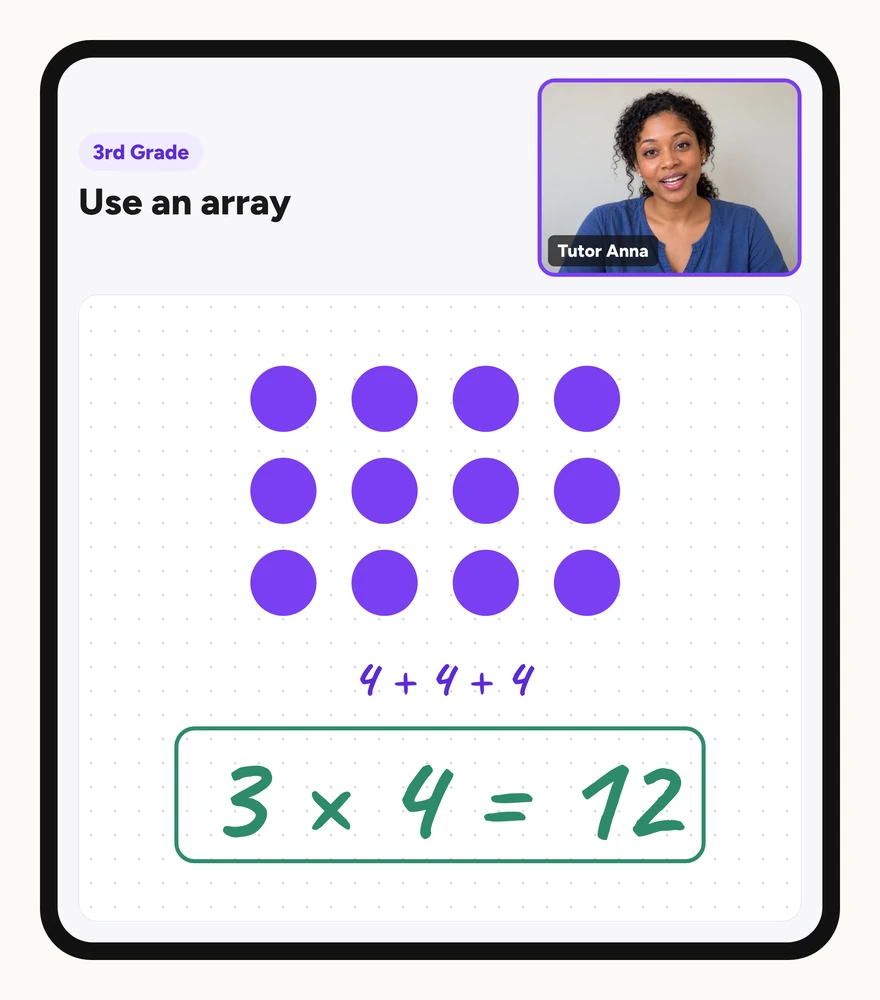
Illustration of an online 3rd grade lesson: a tutor on video and an array of 3 rows of 4 dots showing 3 × 4 = 12.

I have seen such a boost in her grades and confidence — Jessica S

Try a class

Top 3rd Grade Tutors

5 of 300+ tutors shown · 5.0 avg rating from 782 reviews

3rd grade, 4th grade, 5th grade

Available Tue, Wed, Thu

Can support: ESL, Gifted & talented

Hi! I’m passionate about helping elementary students build confidence and discover the joy in learning. I enjoy making lessons fun, supportive, and…

Amanda L.

Certified classroom teacher

Super tutor

5.0

91 ratings

26 years

Experience

1st - 8th

Available Wed, Thu, Sat

Can support: ADHD, Dyslexia, Special ed ...

Hi families! I bring over 25 years of teaching experience, both in the classroom and online. Helping children learn to read is truly one of my…

K - 3rd

Available Tue, Thu, Sat

Can support: Gifted & talented

👋 Hi! I’m Esther — and I’m thrilled to join your child on their learning journey! With two years of teaching experience and a passion for helping…

1st - 4th

Available Mon, Tue, Wed

Can support: ADHD, Behavioral, Gifted & talented

Tell families a bit about you Hello! My name is Kate and I live in North Carolina with my dog and 3 cats. In my free time I enjoy spending time with…

K - 4th

Available Mon, Thu, Fri

Hello! My name is Deborah and I am excited to have the opportunity to work with your child. I believe in caring and connecting with the student to…

What parents are saying

I love that Ms. Vanessa engaged Montrail by asking him what are some of the things that he liked. She allowed him to express his emotions an... d then gave him reassurance. By the end of class, his mood had changed! I like the idea that she asked questions that made him utilize his critical thinking skills! She also gave pointers on things that he can benefit from during the tutoring sessions.

Tyler - 3rd grade, Science

We have been working with Hannah for 2 years and my son looks forward to their sessions. She has made great suggestions and has boost my son... ’s writing capabilities.

Jannella - 3rd grade, Writing

Mrs. Boehm is an awesome tutor! I would love for Gracen to continue to work with her because she had Gracen engaged and excited to learn. I ... love how calm and caring she is. The way that she taught Gracen was with grace and kindness. I am excited for Gracen to work with Mrs. Boehm again.

Armenta - 3rd grade, Math

Third-grade tutoring that connects Reading, Writing, and Math

A third grader may need different kinds of support across the school day: reading a longer word, explaining an answer about a passage, organizing a few sentences, or deciding whether a word problem calls for addition or multiplication. A grade-level page should leave room for those different needs rather than assume every student is working on the same skill.

Tutors can use current work to choose a focused starting point. That might mean connecting equal groups to a multiplication expression, returning to a sentence that supports a reading answer, or helping a writer complete a thought. Drawings, spoken explanations, and written steps can give students ways to show what they understand and identify what to practice next.

Sound familiar?

Why families look for third-grade support

Different subjects reveal different gaps

A student may read a passage but need help explaining it, or write a clear idea but miss sentence endings. Tutors can look at the specific task rather than assume that difficulty in one area means every subject needs the same support.

Getting started or checking work still needs prompting

Tutors can model a small routine: identify the question, choose a strategy, and check the result. The routine can look different across subjects, such as rereading for evidence, checking a complete sentence, or using a drawing to verify equal groups.

Learning needs that can show up in third grade

Reading: checking the whole word

A familiar beginning can lead to a guess that misses the rest of a longer word. Tutors can help students notice a known spelling pattern or word part, read to the end, and check the spoken word against the print before returning to the sentence's meaning.

Reading: answering from the text

Students may offer a plausible answer without identifying what the passage says. Tutors can separate the question from the response, locate a relevant detail, and ask how that detail supports the answer. An inference also needs evidence, even when the text does not state it directly.

Writing: completing a thought

A phrase can contain several descriptive words while leaving the reader unsure what happened. Tutors can ask what is being said about the subject, help students complete the thought, and then check capitalization and the sentence ending. Sentence length alone does not show whether the thought is complete.

Writing: adding relevant detail

Adding detail is more useful when it answers a reader's question. Tutors can ask where an action happens, why a point matters, or which example supports an idea. Students can also remove a detail that distracts from the paragraph's main point.

Math: understanding a regrouping exchange

In 42 − 17, four tens and two ones can be exchanged for three tens and twelve ones. The amount is still 42. Showing that exchange can explain why the written digits change before students subtract seven ones and one ten to get 25.

Math: distinguishing groups from a total

Four boxes with six crayons in each contain 24 crayons. Students can draw the boxes, count the equal groups, and connect the picture to 4 × 6. Asking what each number describes helps distinguish the number of groups from the amount in each group.

How tutors make third-grade work easier to explain

Connect a Math model to its equation

An array or equal-groups drawing can connect multiplication and division. If 24 crayons are shared equally among four boxes, each box contains six. Tutors can ask what 24 ÷ 4 means in that situation and connect the answer to 4 × 6 = 24, keeping the quantities and units clear.

Separate what the text says from an inference

Tutors can ask students to identify a stated detail before explaining a conclusion. Students can point to the words they used and describe how those words support the inference. This gives the discussion a concrete starting point when an answer relies mostly on outside knowledge.

Give a short piece of writing one clear job

Before drafting, students can decide what they want the reader to understand and choose a detail that fits. Tutors can then review the idea, the sentence's completeness, and its ending in separate passes. That keeps adding meaning from becoming a task of adding words without a purpose.

Connecting skills across third-grade work

Original practice examples that connect an explanation to something students can show.

From a reading clue to a written explanation

Read this original text: Leaves blew across the path. A jacket flapped on the fence. Ask what the weather might be like and which details support the answer. Students can explain that it may be windy because the leaves moved and the jacket flapped, then write a complete response that connects the inference to a detail.

From an equal-groups picture to two operations

Draw four boxes with six crayons in each. Count the total and write 4 × 6 = 24. Then begin with 24 crayons shared among four boxes and write 24 ÷ 4 = 6. Tutors can ask students to explain why the six represents crayons per box, rather than a different total.

Inside a 25-minute session

What a third-grade tutoring session can look like

This illustrative lesson focuses on one Reading need: supporting an inference with text evidence. It includes a short written answer as part of that task. Another session could focus on a Math or Writing need instead.

  1. 0–3 min

    Identify the question

    Read a short passage and identify what the question asks. Check whether students need help reading a word or understanding what kind of answer is needed.

  2. 3–8 min

    Reread the relevant details

    Use the original practice text about leaves and a jacket. Check the meaning of flapped if needed, then find the actions the passage describes.

  3. 8–15 min

    Build an inference from evidence

    Discuss whether the details suggest wind. Separate that inference from what the text states directly, and point to the words that support it.

  4. 15–22 min

    Try another short example

    Read the original sentence The flag stretched out, and loose papers slid across the yard. Ask what it suggests about the weather and which words support the response.

  5. 22–25 min

    Explain and check the answer

    Write one response connecting an inference to a detail. Check that it answers the question and forms a complete thought, then choose a next Reading practice.

Example timings only. One lesson does not need to cover all three subjects; tutors can adjust the focus and pace.

Frequently Asked Questions

Terms of servicePrivacy PolicyNotice at Collection

© 2026 ClassDojo. All Rights Reserved.