

Skip content
Dojo Tutor
Log inTry class

2nd Grade Tutoring

Personalized support from experienced teachers, with the flexibility of learning online.

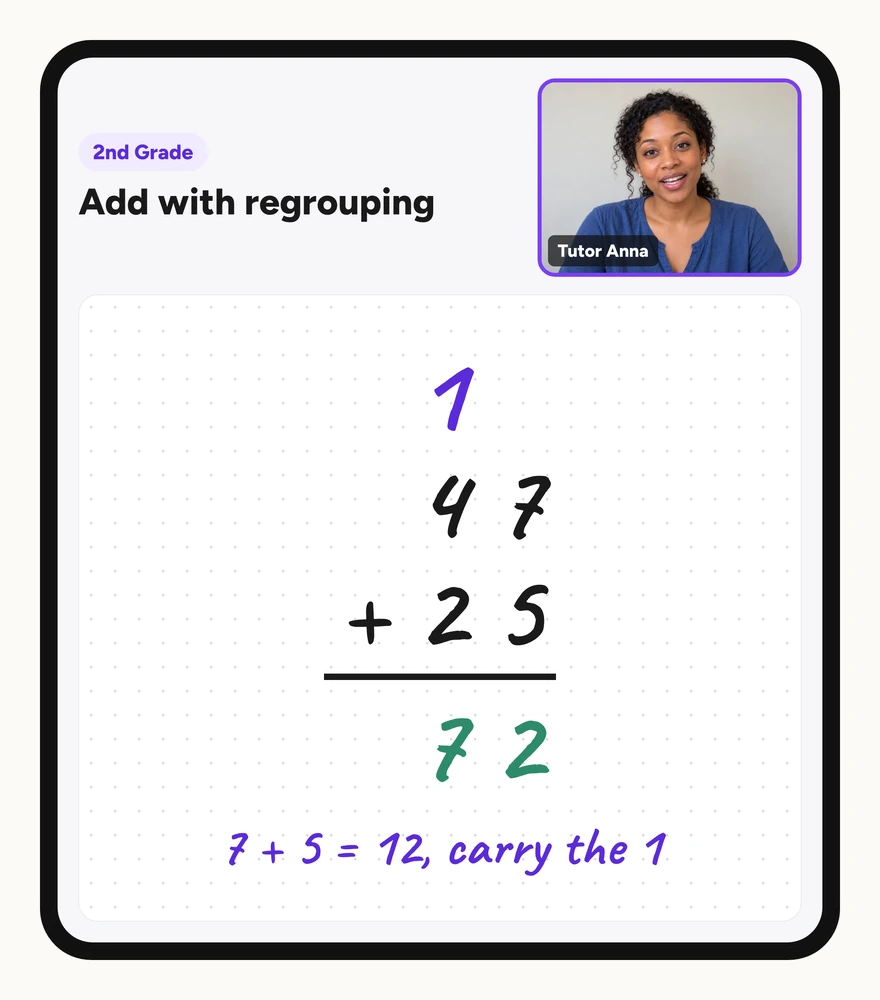
Illustration of an online 2nd grade lesson: a tutor on video and the problem 47 + 25 = 72 solved by regrouping.

I have seen such a boost in her grades and confidence — Jessica S

Try a class

Top 2nd Grade Tutors

5 of 300+ tutors shown · 5.0 avg rating from 861 reviews

2nd grade

Available Mon, Tue, Thu, Sat

Hi! My name is Ms. Ashley, and I am super excited to have the opportunity to help your child succeed academically. I have 6 years of teaching…

Ms. Kristen

Certified classroom teacher

Super tutor

5.0

45 ratings

11 years

Experience

K-3rd grade

Available Sun, Thu, Sat

Can support: Gifted & talented

Hi, I’m Kristen! I love helping students feel confident and capable in the classroom. Whether we’re tackling homework, preparing for tests, or…

2nd - 5th

Available Wed, Fri

Can support: ADHD, Autism spectrum

I have been teaching for 15 years, and I have experience teaching learners from 2nd to 7th grade in a variety of subjects. Some of my favorite…

1st - 4th

Available Tue, Thu, Sat

I am currently in my 6th year of teaching and have experience teaching learners in Kindergarten through 6th grade in a variety of subjects, including…

1st grade, 2nd grade, 3rd grade

Available Sun, Wed, Thu, Fri, Sat

Can support: Dyslexia

Looking for a summer reading boost? I help elementary students strengthen phonics, fluency, comprehension, and confidence through personalized…

What parents are saying

Miss Field has been an awesome asset to Caleb’s learning experience. His improvement is noticeable since he started working with her. We app... reciate her so much.

Justin - 2nd grade, Math

Trial session went great. Very interactive, kept my child’s attention the entire session. Mrs. Richardson was encouraging and patient. Loo... king forward to future sessions.

Aura - 2nd grade, General Tutoring

It's always a good time with Miss. Marissa. Amora has come such a long way and she's more confident when reading now.

Nakia - 2nd grade, Reading

Second-grade tutoring across Reading, Writing, Math, and Science

Second graders may need support in different areas: sounding out a word with a new vowel pattern, writing a complete sentence, understanding place value during regrouping, or explaining what plants need to grow. Tutoring can start with the specific point where the student gets stuck, rather than assume every second grader needs the same lesson.

Tutors can connect a skill to something students can show or explain. That might mean using a hundred chart to see what happens when ten is added, breaking a longer word into familiar parts, adding a missing detail to a sentence, or labeling a diagram to show how roots and stems work. The goal is to make the next step clearer and give students a way to check their own work.

Why families look for second-grade support

Different subjects reveal different needs

Students may read simple sentences but need help with vowel patterns, write ideas but leave out capitals or periods, or add single digits but lose track during regrouping. Tutors can look at the specific task and choose a focused starting point.

The steps are memorized, but the reasoning is unclear

Students may follow a procedure without understanding what it represents. Tutors can ask them to show the same idea with a drawing, number line, or spoken explanation, then connect that representation to the written work.

Learning needs that can show up in second grade

Blending sounds into a recognizable word

Students may produce individual sounds without joining them smoothly. In the word 'seat,' they might say /s/ /e/ /a/ /t/ as separate pieces. Tutors can model blending the sounds together, then ask students to try another word with the same vowel team, checking whether the spoken result matches the printed letters.

Distinguishing short and long vowel sounds

The vowel in 'hop' makes a short sound, while the vowel in 'hope' says its name because of the silent e. Students may confuse these patterns or read only the beginning of a word. Tutors can compare pairs like 'mat' and 'mate' to show how the spelling changes the sound, then practice reading the whole word.

Writing a complete thought with correct punctuation

A phrase like 'the tall green tree' may contain describing words but leave the reader unsure what happened. Tutors can ask what the tree is doing and help add a verb, such as 'The tall green tree swayed in the wind.' Students can then check for a capital letter at the start and a period at the end.

Understanding what changes during regrouping

In 48 + 27, eight ones plus seven ones make fifteen ones. That is one ten and five ones. Students may write both digits in the ones column or forget to add the carried ten. Drawing tens and ones can show that the total stays the same while the way it is grouped changes.

Recognizing that ten more or ten less changes only the tens place

When finding ten more than 32, students may change both digits instead of recognizing that only the tens place increases. A hundred chart can show that moving down one row adds ten, changing 32 to 42, while the ones digit remains two.

Spelling words with vowel teams and silent letters

Vowel teams like 'ea' in 'seat' or 'ay' in 'play' represent one sound with two letters. Silent letters like the 'w' in 'wrap' or the 'k' in 'knee' do not make a sound but are part of the spelling. Tutors can introduce these patterns in small groups of words and give students a way to remember which letters to include.

How tutors make second-grade work easier to explain

Use a hundred chart to show adding or subtracting ten

On a hundred chart, moving down one row adds ten and moving up one row subtracts ten. Students can start at 32, move down to 42, and see that only the tens digit changed. This visual model connects the pattern to place value before students practice the same step without the chart.

  1. Find the starting number on the hundred chart.
  2. Move down one row to add ten or up one row to subtract ten.
  3. Read the new number and compare the digits.
  4. Explain which place value changed and why.

Break a word into sounds or familiar parts

Tutors can help students notice a vowel team, consonant blend, or suffix within a longer word. In 'teacher,' students can identify 'teach' and the ending 'er,' then blend the parts. For a word like 'count,' they can recognize that 'ou' makes the sound in the middle, then read the whole word and check its meaning.

Connect a sentence to what the reader needs to know

Before adding more words, tutors can ask whether the sentence expresses a complete thought. Students can identify the subject and what it does, then add a detail that answers where, when, or why if the reader needs it. A separate check can focus on capitalization and punctuation after the meaning is clear.

Connecting skills across second-grade work

From counting by tens to recognizing the place-value pattern

On a standard hundred chart arranged in rows of ten, follow 8, 18, 28, and 38 down a column. The ones digit stays eight while each move adds one ten. Students can explain that pattern, then find ten more than other numbers whose results remain on the chart.

From reading a vowel team to spelling a new word

Read 'team,' 'leaf,' and 'seat,' noticing that 'ea' represents the long e sound. Then spell a new word like 'bead' by identifying the sounds and choosing the correct vowel team. Tutors can check whether students attend to all the letters, including the final consonant, rather than guess from the beginning alone.

What a second-grade tutoring session can look like

This illustrative lesson focuses on using a hundred chart to understand ten more and ten less. Another session might focus on a reading pattern, sentence writing, or a science topic instead. Tutors adjust the activity and pace to match the student's current work.

  1. 0–3 min

    Review tens and ones

    Represent a number like 32 as three tens and two ones. Check that students understand the value of each digit before moving to addition or subtraction.

  2. 3–8 min

    Find a number on the hundred chart

    Locate 32 on the chart. Ask what happens when you move down one row. Students can see that the number becomes 42 and explain that ten was added.

  3. 8–15 min

    Practice ten more and ten less

    Try several examples: ten more than 45, ten less than 67. Students can move on the chart, read the new number, and identify which digit changed. Discuss why the ones place stays the same.

  4. 15–22 min

    Connect the chart to written problems

    Write 32 + 10 and ask students to solve it using the hundred chart or by reasoning about place value. Check that they can explain the answer without needing to count every number.

  5. 22–25 min

    Review the pattern and choose next practice

    Ask students to explain what changes when ten is added or subtracted. Choose another place-value activity or return to the hundred chart if the pattern is still unclear.

Example timings only. One lesson does not need to cover all subjects; tutors can change the focus and spend more or less time on any stage.

Frequently Asked Questions

Terms of servicePrivacy PolicyNotice at Collection

© 2026 ClassDojo. All Rights Reserved.