Skip content
Dojo Tutor
Log inTry class

1st Grade Tutoring

Personalized support from experienced teachers, with the flexibility of learning online.

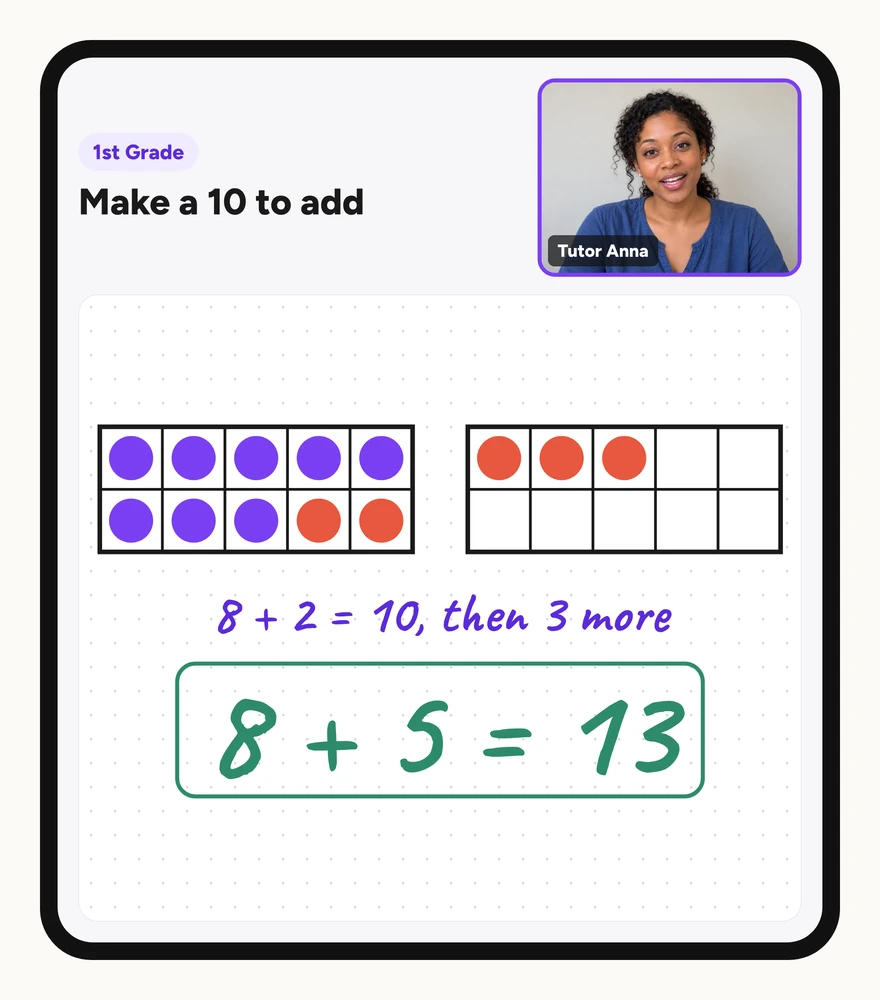
Illustration of an online 1st grade lesson: a tutor on video and two ten frames showing 8 + 5 = 13 by making a ten.

I have seen such a boost in her grades and confidence — Jessica S

Try a class

Top 1st Grade Tutors

5 of 300+ tutors shown · 4.9 avg rating from 909 reviews

Ms. D

5.0

1 ratings

10 years

Experience

1st - 8th

7 days a week

Can support: ADHD, Dyslexia, Behavioral ...

Hello, dear families! I’m Ms. D, a licensed professional teacher with over 10 years of experience teaching learners from preschool through high…

1st to 2nd grade

Available Sun, Mon, Wed

Hello! I'm a dedicated tutor who is passionate about helping students build confidence and achieve their academic goals. I believe every child learns…

1st - 4th

Available Mon, Tue

I have been teaching for 4 years, specializing in 3rd grade. I have had the pleasure of teaching in Massachusetts and have a BA in Elementary…

1st - 8th

7 days a week

Can support: ESL

Hello! I am an ESL and reading educator with over a decade of experience in remote education. I hold a Bachelor of Science in Professional…

1st - 5th

Available Mon, Tue, Wed, Fri, Sat

Can support: ADHD, Dyslexia, ESL ...

Hi! My name is Youlande Hall. I am a passionate and dedicated elementary educator with years of teaching experience. I enjoy helping students develop…

What parents are saying

Ms Van Horn is always patient, encouraging, and amazing. She gets so much accomplished in the little time available to her. We love working ... with her.

Amy - 1st grade, Reading

Miss Susan is wonderful! My daughter improved so much with her reading! Love Her!

Barbara - 1st grade, Reading

Miss Stef is amazing and her patience is amazing with our little one. We’ve seen a lot of improvement with our child. Do not hesitate to boo... k her.

Ivy - 1st grade, Summer Boost

First-grade tutoring that builds reading, writing, and math foundations

First graders may need support blending sounds into words, writing a complete sentence, or understanding what an addition problem asks them to find. Tutoring can start with the specific place where a student pauses: a vowel sound, a missing capital letter, or the meaning behind counting on.

Tutors can connect spoken sounds to printed letters, help students explain their thinking in math, and guide the first steps of sentence writing. Short activities with clear goals—such as reading a small set of words with the same pattern, drawing equal groups, or completing one sentence—give students concrete ways to practice and check their progress.

Sound familiar?

Why families look for first-grade support

Sounding out letters without blending the word

Students may say each letter sound separately but struggle to join them into a recognizable word. Tutors can model blending with short words, then ask students to say the sounds smoothly and check whether the result matches a word they know.

Writing ideas without sentence structure

A first grader may have a clear idea but write a string of words without capitalization, spacing, or an ending. Tutors can help students say the sentence aloud, write one word at a time with finger spaces, and add a capital letter and period to complete the thought.

Counting to find an answer without understanding the operation

Students may find an answer by counting but need help explaining what the operation represents. Tutors can connect a drawing to an addition or subtraction sentence, then ask what each number describes.

Learning needs that can show up in first grade

Confusing similar letters

Lowercase b and d have the same parts arranged differently. In b, the tall stroke is on the left and the rounded part is on the right; d reverses that arrangement. Tutors can model each letter and ask students to check its shape in a word.

Blending sounds into a whole word

Saying the sounds /m/ /a/ /p/ does not automatically produce map for every learner. Tutors can model saying the sounds closer together, then ask students to repeat the blending until the spoken word is clear. Practice with a small set of similar words can reinforce the skill.

Reading words with an unexpected spelling

Words such as could and said include spellings that need extra attention. Tutors can connect the regular parts to their sounds, identify the unexpected part, and practice reading and spelling the word in context.

Distinguishing vowel sounds

Short vowel sounds can be difficult to hear and produce consistently. Students may confuse the vowel in pig with the vowel in peg. Tutors can compare minimal pairs—words that differ by one sound—and ask students to identify which vowel they hear and see.

Writing without spaces between words

A sentence may appear as a continuous string of letters. Tutors can teach students to use a finger space after each word, say the sentence aloud to identify word boundaries, and reread to check that each word is separate.

Understanding what addition and subtraction represent

Students may know that plus means add but not understand that addition combines two groups into a total. Tutors can use drawings or objects to show the groups, write the corresponding number sentence, and ask students to explain what each number represents.

Counting on without recognizing the starting number

To solve 8 + 3, students can start at eight and count three more: nine, ten, eleven. Some students restart counting from one each time. Tutors can model holding the larger number in mind and counting on, then ask students to try the strategy with another problem.

How tutors make first-grade skills clearer

Connect sounds to letters in a small, focused set

Tutors can choose a few words that share a spelling pattern, such as cat, map, and sat for short a. Students can blend each word using letter-sound relationships they have learned, then read one in a short sentence.

  1. Identify the target sound and show it in a word.
  2. Blend the whole word by connecting all the sounds.
  3. Read another word with the same pattern.
  4. Use the word in a sentence to check meaning.

Build a sentence one step at a time

Students can say a sentence aloud, then write it word by word with spaces. Tutors can review whether it communicates a complete thought, then check the capital letter and appropriate ending. Rereading helps students notice missing words or an idea that still needs explanation.

Show what an operation means with a drawing

For 5 + 3, students can draw five objects, draw three more, and count the total. Tutors can write 5 + 3 = 8 beside the drawing and ask what each number represents. For 7 − 2, students can draw seven objects, cross out two, and count what remains. Connecting the picture to the number sentence helps students explain their thinking.

Connecting first-grade skills to new tasks

Original examples that show how a practiced skill can transfer to a related problem.

From blending one word family to reading a sentence

Practice blending cat, bat, and hat. Then read the sentence The cat sat on a mat. Students can identify the words with the short a pattern and explain how they read each one. Tutors can check whether students attend to the final consonant as well as the vowel.

From drawing equal groups to writing an addition sentence

Draw two boxes with four dots in each. Count the dots in one box, then the other, then the total. Write 4 + 4 = 8 and ask students to explain what the numbers mean. For a related problem, draw three boxes with two dots in each and write 2 + 2 + 2 = 6.

Inside a 25-minute session

What a first-grade tutoring session can look like

This illustrative lesson focuses on blending short-vowel words with a consonant-vowel-consonant pattern. Tutors can choose words with familiar letter sounds or select a different Reading, Writing, or Math need. One clear goal can guide the lesson without covering every subject.

  1. 0–3 min

    Check a familiar starting point

    Review a few letter sounds the student already knows. Try blending a previously practiced word to see whether the student can connect the sounds smoothly.

  2. 3–8 min

    Introduce a small set of words with one vowel

    Show three words with short a: cat, map, sat. Point to each letter, say its sound, and blend the whole word. Ask the student to repeat the blending for each word.

  3. 8–15 min

    Practice blending independently

    Present the same words in a different order. The student reads each word by blending the sounds. If a word is difficult, the tutor models again and asks the student to try once more.

  4. 15–22 min

    Read a word in a sentence

    Read the short sentence “The cat sat.” Check that students use the letters to read cat and sat, discuss the meaning, and reread the sentence with support as needed.

  5. 22–25 min

    Review and choose the next practice

    Ask the student to read one word from the lesson and explain how they figured it out. Decide whether to continue with the same vowel pattern or introduce a new one in the next session.

Example timings only. Tutors adjust the activity, number of words, and pace to match the learner.

Frequently Asked Questions

Terms of servicePrivacy PolicyNotice at Collection

© 2026 ClassDojo. All Rights Reserved.