Skip content
Dojo Tutor
Log inTry class

12th Grade Tutoring

Personalized support from experienced teachers, with the flexibility of learning online.

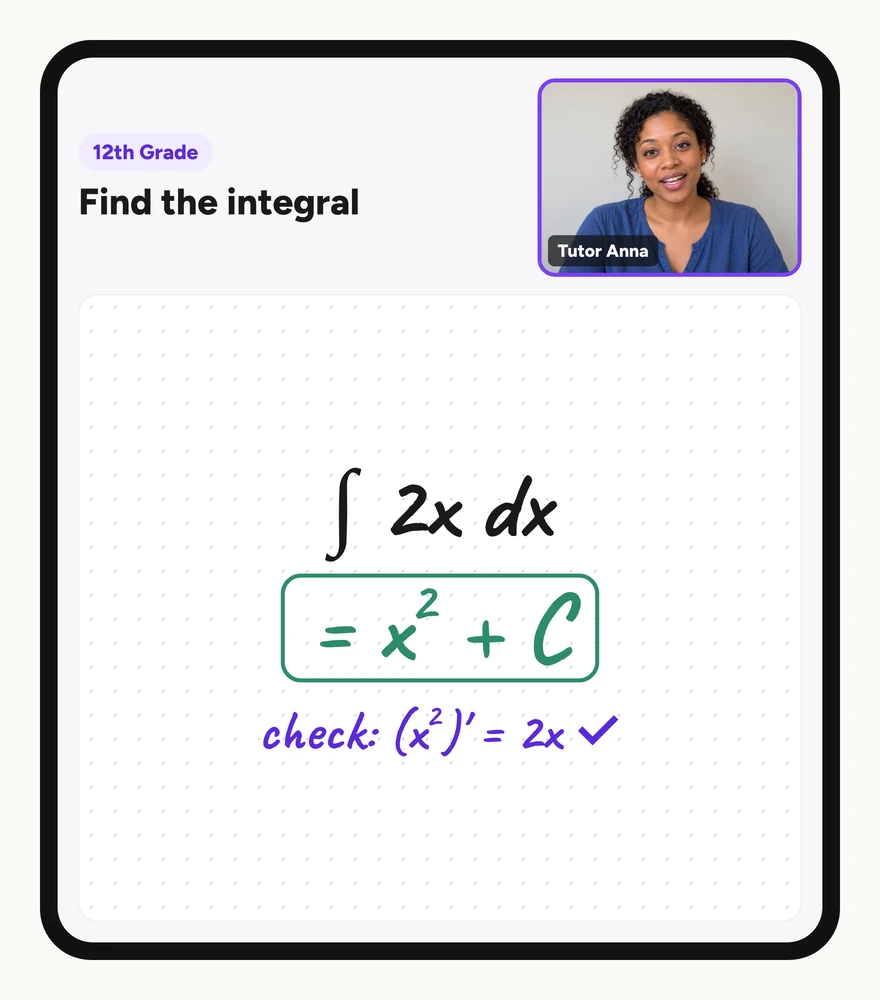
Illustration of an online 12th grade lesson: a tutor on video and a whiteboard finding the integral of 2x as x² + C.

I have seen such a boost in her grades and confidence — Jessica S

Try a class

Top 12th Grade Tutors

5 of 36 tutors shown · 5.0 avg rating from 1,639 reviews

Mrs. Sanders

Certified classroom teacher

5.0

80 ratings

21 years

Experience

K-6th grade

Available Mon, Tue, Wed, Thu, Fri

Can support: ADHD, Dyslexia, Behavioral ...

Hi there! I’m so glad you’re here. I’m a passionate educator with over 20 years of experience helping students unlock their full potential. Whether…

All grades

7 days a week

Hi! 👋 I’m Dr. Darris, a certified educator with more than 7 years of classroom teaching experience and extensive experience supporting learners…

All grades

Available Tue, Wed, Fri, Sat

Can support: ADHD, Dyslexia, ESL ...

Hi! My name is Tammie, and I'm excited to start this learning journey with you. I bring approximately 20 years of teaching experience across grades…

K-6th grade

Available Sat

Can support: ADHD, Dyslexia, Behavioral ...

I'm Dani! I am currently a 5th grade teacher at a local public elementary school. Some of my favorite moments teaching involve connecting scholars to…

All grades

Available Wed

As an educator with 19 years of classroom experience, I believe every student can succeed with the right support. I focus on creating a positive,…

What parents are saying

Samaria says she loves Ms Irene and likes the way she instructs her because she takes her time with her.

Phyllis - 12th grade, Reading

Thank you very much, He really liked it, she showed him easier ways to work out the problem, he wants to continue working with her.

Latonya - 12th grade, Algebra

Loved it. Feeling way more confident already and it's just my second class !

FIFA - 12th grade, Writing

Twelfth-grade tutoring that connects advanced concepts to clear reasoning

Twelfth-grade students may encounter calculus derivatives, statistical sampling, chemical equations, triangle proofs, and timed essay writing—often in the same week. A difficulty in one subject does not predict difficulty in another, and a strong grade does not mean every concept is secure. Tutoring can start with the exact point where a procedure stops making sense or a written argument needs sharper evidence.

Tutors can ask students to explain a step, connect a formula to its meaning, or revise a sentence for clarity. A calculus problem might need attention to notation; a statistics question might need a check of which population the sample represents; an essay might need one focused revision pass before editing mechanics. The goal is to give students a way to verify their reasoning and communicate it clearly.

Why families seek twelfth-grade support

Procedures work until an unfamiliar variation appears

Students may apply implicit differentiation or factor a quadratic successfully in one context, then hesitate when the same skill appears with an extra variable or nested expression. Tutors can identify the new feature, connect it to familiar work, and check understanding with a closely related example.

Written work needs more than grammar corrections

A timed essay or lab report can contain clear sentences that lack a connecting explanation or specific evidence. Tutors can help students plan an argument, choose relevant support, and revise for precision before addressing punctuation or word choice.

Learning needs that can show up in twelfth grade

Calculus: tracking dy/dx notation in implicit differentiation

When differentiating an equation like x·y = 5 with respect to x, the product rule applies: the derivative of x is 1, and the derivative of y is dy/dx. Students may omit dy/dx or place it inconsistently. Writing it explicitly after each y-term, then collecting and factoring those terms, makes the isolation step clearer.

Statistics: distinguishing sample design from bias

Stratified sampling selects within defined subgroups; systematic sampling selects at regular intervals after a starting point. Random selection does not by itself remove undercoverage, nonresponse, or biased question wording. Tutors can ask how the sampling frame relates to the target population and which groups may be missing.

Geometry: identifying corresponding sides in similar triangles

Matching angle markings identify equal angles in similar triangles; side tick marks identify equal lengths. Students can match a side's two endpoint angles with those of a side in the other triangle, then set up ratios of corresponding lengths. Distinguishing angle arcs from side marks helps prevent a mismatched proportion.

Chemistry: counting atoms when coefficients and subscripts combine

In 4H₂O, the coefficient 4 multiplies everything in the formula: 4 × 2 hydrogen atoms gives 8 hydrogen total, and 4 × 1 oxygen gives 4 oxygen. Students may multiply only the subscript or add instead of multiply. Writing out the count for each element separately can prevent this error.

Writing: using transition words without redundancy

Students can check whether a transition expresses the intended relationship and fits the sentence structure. A construction such as 'Although the results differed, however, the method was useful' can be simplified to 'Although the results differed, the method was useful.' Tutors can compare versions rather than assume two contrast words are always wrong together.

How tutors make advanced work easier to verify

Show every dy/dx term before collecting

For x² + y² = 25, implicit differentiation gives 2x + 2y·dy/dx = 0. At points where y is nonzero, divide to obtain dy/dx = −x/y. Tutors can explain why y is treated as a function of x, keep the derivative factor visible, and notice where this formula cannot be used because its denominator is zero.

  1. Differentiate both sides with respect to x.
  2. Write dy/dx after each derivative of a y-term.
  3. Collect all dy/dx terms on one side.
  4. Factor dy/dx and divide to isolate it.

Match corresponding sides using angle markings

In similar triangles, match vertices using the angle markings, then match the sides joining corresponding vertices. Tutors can use clearly labelled angle arcs and distinguish them from side tick marks. Ratios should use the same order of the two triangles so that corresponding side lengths give a consistent scale factor.

Plan an essay paragraph with point, evidence, and explanation

Before drafting, state the claim the paragraph will support. Select a relevant quotation or detail from the source. Then explain how that evidence supports the claim, using your own reasoning rather than repeating the quote. This structure keeps the paragraph focused and shows the connection between assertion and support.

Connecting procedures to reasoning

Original examples that show how to verify a step or connect a skill to a related task.

From a known derivative rule to logarithmic differentiation

For f(x) = ln(x² + 1), the logarithm input is positive for every real x. The chain rule gives f′(x) = 2x/(x² + 1). Students can identify the inner derivative, check the algebra, and compare the proposed derivative with a nearby difference quotient at a chosen point as a numerical check.

From a sample method to a bias check

Consider selecting every fifth address after a random starting address on an ordered list. This is systematic sampling. If the list has a repeating pattern aligned with that interval, the sample can miss relevant variation. Tutors can ask how the list was assembled, which population it covers, and what a different interval or design would change.

Inside a 25-minute session

What a twelfth-grade tutoring session can look like

This illustrative lesson focuses on implicit differentiation with the product rule. Another session might address a statistics concept, essay revision, or a different calculus topic. Tutors adjust the pace and examples to match the student's current work.

  1. 0–3 min

    Review the product rule

    Recall that the derivative of u·v is u·(dv/dx) + v·(du/dx). Try a simple example like x·x² to confirm the pattern before introducing a y-term.

  2. 3–10 min

    Differentiate an equation with x and y

    Work with x·y = 6. Apply the product rule: 1·y + x·(dy/dx) = 0. Emphasize that dy/dx appears because y depends on x. Students write every term explicitly.

  3. 10–17 min

    Isolate dy/dx

    Move y to the right side: x·(dy/dx) = −y. Divide both sides by x to get dy/dx = −y/x. Check the algebra and discuss what the expression means: the slope of the curve at any point (x, y) on the hyperbola.

  4. 17–23 min

    Try a related example independently

    Differentiate x² + y² = 25. Students apply the same process, writing 2x + 2y·(dy/dx) = 0, then solve for dy/dx. Compare the structure to the first example.

  5. 23–25 min

    Verify and choose next practice

    Substitute a point on the circle to check that the derivative formula gives a reasonable slope. Identify any notation or algebra step that needs reinforcement and select a follow-up problem or topic.

Example timings only. The topic, depth, and pace change with the student's needs and the course material.

Frequently Asked Questions

Browse tutors by subject

Browse tutors by specialty

Terms of servicePrivacy PolicyNotice at Collection

© 2026 ClassDojo. All Rights Reserved.