
Skip content
Dojo Tutor
Log inTry class

11th Grade Tutoring

Personalized support from experienced teachers, with the flexibility of learning online.

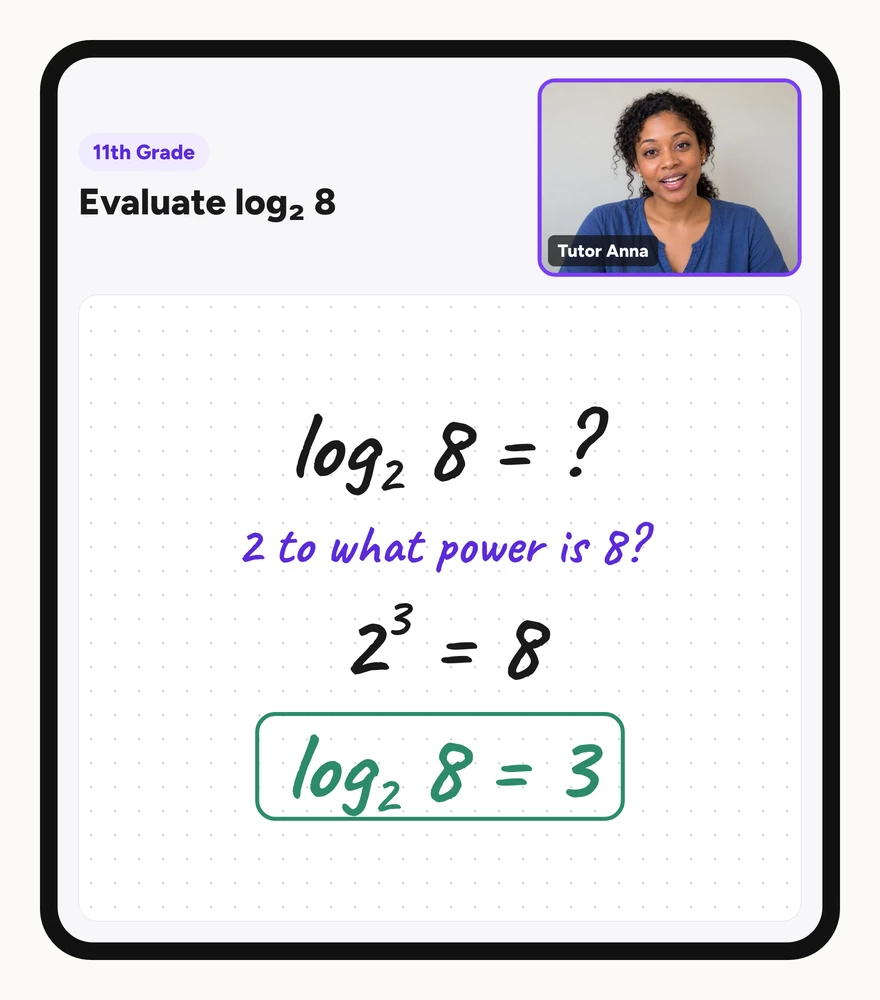
Illustration of an online 11th grade lesson: a tutor on video and a whiteboard showing log₂ 8 = 3 because 2³ = 8.

I have seen such a boost in her grades and confidence — Jessica S

Try a class

Top 11th Grade Tutors

5 of 48 tutors shown · 5.0 avg rating from 3,228 reviews

Dr. Jones

Certified classroom teacher

Super tutor

5.0

181 ratings

21 years

Experience

K-6th grade

Available Mon, Wed, Thu, Sat

Hi, I’m Dr. Brandi Jones. I’m a certified elementary educator with advanced expertise in mathematics instruction and gifted education. I hold a Ph.D.…

6th grade

7 days a week

Can support: ESL

With over 20 years of teaching experience, I have had the opportunity to work with learners of all ages, but my true passion lies in working with…

All grades

Available Sun

Can support: ADHD, Special ed, Autism spectrum

Hi, my name is Marinne! I am excited to start this learning journey with you! I'd like to share a bit about myself. I grew up just outside of…

All grades

7 days a week

Hello, families! I'm an experienced educator with a Bachelor's degree in Psychology, a Master's degree in Reading and ESOL, and over six years of…

All grades

7 days a week

Can support: ADHD, Dyslexia, ESL ...

Hi! I’m Teacher Michelle. I am a dual-licensed US and Philippine professional educator with 12 years of experience and a passion for making…

What parents are saying

Mr. B is helping my son gain his confidence back in his math skills. My son looks forward to his tutoring sessions. Mr. B is thorough and pa... tient and tries to help with whatever your biggest concerns are and he is incredibly responsive. Any time I have sent a message I hear back shortly after and Mr. b is ready with feedback and he applies the lesson to material you provide. I am so grateful for his knowledge and help.

Christina - 11th grade, Geometry

It was very nice to talk with Ms. Irene. She is very friendly, kind, caring, understanding. I like the questions she asked. I like how ... she can make communication easy and comfortable. Her help would be very beneficial and helpful for any child.

Tatiana - 11th grade, Study Skills

Lisa was very helpful! My daughter loved the connection and the material! Thank you Lisa!

Grace - 11th grade, Algebra

Eleventh-grade tutoring across advanced coursework

Eleventh graders may be balancing AP or honors courses in Calculus, Physics, Chemistry, Biology, Precalculus, and English alongside SAT preparation. A difficulty in one subject can look very different from a difficulty in another: applying the chain rule, setting up a free-body diagram, balancing a redox equation, interpreting a reading passage under time pressure, or writing a thesis statement with clear support. Tutoring can start with the specific concept or skill that is causing the current challenge.

Tutors can connect a procedure to its reasoning, check prerequisite understanding, and help students verify their work. That might mean using the unit circle to find a trigonometric derivative, drawing forces before writing equations, distinguishing ionic from covalent bonding, or locating text evidence for an inference. The goal is to give students a way to explain each step and catch errors before submitting an answer.

Sound familiar?

Why families look for eleventh-grade support

Formulas are memorized but not understood

Students may recall a derivative rule or friction formula without recognizing its conditions. Tutors can identify inner and outer functions for the chain rule, or distinguish kinetic friction fₖ = μₖN from static friction, which can vary up to μₛN. A diagram, example, or unit check can show whether the relationship fits the problem.

Reading and writing tasks require more than decoding

SAT reading passages and timed essays ask students to identify main ideas, draw inferences, support claims with evidence, and organize arguments. Tutors can help students annotate strategically, distinguish stated details from inferences, and structure paragraphs with clear topic sentences and explanations.

Advanced Math builds on gaps in earlier skills

Trigonometric transformations assume fluency with the unit circle; implicit differentiation assumes algebra skills; stoichiometry assumes mole conversions. Tutors can identify which building block needs review and practice it in the context of the current assignment.

Learning needs that can show up in eleventh grade

Calculus: applying the chain rule to nested functions

For trigonometric derivatives using radians, students can identify the outer function and the inner function, then include the inner derivative as a factor. Differentiating tan(3x) gives 3sec²(3x). Tutors can label both parts and check signs, notation, and where the expression is defined.

Physics: distinguishing force types and directions

A free-body diagram shows the forces acting on the chosen object. Tutors can identify contact and noncontact forces, draw the normal force perpendicular to the surface, and reason about friction from relative motion or its tendency at the contact. Constant velocity means zero acceleration and zero net force; constant speed with changing direction does not.

Chemistry: converting between moles, grams, and particles

Mole conversions require attention to units and the correct use of molar mass or Avogadro's number. Students may divide when they should multiply, or forget to convert grams to kilograms in physics equations. Tutors can emphasize unit cancellation and dimensional analysis as a check.

Precalculus: identifying transformations in function notation

In vertex form or trigonometric equations, students may confuse horizontal and vertical shifts, or forget that horizontal transformations work opposite to vertical ones. For example, in y equals sine of the quantity x minus 3, the graph shifts right by 3, not left. Tutors can use specific examples and ask students to describe the transformation in words before graphing.

Reading: distinguishing inference from stated detail

SAT and classroom reading questions may ask what a passage implies rather than what it states directly. Students may offer plausible answers without locating supporting text. Tutors can ask students to point to the relevant sentence and explain how it supports the inference, separating reasonable guesses from evidence-based conclusions.

Writing: supporting a thesis with explanation, not just evidence

A quotation or fact does not automatically prove a point. Students may include evidence without explaining its relevance. Tutors can help students state their claim, select a relevant detail, and then explain in their own words how that detail supports the argument.

How tutors make advanced coursework clearer

Connect a derivative rule to the function's structure

Before applying the chain rule, students can identify the outer and inner functions. For the derivative of sine of x squared, the outer function is sine and the inner is x squared. The derivative is cosine of x squared (outer derivative evaluated at the inner) times 2x (inner derivative). Tutors can use color or parentheses to highlight the nested structure and check each part separately.

  1. Identify the outer function and the inner function.
  2. Find the derivative of the outer function, leaving the inner unchanged.
  3. Multiply by the derivative of the inner function.
  4. Simplify and check units or sign as appropriate.

Draw and label forces before writing equations

A box with arrows representing gravity, normal force, applied force, and friction gives students a visual reference. Tutors can ask which forces balance in the vertical direction (gravity and normal force when there is no vertical acceleration) and which forces affect horizontal motion (applied force minus friction). Students can then write net force equals mass times acceleration with correct signs.

Use unit cancellation to guide mole conversions

Using a rounded molar mass of 18 g/mol for water, 36 g × (1 mol / 18 g) gives approximately 2 mol. Tutors can show why the mass units cancel, then extend the chain to molecules using Avogadro's constant. Students can label assumptions and retain appropriate precision for the problem.

Connecting skills across eleventh-grade subjects

Original examples that show how understanding transfers within and across subjects.

From the unit circle to a trigonometric derivative

Use the unit circle to recall that sine of pi over 6 equals one-half and cosine of pi over 6 equals square root of three over two. Then find the derivative of sine of 2x at x equals pi over 6. The chain rule gives 2 cosine of 2x. Substituting x equals pi over 6 gives 2 cosine of pi over 3, which equals 2 times one-half, or 1. Tutors can ask students to verify each substitution and check the sign.

From a stated detail to a supported inference in reading

Read this original miniature passage: The narrator glanced at the clock repeatedly while waiting beside a closed door. Ask which feelings the action might suggest and which words support the inference. Repeated checking could suggest impatience, but it does not establish a single emotion with certainty. Students can distinguish a plausible inference from an unsupported conclusion.

Inside a 25-minute session

What an eleventh-grade tutoring session can look like

This illustrative lesson focuses on applying the chain rule to find a trigonometric derivative. Another session might address a Physics free-body diagram, a Chemistry stoichiometry problem, or an SAT reading inference question. Tutors adjust the topic and pace to match the student's current coursework.

  1. 0–3 min

    Identify the function's structure

    Look at the derivative of tangent of 3x. Identify tangent as the outer function and 3x as the inner function. Check that the student recalls the derivative of tangent is secant squared.

  2. 3–10 min

    Apply the chain rule step by step

    Write the derivative of the outer function: secant squared of 3x. Multiply by the derivative of the inner function: 3. The result is 3 secant squared of 3x. Check each part and verify the sign.

  3. 10–16 min

    Connect to the unit circle if needed

    If the problem asks for a numerical value at a specific angle, substitute into the derivative and use the unit circle to evaluate secant. For example, secant of pi over 4 equals square root of 2. Tutors can review the reciprocal relationship between cosine and secant.

  4. 16–22 min

    Try a related problem independently

    Find the derivative of sine of 2x or cosine of x squared. Students identify the outer and inner functions, apply the chain rule, and simplify. The tutor checks the work and asks the student to explain each step.

  5. 22–25 min

    Review and choose next practice

    Recap the chain rule structure and common errors, such as forgetting the inner derivative or misapplying a sign. Identify whether the next session should continue with derivatives, move to a different Calculus topic, or address another subject.

Example timings only. The subject, problem type, and pacing can change based on the student's needs and upcoming assessments.

Frequently Asked Questions

Browse tutors by subject

Browse tutors by specialty

Terms of servicePrivacy PolicyNotice at Collection

© 2026 ClassDojo. All Rights Reserved.