

Skip content
Dojo Tutor
Log inTry class

10th Grade Tutoring

Personalized support from experienced teachers, with the flexibility of learning online.

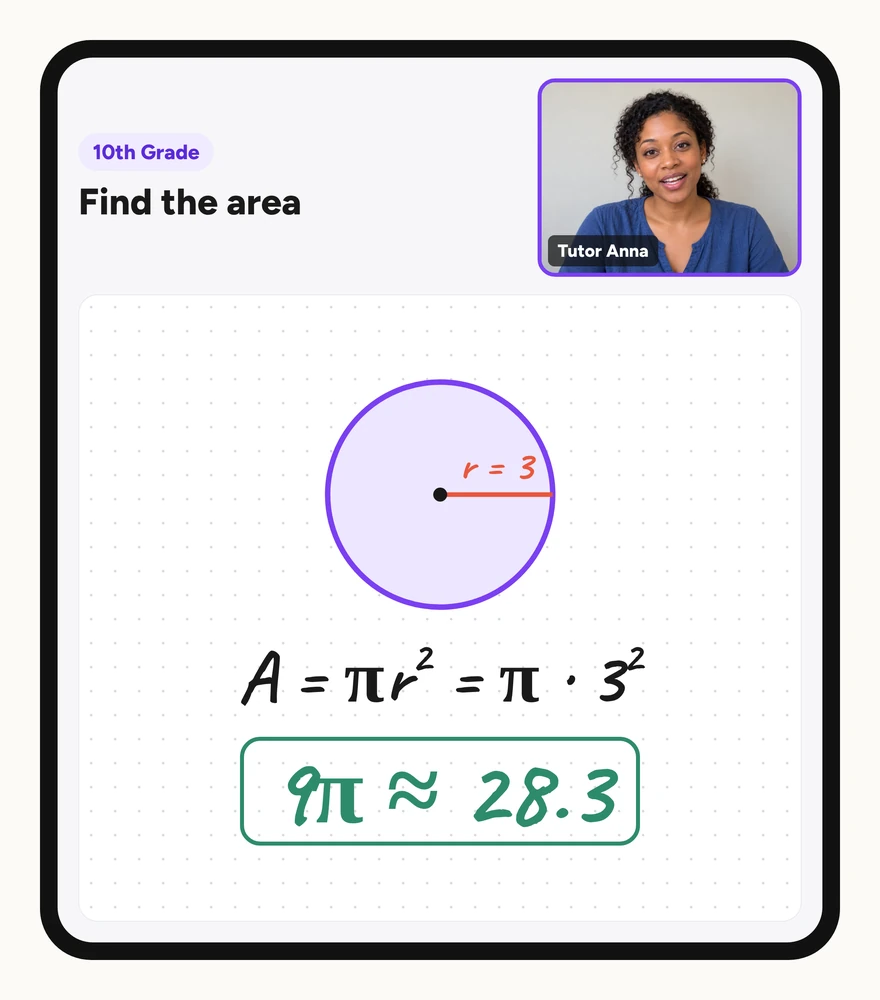
Illustration of an online 10th grade lesson: a tutor on video and a circle with radius 3, finding its area as 9π, about 28.3.

I have seen such a boost in her grades and confidence — Jessica S

Try a class

Top 10th Grade Tutors

5 of 60 tutors shown · 5.0 avg rating from 2,996 reviews

Mrs. Thomas

Certified classroom teacher

Super tutor

5.0

207 ratings

20 years

Experience

3rd - 8th

Available Mon, Tue, Wed, Thu

Can support: ESL, Gifted & talented

I have more than 2 decades of experience in elementary and middle school education. I was a classroom teacher for twenty years. Then, I began working…

All grades

Available Tue, Wed, Thu, Fri

Can support: ESL, Behavioral, Special ed ...

Hi, my name is Ms. O and I am excited to start this learning journey with you! With over 20 years of teaching experience, I’ve had the joy of…

All grades

Available Sun, Mon, Tue, Thu, Fri, Sat

Can support: ADHD, Dyslexia, ESL ...

Hi there! I'm Mr. Elliott (Petrilla)! I'm an educator, performer, and lifelong learner who believes every student deserves to feel confident,…

4th to 6th grade

Available Wed, Thu, Fri

Can support: Gifted & talented

Hi families! My name is Ms. Moore, and I’m a 9th Grade English Language Arts teacher with years of experience supporting students academically and…

1st - 12th

7 days a week

Can support: ESL

I hold a Bachelor of Secondary Education major in General Science and a Master of Arts in Science Education. I have been teaching since 2010, with…

What parents are saying

Paul L is an excellent and very knowledgeable Physics teacher. He was able to help my nephew, who struggled in his physics classes improve h... is grades from the 50s and 60s to the 90s. I would certainly recommend him.

Angela - 10th grade, Physics

Kari has consistently helped our son sustain confidence in math for over two years and his grades reflect this!

Sean - 10th grade, Math

The class with Sun was an optimal experience for my son. Sun was punctual, very professional, engaging and to the point while making hard co... ncepts seem like a piece of cake. Sun started diagnosing and teaching right off the bat with a clear and approachable tone, making learning algebra something to look forward to. We highly recommend Sun as a teacher/tutor for your student.

Loucine - 10th grade, Algebra

Tenth-grade tutoring across Math, Science, Reading, and Writing

Tenth graders may encounter challenges across several subjects: balancing a chemical equation, solving a system of equations, interpreting a literary passage, or organizing evidence in an essay. The difficulty can lie in a prerequisite skill, a new concept, or the transition from following steps to explaining reasoning.

Tutors can start with the student's current work to identify where understanding breaks down. That might mean revisiting how to handle negative coefficients in algebra, clarifying the difference between atomic number and mass number in chemistry, connecting a quote to a written claim, or distinguishing stated details from inferences in reading. Sessions can focus on one subject or connect skills when a task requires both reading and writing.

Sound familiar?

Why families look for tenth-grade support

Steps are memorized but reasoning is unclear

Students may apply a formula or procedure without understanding when it applies or why it works. Tutors can ask students to explain each step, connect an equation to a diagram, or check a solution by substitution to make the reasoning visible.

Skipped steps lead to repeated errors

Jumping to an answer without writing intermediate work can hide sign errors, transcription mistakes, or misapplied rules. Tutors can emphasize writing every step in sequence and checking that each line follows logically from the previous one.

Reading accurately without grasping the meaning

Students may decode a passage or problem statement but struggle to identify the main idea, locate relevant evidence, or distinguish what the text states from what it implies. Tutors can help students reread strategically and explain their reasoning in their own words.

Learning needs that can show up in tenth grade

Algebra: combining like terms with negative coefficients

In an expression such as −3xy − xy, students may forget that xy has an implicit coefficient of 1. The result is −3xy − 1xy, which simplifies to −4xy. Tutors can make the coefficient explicit and review how subtraction affects the sign.

Algebra: transcription errors in multi-step equations

When solving systems of equations, students may omit a variable or copy an equation incorrectly, leading to confusion later. Writing each equation clearly and checking it against the original before proceeding can prevent these errors.

Geometry: misreading graph axes

If axis increments are not one unit, counting grid squares without checking the scale can produce an incorrect slope. For example, moving two grid squares on an axis labeled in increments of 2 represents a change of 4, not 2. Tutors can prompt students to read the axis labels before calculating.

Chemistry: confusing atomic number, mass number, and charge

Atomic number counts protons; mass number is the sum of protons and neutrons; charge reflects the difference between protons and electrons. An element with atomic number 13 and charge +2 has lost two electrons, leaving 11 electrons. Tutors can clarify these definitions with specific examples.

Chemistry: handling non-whole mole ratios in empirical formulas

When mole ratios end in 0.5, students may round instead of multiplying all ratios by 2 to obtain whole-number subscripts. Tutors can explain that subscripts must be whole numbers and demonstrate the multiplication step with a worked example.

Physics: interpreting force versus time graphs

On a force-time graph, horizontal lines indicate balanced forces (zero net force), while sloped lines indicate unbalanced forces and acceleration. Students may confuse these with velocity graphs. Tutors can compare graph types and emphasize reading axis labels and units.

Biology: omitting numerical data in evidence statements

A correct explanation may still lose credit if specific values from a data table are not included. Tutors can remind students to cite numbers alongside reasoning when the question or rubric requires quantitative evidence.

Reading: identifying main idea versus supporting details

Students may select an interesting detail rather than the sentence that captures the passage's overall purpose. Tutors can ask students to explain what the passage is mostly about and check whether their chosen sentence supports that summary.

Writing: including evidence without explanation

A quotation or detail does not automatically show why it supports a claim. Tutors can prompt students to state their point, select relevant evidence, and then explain the connection in their own words rather than simply restating the quote.

Writing: paragraphs drifting from the thesis

Students may introduce ideas that are interesting but do not directly support the main argument. Tutors can help students review each sentence and ask whether it advances the paragraph's purpose or belongs elsewhere.

How tutors make tenth-grade concepts clearer

Write every algebraic step and check the transcription

Tutors can model writing each equation on a new line, copying all terms and signs carefully, and pausing to verify that the new line matches the intended operation. For systems of equations, labeling equations and checking substitutions can prevent confusion. Students can then apply the same habit to their own work.

  1. Write the original equation and check that all terms are copied correctly.
  2. Perform one operation and write the resulting equation on a new line.
  3. Verify that the new equation follows from the previous step.
  4. Continue until the variable is isolated, then check the solution by substitution.

Distinguish definitions in chemistry and use them consistently

Tutors can create a reference table listing atomic number (number of protons), mass number (protons plus neutrons), and charge (protons minus electrons). Students can then apply these definitions to identify elements, calculate neutrons, or determine electron count. Keeping definitions visible reduces reliance on memory alone.

Separate what a text states from what it implies

Tutors can ask students to underline a sentence that directly answers a question, then discuss what can be inferred from that sentence. For example, if a passage describes leaves blowing and a jacket flapping, students can infer wind but should identify the specific details that support that inference. This distinction helps in both reading comprehension and evidence-based writing.

Connecting skills across tenth-grade subjects

Original examples that show how understanding in one area can support work in another.

From a chemistry definition to a calculation

Given an element with atomic number 20 and mass number 40, students can identify 20 protons and calculate 40 − 20 = 20 neutrons. If the element has a +2 charge, it has lost two electrons, leaving 18 electrons. Tutors can ask students to explain each step using the definitions rather than a memorized procedure.

From reading a physics problem to setting up an equation

A problem states that a rocket in deep space shuts off its engine. Students can identify that with no external forces, the rocket continues at constant velocity (Newton's first law). Tutors can ask what the graph of velocity versus time would look like and why, connecting the conceptual understanding to a graphical representation.

Inside a 25-minute session

What a tenth-grade tutoring session can look like

This illustrative lesson focuses on solving a system of equations using substitution, with attention to writing every step and checking the solution. Tutors can choose a different topic in algebra, chemistry, physics, biology, reading, or writing depending on the student's current need.

  1. 0–3 min

    Identify the system and the method

    Write the two equations clearly. Check that all terms and signs are copied correctly from the original problem. Decide to use substitution because one equation is already solved for a variable.

  2. 3–10 min

    Substitute and simplify carefully

    Substitute the expression for one variable into the other equation. Write each step on a new line: distribute, combine like terms, and isolate the variable. Check that no terms are omitted during transcription.

  3. 10–16 min

    Solve for the second variable

    Substitute the found value back into one of the original equations to solve for the other variable. Write the intermediate steps and verify the arithmetic.

  4. 16–22 min

    Check the solution

    Substitute both values into both original equations to confirm they produce true statements. Discuss why this check is important and what it reveals about the solution.

  5. 22–25 min

    Review the process and choose next practice

    Recap the importance of writing every step and checking transcription. Identify whether the student is ready for a similar problem or needs more practice with a specific step, such as distributing or combining like terms.

Example timings only. The subject, problem type, and pace can change based on the student's work and understanding.

Frequently Asked Questions

Browse tutors by subject

Browse tutors by specialty

Terms of servicePrivacy PolicyNotice at Collection

© 2026 ClassDojo. All Rights Reserved.